

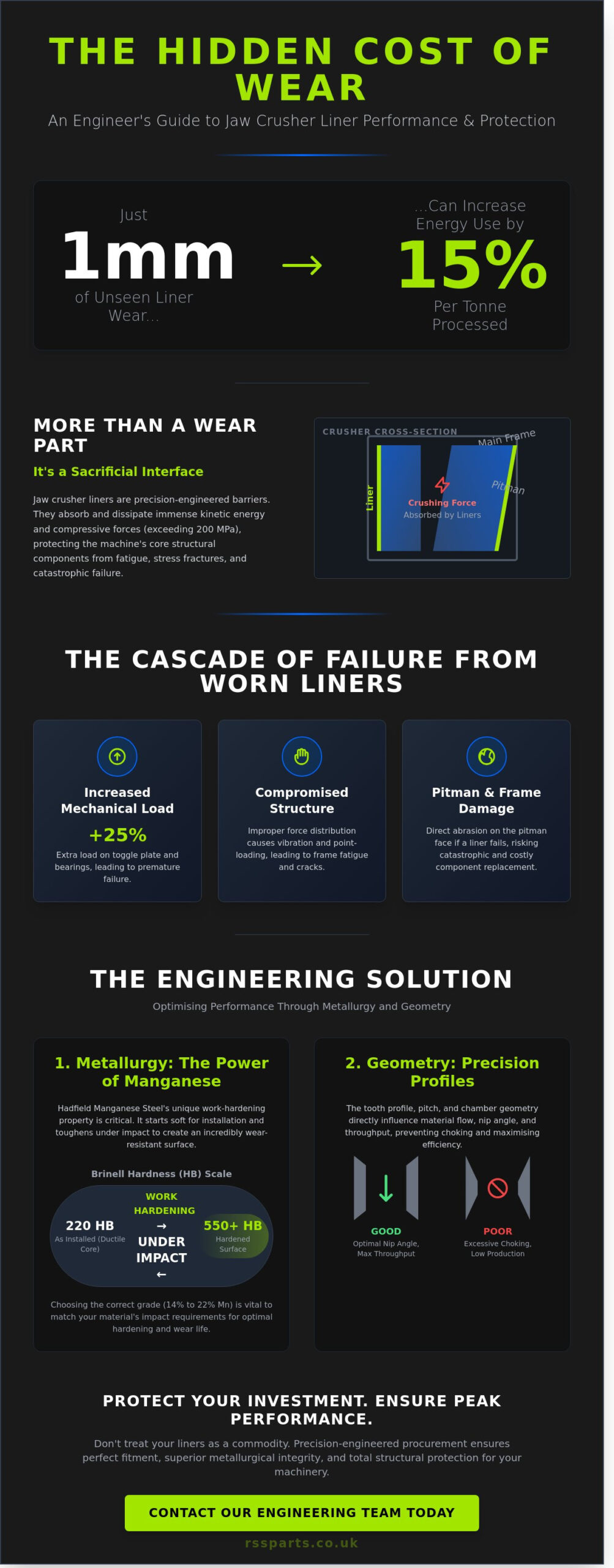
A single millimetre of unintended wear in your jaw crusher liners can increase your energy consumption by up to 15% before you even notice a change in the discharge setting. You’re likely aware that while liners are consumable components, treating them as mere commodities is a costly oversight. Unpredictable failures and excessive recirculating loads don’t just stall your daily production schedule; they compromise the mechanical integrity of your pitman and main frame through improper force distribution. When the fit isn’t precise, the vibration and impact energy transfer directly into the crusher’s core structure, leading to fatigue that no amount of routine maintenance can easily fix.
We’ve engineered this technical guide to help you master the engineering principles behind material selection and profile geometry. By aligning your liner specifications with your specific feed material, you’ll secure consistent product sizing and extend your maintenance intervals significantly. We’ll examine the metallurgical properties of various manganese alloys and the precise tooth profiles required to achieve peak performance and total structural protection for your machinery. This methodical approach ensures your plant operates with the precision and reliability that high-stakes UK quarrying demands.
Key Takeaways
- Understand the engineering role of jaw crusher liners as a sacrificial interface, designed to protect the pitman and main frame while maintaining precise reduction ratios.
- Evaluate the metallurgy of Hadfield manganese steel to select the optimal grade—from 14% to 22%—ensuring work-hardening properties match your material’s impact requirements.
- Analyse how tooth geometry and pitch influence the chamber’s nip angle, allowing you to refine material flow and maximise throughput.
- Learn to diagnose mechanical inefficiencies and feed segregation by accurately interpreting wear patterns on your worn components.
- Recognise why precision-engineered procurement is essential for ensuring fitment and metallurgical integrity that meets or exceeds OEM specifications.
The Engineering Role of Jaw Crusher Liners: Performance and Protection
A high-performance Jaw Crusher operates as a complex mechanical ecosystem where every component must function in perfect synchronicity. At the heart of this system, jaw crusher liners serve as the primary sacrificial interface between the raw feed material and the machine’s structural steel. This isn’t just a wear part; it’s a precision-engineered barrier designed to achieve a specific reduction ratio while shielding the pitman and main frame from the violent forces of primary crushing.
When a liner is poorly specified or fitted with lacklustre precision, the entire mechanical integrity of the crusher is compromised. We view these components through the lens of a Master Technician; every millimetre of fitment matters. A loose liner or an incorrect profile doesn’t just reduce efficiency; it introduces harmonic vibrations and point-loading that can lead to structural failure in the main chassis. Achieving the correct balance between performance and protection requires a deep understanding of how these components interact with the machine’s metallurgy.
Sacrificial Engineering: Why Liners Matter
The physics within a crushing chamber are brutal. Compressive forces often reach levels that would instantly deform standard structural steel, with pressures exceeding 200 MPa in hard rock applications. Liners are engineered to absorb and dissipate this kinetic energy, preventing the propagation of stress fractures through the frame. Without this sacrificial layer, the frame would succumb to metal fatigue within a fraction of its intended service life. The jaw liner is the critical wear component that maintains the crusher’s geometry during operation.
The Cost of Neglect: Beyond the Wear Part
Allowing jaw crusher liners to wear beyond their service limits triggers a cascade of expensive mechanical issues. Industry data from UK aggregates operations indicates that over-wearing liners by as little as 10% past their recommended limit can increase the load on the toggle plate and bearings by up to 25%. This imbalance often leads to premature bearing failure or a snapped toggle plate, resulting in significant unscheduled downtime.
- Catastrophic Pitman Damage: If a liner fails or wears through, the pitman face is exposed to direct abrasion, which can necessitate specialist welding repairs or total component replacement.
- CSS Calibration: The relationship between liner thickness and the closed-side setting (CSS) is absolute; worn liners make it impossible to maintain a consistent product size, forcing the machine to cycle more material to meet production targets.
- Energy Consumption: Inefficient crushing caused by worn profiles can increase energy costs by approximately 15% per tonne of material processed.
Precision fitment is the baseline for operational safety. It ensures that the crushing force is distributed evenly across the machined surfaces of the frame, preserving the longevity of the entire asset and protecting the operator from the risks associated with component failure.
The Metallurgy of Manganese: Optimising Wear Life and Impact Resistance
Manganese steel remains the industry standard for jaw crusher liners due to its unique ability to toughen under stress. Originally developed by Robert Hadfield, this austenitic alloy contains approximately 1.2% Carbon and 12% to 14% Manganese in its base form. At a molecular level, the material is relatively soft upon installation, typically measuring around 200 to 220 Brinell (HB). However, the kinetic energy of the crushing cycle triggers a rapid increase in surface hardness, a process essential for longevity in high-pressure environments.
Understanding Work Hardening
Work hardening occurs when the impact of the feed material causes the crystalline structure of the steel to rearrange. This transformation creates a hard, wear-resistant outer layer while maintaining a ductile core that absorbs shock without fracturing. If the impact force is insufficient, the liner won’t reach its peak hardness of 500 to 600 HB. In low-impact recycling applications, high-manganese liners often perform poorly because the surface remains soft, allowing abrasive fines to scour the metal away prematurely. Accurate Liner Wear Evaluation of Jaw Crushers demonstrates that matching the crushing force to the specific material grade is vital for maintaining geometric integrity. Without sufficient impact, you’re essentially paying for metallurgical properties that your application cannot activate.
Selecting the Grade: 18% vs 22% Manganese
The UK quarrying industry typically relies on 18% Manganese (Mn18) as the primary versatile solution. It offers a superior balance of toughness and wear resistance for materials with a Mohs hardness of 5 to 7. For operators processing extremely hard, abrasive rock like granite or basalt, upgrading to 22% Manganese (Mn22) provides a 15% to 25% increase in service life. This high-grade alloy often includes 2% to 3% Chromium to enhance tensile strength and prevent the liners from “mushrooming” or spreading under extreme pressure. The same metallurgical principles that govern jaw liner selection apply equally to cone crusher liners, where alloy composition must be matched precisely to feed abrasiveness and impact frequency.
- 14% Manganese: Best for soft rock, limestone, and recycled concrete where impact is moderate.
- 18% Manganese: The standard for UK gritstone and secondary crushing stages.
- 22% Manganese: Engineered for high-silica content and primary crushing of igneous rocks.
Consistency in the casting process determines the final performance. Impurities or poor heat treatment can lead to premature cracking, regardless of the manganese percentage. If you’re looking to refine your plant’s efficiency, our team can help you optimise your component selection based on specific geological data. We focus on the precision of the alloy to ensure your jaw crusher liners deliver the lowest cost-per-tonne ratio possible.
Selecting Jaw Profiles: Matching Tooth Geometry to Application
Precision in the selection of jaw crusher liners isn’t just about metallurgical composition; it’s about the mechanical interface between the manganese and the rock. The geometry of the tooth profile dictates the nip angle, which is the angle formed between the fixed and swing jaws. If this angle exceeds 21 degrees for most UK granite or limestone, material will likely slip upwards rather than being crushed. This results in accelerated wear on the upper section of the liners and a sharp drop in hourly tonnage.
Tooth pitch and depth are the primary levers for controlling material flow. A tight pitch increases the surface area in contact with the rock, which is ideal for producing a finer product but can lead to “packing” if the material contains high moisture or clay. Conversely, a wider pitch allows fines to migrate through the chamber faster, reducing the energy wasted on over-crushing material that’s already at the required size. It’s a technical balancing act between fragmentation quality and component longevity.
Standard vs. Super Tooth Profiles
Standard profiles are the baseline for clean rock and non-abrasive applications. They offer a consistent surface area that promotes even wear across the face of the liner. However, they often struggle with slabby material, where flat rocks can pass through the crusher without being properly fractured. This is where the Super Tooth profile excels. With valleys that are often 30% deeper than standard designs, the Super Tooth provides a superior grip on slippery or elongated feed.
- Standard: Best for consistent, cubic feed where wear life is the primary KPI.
- Super Tooth: High peaks penetrate slabby material, ensuring a better reduction ratio.
- Power Consumption: Super Tooth profiles can increase power draw by 10% due to deeper penetration into the rock mass.
Specialised Profiles for Recycling and Aggregates
Quarry profiles are engineered for maximum life in high-abrasion environments like flint or basalt. These designs often feature a heavier tooth structure to withstand the high compressive forces required for primary reduction. In recycling applications, the challenge shifts to managing construction waste. Recycling-specific jaw crusher liners utilise a multi-tooth or “wavy” geometry to handle rebar and mixed debris without clogging the chamber or causing “pancaking” at the discharge point.
The “belly” wear pattern is a common failure point where the centre of the liner wears faster than the ends. Curved profiles mitigate this by altering the crushing stroke’s effectiveness in the lower zone. By incorporating a radius into the liner face, the discharge area opens more efficiently. This design can improve throughput by up to 15% in high-moisture conditions, as it prevents the “pancake” effect where fines compress into a solid mass that chokes the crusher. It’s a simple geometric solution to a complex mechanical bottleneck.
Wear Pattern Analysis and Maintenance Engineering
Analysing a worn liner provides critical data on the mechanical health of your crushing circuit. Much like reviewing telemetry after a high-performance track session, visual inspection reveals exactly how the geometry of the chamber interacts with the feed material. If you ignore these signs, you risk premature component failure and unnecessary downtime.
Diagnosing Wear Patterns
Uneven wear is often the result of poor feed distribution or segregation within the hopper. When larger rocks migrate to one side, the eccentric shaft undergoes uneven loading, which creates heat and accelerates fatigue. You can identify specific issues by looking at the profile of the wear:
- Cupping: This hollowed-out appearance suggests the material is too soft for the liner grade or that the stroke is too short, causing localised abrasion.
- Bowing: A convex wear pattern often indicates that the material is exceptionally hard, putting excessive pressure on the centre of the jaw.
- Bottom-Heavy Wear: This typically signals that the Closed Side Setting (CSS) is too tight or that “packing” is occurring because fines aren’t being cleared efficiently.
Consistent wear across the entire face of the liner indicates an optimised feed and stroke calibration. These diagnostic principles extend beyond the primary jaw stage; understanding how to interpret wear patterns on cone crusher liners in your secondary circuit is equally critical for protecting downstream equipment and maintaining product gradation.
Maximising Lifespan through Rotation
Effective maintenance engineering requires a proactive approach to liner rotation. You shouldn’t wait until the liner is paper-thin at the base to take action. Industry best practice follows the 50% wear rule; you should flip your jaw crusher liners when the lower third reaches half its original thickness. This strategy ensures the crushing zone remains efficient and prevents the material from “bellying” out the liner.
The flipping process must be executed with precision. After removing the wedge bolts and clearing debris, the liner is inverted so the less-worn top section becomes the new crushing face. This simple mechanical adjustment can extend the service life of the component by as much as 40%. During installation, the use of high-compression epoxy backing compounds is non-negotiable. These compounds provide a uniform support structure, damping vibrations and preventing the liner from shifting under the immense loads of the crushing cycle. A secure fitment prevents the micro-movements that lead to backing material failure and subsequent frame damage.
Establishing a rigorous inspection programme is the only way to safeguard your investment. Monthly ultrasonic thickness testing allows you to predict replacement dates with 95% accuracy, ensuring you never run to failure. If you need to refine your maintenance schedule or upgrade your hardware, consult our engineering team for bespoke technical support.
Precision Procurement: Why Engineering Expertise Matters in Liner Selection
Procuring wear components shouldn’t be a simple transactional process. It’s a critical engineering decision that dictates the operational efficiency of your entire primary crushing circuit. RSS Parts functions as a technical partner rather than a traditional vendor. We focus on the metallurgical integrity and geometric precision of every component we supply. Selecting the correct jaw crusher liners requires a deep understanding of compressive strength, moisture content, and the abrasive index of your specific feed material.
Our national UK stockholding strategy is designed to eliminate the 15% to 20% production losses often associated with extended lead times. We maintain a comprehensive inventory of high-grade manganese castings, ensuring that critical plant remains operational. Every liner we supply meets or exceeds OEM specifications for fitment and alloy composition. This precision ensures that the transfer of energy from the pitman to the rock is maximised, reducing unnecessary stress on the eccentric shaft and bearings. If you’re considering expanding your fleet, understanding the mechanical condition of any crusher for sale is as critical as specifying the correct liner profile from day one.
The RSS Parts Advantage
Our “Master Technician” approach to quality control ensures that every casting undergoes rigorous dimensional checks before dispatch. We support a vast range of major brands, including Sandvik, Metso, Terex, McCloskey, and Powerscreen. We don’t just provide a part number; our team assists in profile selection based on your site-specific data. Whether your application requires a Standard, Super Tooth, or Multi-tooth profile, we calibrate our recommendations to your desired product gradation and throughput targets. This level of technical consultation helps operators avoid common pitfalls like premature “peening” or localized wear patterns that reduce the effective life of the manganese.
A Holistic Approach to Wear
Optimising the primary jaw is the first step in a wider crusher wear parts maintenance strategy. If the jaw crusher produces an inconsistent or oversized discharge, it places an immediate metallurgical burden on downstream equipment. This often leads to accelerated wear in impactor blow bars
Maximising Operational Throughput via Engineering Precision
Achieving the lowest cost-per-tonne in modern quarrying requires a methodical approach that prioritises both metallurgy and tooth geometry. You’ve seen how matching specific profiles to feed sizes reduces slabing by up to 15 per cent, while high-grade manganese alloys leverage work-hardening to extend service intervals in abrasive conditions. High-performance jaw crusher liners aren’t merely sacrificial wear parts; they’re the primary interface between your machinery and your revenue. When you align material hardness with impact frequency, you protect the crusher’s frame from the catastrophic stress of premature wear-through.
RSS Parts maintains an extensive specialist UK stockholding to facilitate immediate national dispatch, often reaching your site within 24 hours to eliminate costly downtime. Our technical support team consists of engineers who’ve spent decades in the quarrying and recycling sectors, ensuring you receive advice grounded in real-world application. We supply premium manganese alloys specifically engineered for maximum work-hardening, delivering the essential balance of performance and protection your plant demands. It’s about more than just a fit; it’s about refining every stage of the crushing cycle.
Optimise your crushing performance with RSS Parts’ specialised jaw liners today. Precision engineering ensures your plant stays productive and your operational overheads remain firmly under control.
Frequently Asked Questions
How often should I rotate my jaw crusher liners?
You should rotate your liners when wear reaches 50% of the tooth height at the lower section of the jaw. This typically occurs after processing 15,000 to 25,000 tonnes of abrasive material like granite. Rotating the fixed and swing liners ensures even wear distribution across the manganese surface. It prevents the “cupping” effect that reduces crushing efficiency by 15% and extends total service life by approximately 20%.
What is the difference between 18% and 22% manganese for jaw liners?
The primary difference lies in the work-hardening rate and initial hardness levels required for specific geological conditions. 18% manganese is the industry standard for medium-hard rock applications. 22% manganese is engineered for extremely abrasive materials with silica content exceeding 70%. While 18% manganese provides a reliable balance of toughness, 22% manganese offers 15% higher durability in high-impact environments where the material needs to harden quickly under stress.
Can a different tooth profile really improve my crusher’s throughput?
Selecting the correct tooth profile can increase throughput by 10% to 15% depending on your specific feed material. A “Super Tooth” profile is designed for better grip and improved slab reduction compared to a standard corrugated profile. This geometry optimises the nip angle and prevents material slipping during the compression cycle. Using the right jaw crusher liners ensures the crushing force is applied effectively, reducing energy consumption by up to 5% per tonne.
What are the signs that my jaw liners need immediate replacement?
Replace liners when they reach a thickness of 20mm at the thinnest point or when the tooth profile is 80% worn. If you notice a 20% drop in hourly production or a visible change in the discharge product shape, the liners are likely spent. Cracks exceeding 50mm in length or loose components indicate imminent failure. Failing to replace them risks damaging the expensive jaw stock or the main frame of the machine.
Is it necessary to use backing material when installing new liners?
Using backing material is essential for 95% of fixed jaw installations to prevent localised stress points and frame erosion. A high-strength epoxy or zinc-based compound fills the 2mm gaps between the liner and the crusher frame. This creates a uniform contact surface that absorbs 100% of the crushing impact. It prevents the liners from shifting during operation, which can lead to premature cracking or bolt failure under heavy loads.
How does the feed material size affect the wear life of my liners?
Feed material exceeding 80% of the maximum intake opening increases wear rates by approximately 25%. Oversized rocks cause “boiling” in the crushing chamber, where material bounces rather than being gripped effectively. This creates concentrated wear at the top of the jaw crusher liners. Maintaining a consistent feed size between 60% and 80% of the gape ensures the crushing work is distributed across the entire surface area of the manganese.
Why is my jaw crusher producing more fines than usual?
An increase in fines typically indicates that the jaw liners are worn flat, leading to more grinding and less crushing. When the tooth profile wears below 30% of its original height, the rock is crushed through attrition rather than fracture. This inefficient process increases the percentage of sub-5mm fines by up to 12%. Checking the Closed Side Setting daily ensures the geometry remains within the calibrated 40mm to 100mm range for your application.
Can I use the same liners for both quarrying and concrete recycling?
You can use the same liners, but a dedicated recycling profile typically improves performance by 20% when processing demolition waste. Recycling applications often involve rebar, which requires a liner with higher impact resistance to prevent shattering. Standard quarry liners might suffer from “peening” or rapid blunting when hitting steel reinforcement. For mixed-use operations, an 18% manganese liner with a heavy-duty tooth profile provides the most versatile mechanical solution for varied feed stocks.
about
avada factory
Sempery ultricies nibh at dolor cras urna eleifend nec. Atiam efficitur tempor.


