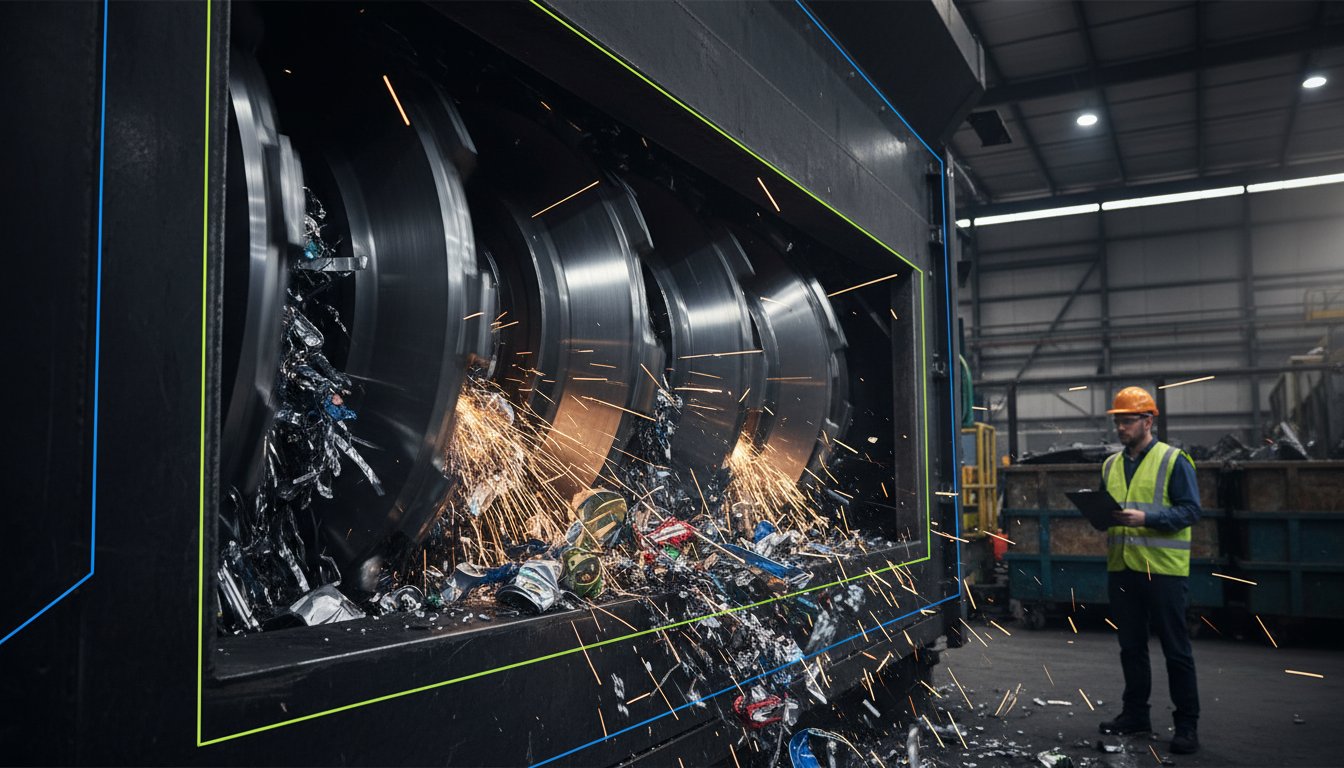
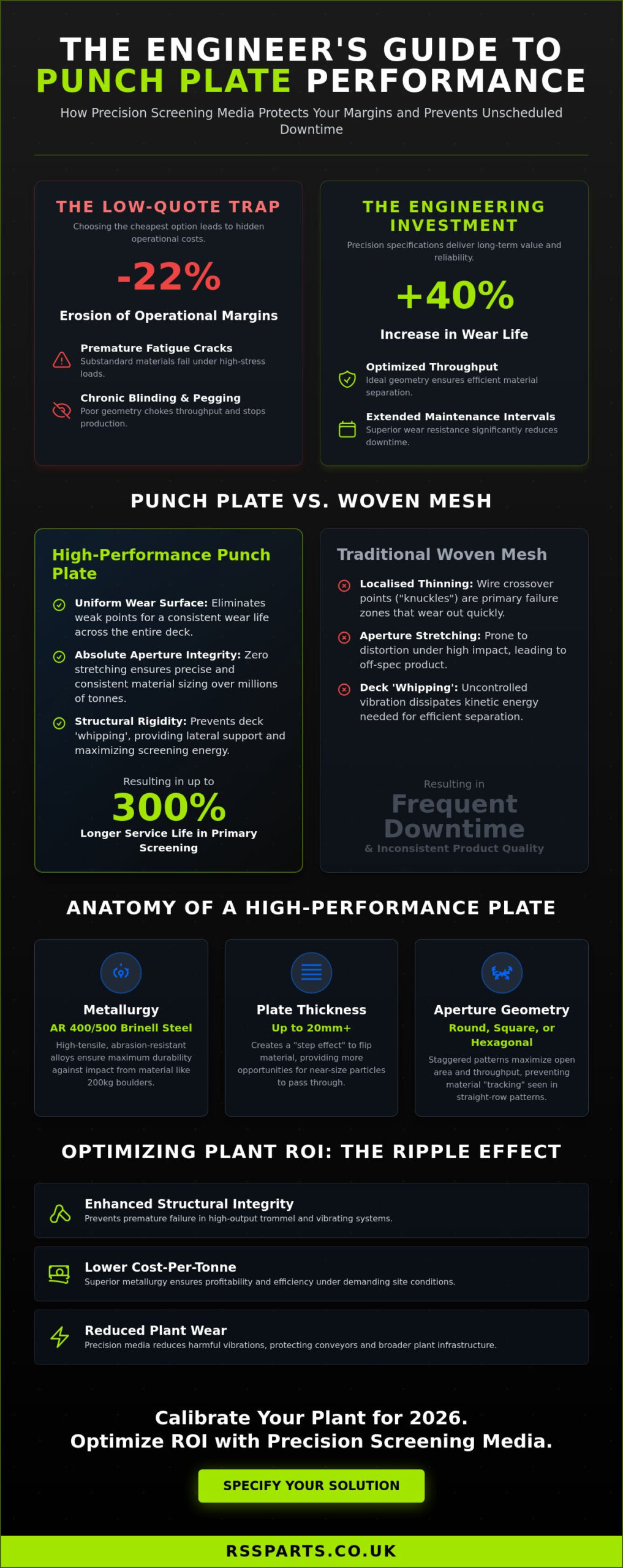
Selecting an industrial screening surface based on the lowest initial quote is the most reliable way to erode your operational margins by 22% through unscheduled downtime. In high-volume UK aggregate and recycling sectors, the hidden cost of a substandard punch plate often manifests in premature fatigue cracks or chronic blinding that chokes your throughput. You already know that every hour your plant sits idle for a screen change is an hour of lost revenue that you simply cannot recover.
This guide provides the engineering framework to master technical specifications and metallurgical requirements, ensuring you optimize screening efficiency while reducing operational downtime. We’ll examine how specific tensile strengths and hole geometries can deliver up to 40% more wear life in abrasive environments. By applying these precision standards, you’ll be able to calibrate your plant for precise material sizing and significantly extended maintenance intervals throughout 2026.
Key Takeaways
- Understand how precision-engineered structural integrity in screening media prevents premature failure in high-output trommel and vibrating systems.
- Learn to evaluate metallurgy against the ‘cost-per-tonne’ metric to ensure material processing remains profitable and efficient under demanding UK site conditions.
- Discover how to optimize throughput and minimize blinding by selecting the ideal punch plate geometry and hole configuration for your specific application.
- Identify the critical procurement criteria for specifying variable plate thickness in high-impact zones to significantly extend the service life of your screen deck.
- Gain technical insights into how precision-engineered media reduces vibration-related wear on conveyor components, protecting your broader plant infrastructure.
The Fundamentals of High-Performance Punch Plate in Screening Operations
High-performance punch plate represents the pinnacle of material separation technology for the 2026 industrial landscape. It’s a precision-engineered screening medium designed to withstand the brutal mechanical stresses of primary scalping and heavy-duty recycling. While many operators view screen media as a consumable, the master technician understands that a punch plate is a structural component that dictates the efficiency of the entire plant. In the UK aggregate sector, where processing plants often handle loads exceeding 450 tonnes per hour, the choice of plate geometry directly impacts both uptime and product purity.
Industrial-grade screening plates differ significantly from standard Perforated metal used in architectural or light-duty applications. These plates are typically manufactured from high-tensile, abrasion-resistant (AR) steel alloys, such as 400 or 500 Brinell grades, to ensure they don’t deform under the impact of 200kg boulders. This structural rigidity is vital for maintaining the balance of vibrating screens and the concentricity of trommel systems.
Material Processing Efficiency and Flow Geometry
Plate thickness is a critical variable that dictates the trajectory of material across the screen deck. A 20mm plate doesn’t just provide wear life; it creates a specific “step” effect that helps flip and turn material, ensuring that smaller fractions have multiple opportunities to find an aperture. Near-size particles are those with dimensions within 10% of the aperture size, often leading to blinding or pegging if the screen deck lacks sufficient kinetic energy or precise hole geometry.
The inherent rigidity of a punch plate prevents the phenomenon known as deck “whipping.” This uncontrolled harmonic vibration, common in thinner or poorly supported media, dissipates energy that should be used for material stratification. By maintaining a flat, stable surface, the plate ensures that every kilowatt of energy from the drive motor is translated into efficient separation.
Structural Advantages Over Traditional Woven Mesh
Woven wire media frequently suffers from localized thinning at wire crossover points, which are the primary failure zones in high-impact environments. Punch plate eliminates these knuckles entirely, providing a smooth, uniform surface that distributes wear across a larger surface area. This design characteristic extends the service life of the deck by up to 300% in primary screening applications compared to standard mesh.
In trommel systems, the plate serves a dual purpose by providing essential lateral support to the drum frame. Because the plate is a solid, monolithic sheet, it resists the torsional twisting forces generated during the rotation of a 10-tonne load. This structural contribution maintains aperture consistency, ensuring that the final product meets strict 2026 UK quality standards without the risk of oversized material “leaking” through stretched or distorted openings.
- Impact Resistance: Optimized for primary zones where feed size exceeds 300mm.
- Aperture Integrity: Zero stretching ensures consistent sizing over the life of the plate.
- Customisation: Available in round, square, or hexagonal patterns to suit specific moisture levels.
Engineering Specifications: Metallurgy and Aperture Geometry
Precision engineering in industrial screening starts with the metallurgical profile of the substrate. Selecting a high-tensile steel grade isn’t just about durability; it’s a strategic move to lower the cost-per-tonne metric. For instance, moving from standard S235 mild steel to a quenched and tempered alloy can reduce maintenance intervals by 40% in high-abrasion environments. This longevity ensures that the punch plate maintains its dimensional accuracy over millions of cycles, preventing the gradual “rounding” of aperture edges that leads to off-spec product.
Hole patterns dictate the flow dynamics across the deck. Staggered configurations, typically set at 60-degree angles, maximize throughput by ensuring material hits an aperture rather than a bridge. Straight-row patterns, while providing higher structural stiffness for heavy impact, often lead to material “tracking” where particles slide between hole rows without being screened. When comparing these configurations, engineers often reference the 5 Types of Screen Media to determine if a perforated solution outperforms woven wire in specific impact zones. The geometry of the hole itself—whether round, square, or slotted—defines the final product quality. Round holes provide the most accurate sizing for aggregate, while slotted apertures are essential for preventing elongated, “flaky” material from passing through the circuit.
Material Selection: Beyond Mild Steel
High-impact recycling requires more than basic carbon steel. AR400 and AR500 abrasion-resistant steels offer Brinell hardness levels that resist the gouging and scraping common in construction waste. For corrosive environments, such as glass recycling or wet organic waste, 304 or 316-grade stainless steel is the professional standard. Specialized heat treatment and surface hardening processes are essential for trommel plates, as they ensure the leading edges of the apertures maintain their profile under heavy rotational loads.
Understanding Open Area Ratios
Balancing the open area against structural rigidity is a core engineering challenge. A 40% open area might provide excellent throughput, but if the bridge width—the metal between the holes—is too narrow, the plate will fatigue and crack under load. Tapered apertures, or relief angles, are critical for preventing “pegging” where material gets wedged. Usually, a 3 to 5-degree taper on the underside allows near-size particles to clear the punch plate easily. For heavy-duty screening, the plate thickness shouldn’t exceed the hole diameter to maintain a clean shear during the manufacturing process. If you’re refining your plant’s efficiency, you can consult with our technical team for a full geometric analysis of your current screening setup.
Comparative Analysis: Punch Plate vs. Alternative Screening Media
Selecting the correct screening media requires a precise calibration of material hardness against operational throughput. While woven wire mesh offers superior open area, it lacks the structural rigidity needed for high-impact primary scalping. A 20mm thick punch plate manufactured from high-tensile steel provides the impact resistance necessary for handling feed sizes exceeding 500mm. This mechanical durability ensures the screen maintains its aperture geometry under the most demanding conditions. Understanding how your screening machine interacts with different media types is essential for making the right selection for your specific application.
For wet processing, polyurethane screening mats offer a technical advantage in terms of corrosion resistance and noise dampening. Standard steel plates generate noise levels often exceeding 100dB(A) during dry aggregate processing. Integrating rubber-coated plates or modular polyurethane sections can reduce these levels by 6dB to 10dB. This reduction is critical for sites operating under strict UK environmental noise regulations near residential areas.
When to Prioritize Durability Over Maximum Open Area
High-velocity impact from heavy aggregate quickly deforms wire mesh, leading to premature fatigue and aperture distortion. In high-tonnage UK primary screening plants, switching to steel plates can extend the service life of a scalping deck by 300% compared to standard wire. Punch plate functions as a self-supporting structural component that bolts directly to the screen frame, whereas woven mesh requires precise tensioning to avoid catastrophic fatigue failure. This design simplifies maintenance and reduces the frequency of deck inspections.
The Efficiency vs. Longevity Trade-off
The primary challenge with heavy-duty plates is the reduced open area relative to wire mesh. To mitigate this, engineers optimize the aperture layout using staggered patterns to maximize the passing probability of the material. Blinding and pegging often increase operational costs through lost production time and manual cleaning requirements. Hybrid decks offer a sophisticated solution for balanced performance. These systems utilize the impact resistance of heavy steel at the feed end while integrating woven wire mesh on the discharge end to improve final sizing accuracy.
- Maintenance: Modular punch plate sections allow for targeted replacement of high-wear zones without discarding the entire deck.
- Cost-Benefit: While the initial investment in steel plate is higher than mesh, the reduction in downtime often yields a lower cost-per-tonne over a 12-month cycle.
- Precision: Laser-cut apertures provide tighter tolerances for specific aggregate specifications required by UK building standards.
Procurement Criteria: A Buyer’s Framework for Industrial Screens
Procuring a high-performance punch plate is less about ordering a commodity and more about calibrating a precision component for a specific mechanical ecosystem. Accuracy begins with the physical dimensions. Beyond the standard length and width, you must specify the exact bolt-hole pitch and diameter to ensure the plate seats perfectly against the sub-frame. Misalignment by as little as 3mm leads to vibration-induced fatigue, which can cause premature cracking around the fixing points.
Identifying the ‘Impact Zone’ is a critical step for 2026 operational efficiency. In most screening applications, the first 1.2 metres of the deck endure 70% of the material’s kinetic energy. Specifying a variable thickness, such as 15mm at the feed end tapering to 10mm for the remainder of the deck, can increase service life by 35% without adding unnecessary weight to the vibratory motor’s load.
Fixing methods must be robust enough to withstand high G-force environments. You’ll need to define edge margins, typically 50mm to 75mm, to allow clamping bars to secure the plate without obstructing the apertures. For critical wear parts, UK-based supply chain reliability is paramount. Relying on international shipping can lead to 12-week lead times, whereas domestic fabrication often delivers bespoke plates in 10 to 14 days, keeping your downtime to a minimum.
Specifying for Abrasive Aggregates
Material chemistry dictates the metallurgy of your screen. Processing abrasive granite requires high-tensile steels like Hardox 500, while limestone allows for more cost-effective mild steel variants. To protect the punch plate surface, we recommend integrating skid bars or lifters. These sacrificial components are welded between aperture rows to lift oversized rocks, allowing fines to pass through while the heavy material slides across the bars rather than the plate itself. For plates exceeding 20mm in thickness, precision-drilled holes are superior to traditional punching as they eliminate the micro-fractures that occur during the heavy-duty stamping process.
Customization for Recycling and Waste Management
Recycling facilities face unique challenges with Material Recovery Facility (MRF) trommels, particularly regarding glass and municipal solid waste (MSW). Glass is exceptionally abrasive and requires hardened surfaces to maintain aperture geometry. When dealing with MSW, the primary risk is wrapping and tangling. Utilizing staggered hole patterns or tapered apertures helps prevent plastic film from snagging. It’s also vital to ensure your screen specifications align with your upstream shredder parts to maintain a consistent flow rate throughout the plant. This holistic approach prevents bottlenecks and ensures the entire processing line operates at peak capacity.
Optimise your plant’s throughput by consulting with our engineering team at RSS Parts today.
Optimising Plant ROI with RSS Parts Precision Screening Media
Maximising return on investment in the UK’s quarrying and recycling sectors requires more than just off-the-shelf components. It demands an engineering-led strategy that views the screening deck as a critical node in a wider mechanical ecosystem. At RSS Parts, we apply the same rigorous standards to industrial screening that we bring to high-performance automotive engineering. Our approach focuses on technical calibration to ensure that every punch plate we supply enhances the efficiency of the entire processing line.
Precision-engineered plates do more than just grade material. They play a vital role in protecting your infrastructure. When plates are manufactured with exact flatness and thickness, they eliminate the harmonic imbalances that lead to excessive vibration. This stability directly reduces the fatigue load on conveyor system components, extending the service life of bearings, rollers, and drive motors. By choosing a UK-based partner, you gain access to rapid technical fitment advice that keeps your plant operational during critical production windows.
Consolidating your supply chain also yields significant operational advantages. By sourcing everything from crusher wear parts to specialized screening media from a single expert source, you simplify your inventory management. This holistic view of wear protection ensures that every component is matched for material hardness and throughput requirements, preventing the bottlenecks that occur when mismatched parts are forced to work in tandem.
The Master Technician Standard
Our quality control protocols are designed for operators who cannot afford unplanned downtime. We treat aperture precision as a non-negotiable metric. Every punch plate undergoes rigorous inspection to ensure it meets the specific machinery geometry of your plant. This isn’t just about fitment; it’s about calibrating the plate to the specific stroke and frequency of your vibratory screen. This commitment to ‘Performance and Protection’ ensures that your media doesn’t just survive the shift but actively protects the structural integrity of the machine frame.
- Rigorous flatness testing to prevent material bypass and pegging.
- Bespoke metallurgical selection based on 2026 industry benchmarks for abrasive resistance.
- Technical consultation to align plate specifications with existing dampening systems.
Seamless Integration and Technical Support
Identifying and solving screening bottlenecks requires a level of expertise that goes beyond a standard parts catalogue. Our nationwide technical support team assists in the procurement process for complex, multi-deck plants, ensuring that each layer of the screening process is optimised for the specific tensile strength of the material being processed. We don’t just ship parts; we provide the engineering wisdom needed to refine your output and lower your cost-per-tonne.
Optimize your screening plant with precision-engineered punch plate from RSS Parts.
Optimising Screening Efficiency for 2026 and Beyond
Achieving peak throughput in quarrying and recycling operations requires moving beyond generic components toward high-grade engineering solutions. Selecting the correct aperture geometry and metallurgical grade is the most effective way to calibrate your plant for maximum ROI. Data from 2025 industry benchmarks indicates that transitioning from standard wire mesh to precision-engineered screening media can extend wear life by 40% in high-impact applications. This shift reduces unscheduled downtime and ensures consistent material sizing even under extreme load conditions.
As a specialist UK supplier, RSS Parts brings a motorsport-inspired precision to the industrial sector. Our engineering-led approach focuses on wear part optimisation, drawing from an extensive inventory of high-grade materials like Hardox 450. We don’t just supply parts; we refine your entire screening ecosystem to ensure performance and protection are never compromised. By integrating specific aperture designs tailored to your feed material, you’ll secure a significant competitive advantage in the 2026 market.
Take the first step toward superior plant reliability. Request a Technical Quote for Precision Punch Plate from our expert team today. We’re ready to help you engineer a more resilient and profitable operation.
Frequently Asked Questions
What is the primary advantage of punch plate over woven wire mesh?
Superior structural rigidity is the primary advantage of punch plate over woven wire mesh. While mesh tends to stretch or fray under heavy impact, a precision-engineered punch plate maintains its aperture geometry throughout its entire service life. This durability reduces maintenance intervals by approximately 40% in high-impact environments like primary aggregate scalping. It’s a more stable solution for heavy-duty sorting.
Can punch plate be manufactured from abrasion-resistant (AR) steel?
We frequently manufacture punch plate from high-grade abrasion-resistant steel, including Hardox 400 and 500 series. These materials provide a Brinell hardness rating between 360 and 540 HBW. Utilizing AR steel increases the wear life of the screen by 3 to 5 times compared to standard mild steel options. It’s the technical choice for processing high-silica granite or recycled concrete.
How do I calculate the open area of a punch plate screen?
You calculate the open area by dividing the total hole area by the total plate area. For a standard 60-degree staggered round hole pattern, the technical formula is (hole diameter squared x 90.69) divided by the pitch squared. Maintaining an open area of at least 45% is vital to ensure optimal throughput in high-volume UK processing plants. Accuracy here prevents material bottlenecks.
Is punch plate suitable for wet screening applications?
Punch plate is highly effective for wet screening, especially when you’re processing abrasive slurries. The smooth surface of the plate allows water and fines to pass through more efficiently than textured woven alternatives. In many UK quarrying operations, specifying stainless steel 304 or 316 grades prevents corrosion. This ensures the screening surface remains clear for consistent drainage during heavy rainfall.
What are the most common hole patterns for industrial screening?
Round, square, and hexagonal patterns are the three most prevalent configurations used in modern industrial screening. Round holes provide the most accurate sizing for spherical materials. Hexagonal patterns offer up to 10% more open area than round holes of the same diameter. Slotted patterns are usually reserved for elongated materials to prevent them from passing through the deck incorrectly.
How do I prevent blinding and pegging on my punch plate screens?
You prevent blinding and pegging by specifying tapered holes that widen toward the discharge side of the plate. This geometry ensures that any particle entering the aperture passes through the plate completely. Implementing a staggered pattern with a minimum 3mm bridge width also reduces material build-up. These engineering refinements keep your production line running without frequent manual cleaning.
Does RSS Parts supply custom-sized punch plates for specific trommel models?
RSS Parts engineers custom-sized punch plates for all major trommel brands, including McCloskey, Powerscreen, and Terex models. Our technical team utilizes precise CAD drawings to ensure exact fitment, mirroring the tight tolerances required in high-performance engineering. This bespoke approach eliminates the need for on-site modifications. It typically reduces your installation time by 2 to 3 hours per screen change.
What is the typical lead time for replacement screening plates in the UK?
Standard replacement screening plates usually carry a lead time of 7 to 10 working days for delivery within the UK. For complex, custom-engineered orders involving AR450 steel or specialized hole geometries, the lead time typically extends to 14 or 21 days. We use specialized freight partners to ensure these heavy components arrive at your site safely. Planning your maintenance schedule around these windows ensures maximum uptime.
about
avada factory
Sempery ultricies nibh at dolor cras urna eleifend nec. Atiam efficitur tempor.