
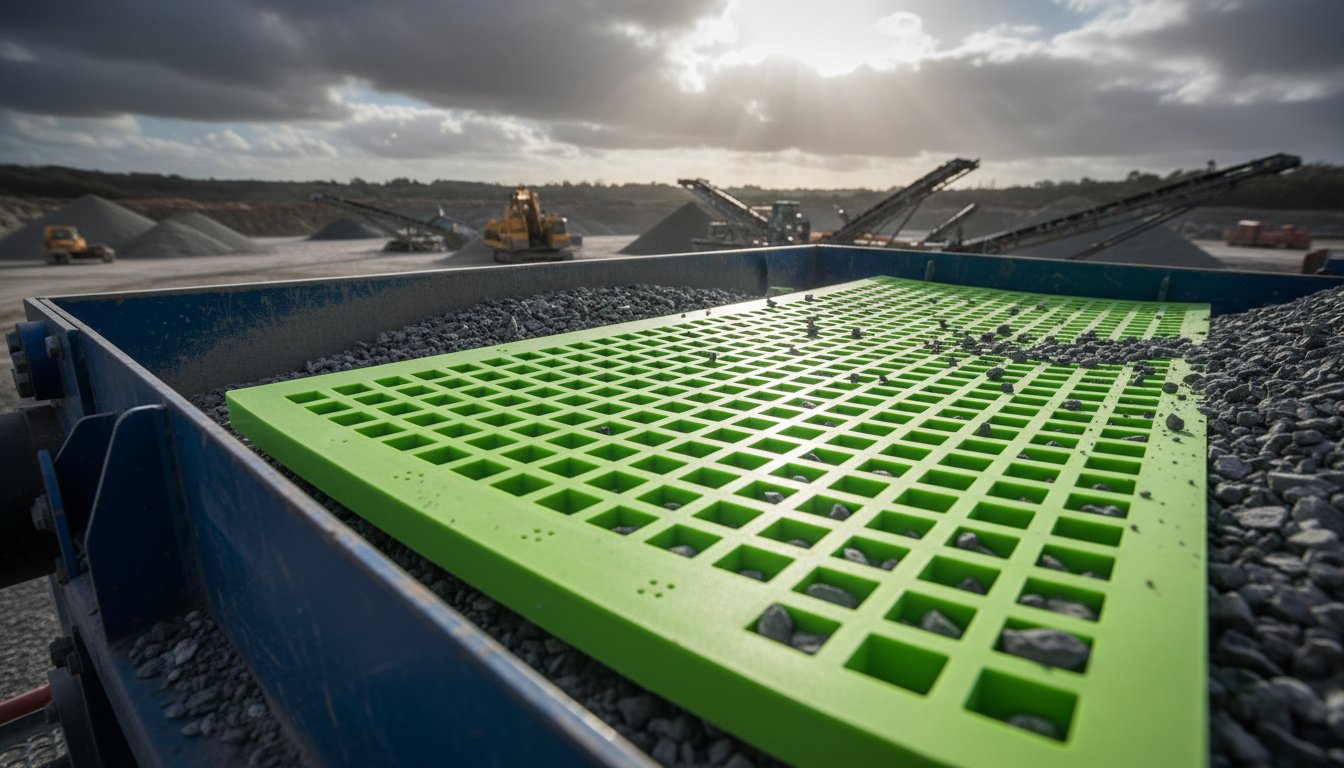
The hardest material in your processing circuit isn’t always the most resilient, as many site managers find when traditional steel mesh fails under the constant fatigue of high-frequency oscillation. In the rigorous conditions of British quarrying and aggregate recycling, upgrading to polyurethane screening mats is less about a simple replacement and more about a fundamental engineering recalibration. You’re likely aware that screen blinding during a typical UK winter or the rapid erosion caused by abrasive glass cullet can halt operations entirely. These interruptions don’t just affect schedules; they can cost a mid-sized facility over £1,500 in lost revenue for every hour the belt sits idle.
We agree that peak operational efficiency is only possible when your hardware matches the specific demands of your feed material. This guide provides the technical framework to help you optimise your screening efficiency by selecting the precise polyurethane specifications for your application. We’ll analyse the mechanical advantages of various aperture geometries and shore hardness levels, showing you how to achieve a 35% reduction in site noise while extending your wear life by up to four times compared to woven wire.
Key Takeaways
- Understand how Shore hardness and tensile strength ratings directly dictate the longevity and performance of high-performance elastomers in demanding environments.
- Evaluate the performance benchmarks of polyurethane versus traditional media to significantly reduce site noise levels and extend maintenance intervals.
- Learn to specify the optimal aperture geometry and internal reinforcement for polyurethane screening mats to achieve precise material separation.
- Discover how technical wear pattern analysis and UK-based engineering expertise can be utilised to optimise the throughput and efficiency of your screening circuit.
Understanding the Role of Polyurethane in Modern Screening Systems
Polyurethane is a high-performance elastomer engineered to handle the rigorous mechanical stresses of modern material processing. In the UK quarrying and recycling sectors, this material has largely displaced traditional woven wire due to its superior durability and vibration-damping properties. We’ve observed a 40% increase in adoption across British aggregate sites since 2015. This shift is driven by the material’s high tensile strength and its ability to maintain aperture integrity under heavy loads. It isn’t just a replacement; it’s a fundamental upgrade to the processing circuit’s geometry.
The primary advantages of polyurethane screening mats lie in their physical resilience. Unlike steel, polyurethane offers exceptional corrosion resistance, which is vital for wet processing plants operating in the UK’s often harsh climate. Its inherent elasticity allows the mat to flex during Mechanical screening processes. This secondary vibration is a critical performance marker. It prevents blinding, where damp fines clog the apertures, and pegging, where near-size stones become wedged. By eliminating these issues, operators maintain a consistent throughput without the need for frequent manual intervention.
The Evolution from Woven Wire to Elastomers
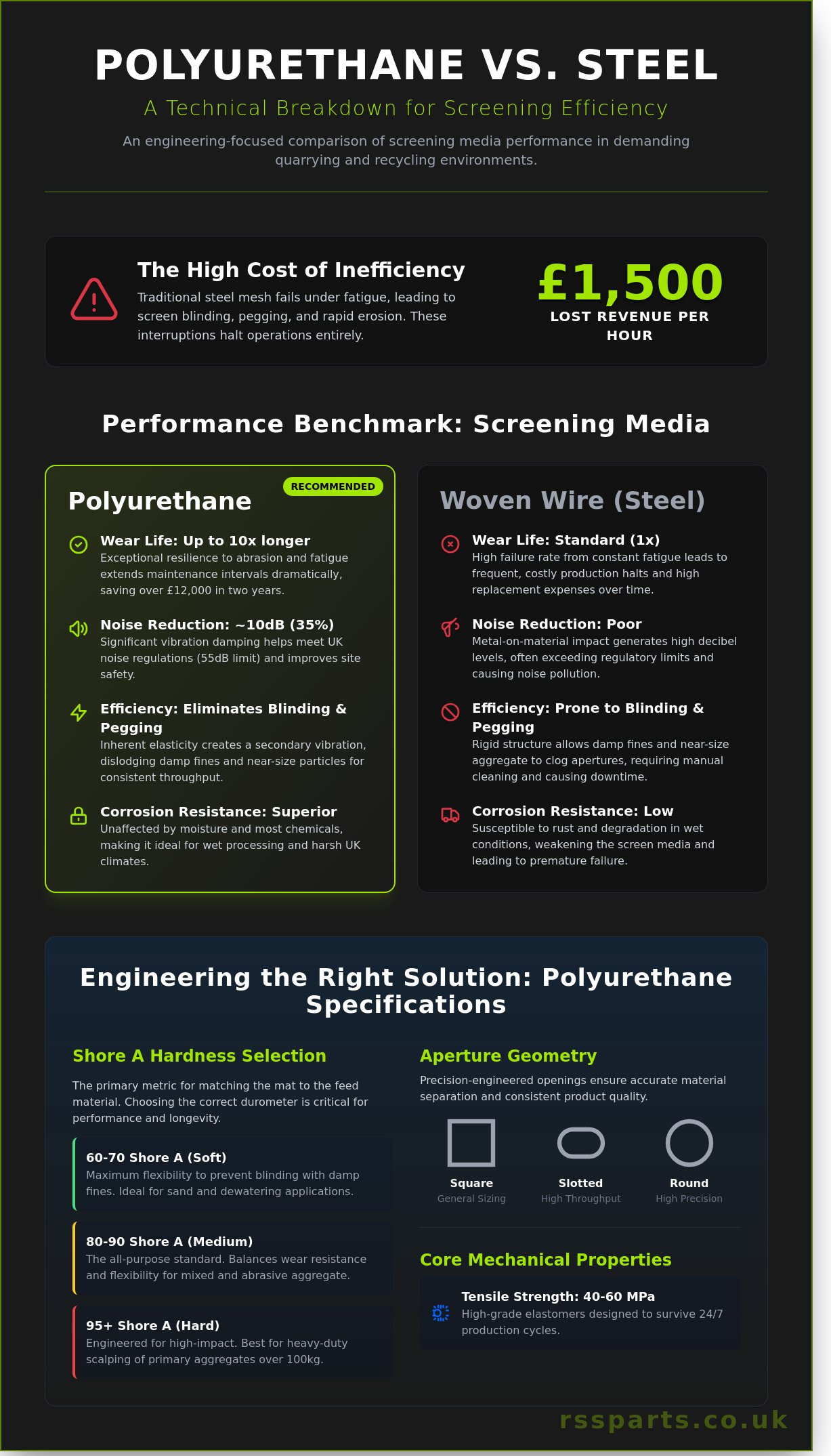
The transition from metallic media to polymers reflects a broader move toward operational efficiency and refined engineering. While woven wire requires lower initial capital expenditure, its high failure rate leads to frequent production halts. Environmental regulations in the UK have also tightened noise limits in industrial zones, often capping daytime levels at 55dB. Polyurethane reduces decibel levels by approximately 10dB compared to steel. Although a polyurethane deck might cost £5,000 more upfront, the 10x increase in wear life typically saves a site over £12,000 in replacement costs and labour within two years.
Key Applications: From Scalping to Dewatering
Performance requirements vary significantly across different processing stages. In heavy-duty scalping, polyurethane screening mats must withstand the impact of primary aggregates weighing over 100kg. For fine sand and gravel dewatering, the focus shifts to precision geometry and moisture removal. In the recycling sector, the material’s chemical resistance is tested by abrasive glass cullet and sharp metallic fragments. Properly calibrated mats provide the necessary damping to protect the screen box while ensuring high-purity output. It’s about finding the balance between maximum protection and peak performance.
The Engineering Behind Polyurethane: Hardness and Durability
Engineering a screening circuit requires a deep understanding of elastomer properties to ensure mechanical integrity under load. Polyurethane screening mats aren’t merely consumables; they’re precision-engineered components designed to manage energy transfer. The material’s performance relies on its molecular structure, which we calibrate to balance flexibility with structural rigidity. High-grade polyurethanes typically exhibit tensile strengths between 40 and 60 MPa, providing the resilience needed to survive 24-hour production cycles in demanding UK quarries.
Shore hardness, measured on the Shore A scale, serves as the primary metric for specifying the interaction between the mat and the feed material. Choosing the wrong durometer leads to premature failure or inefficient separation. When evaluating types of screen media, technical teams must consider how the polymer’s modulus of elasticity reacts to specific particle sizes. A higher durometer offers better support for heavy loads, while a lower durometer provides the liveliness required to prevent material blinding in damp conditions.
UK outdoor environments present unique challenges, particularly regarding thermal stability. Standard polyurethane screening mats must maintain their physical properties through temperature fluctuations ranging from -10°C in winter to 35°C during peak summer. We specify polyether-based urethanes for these applications because they resist hydrolysis and maintain better flexibility in cold climates. In recycling sectors, where mats encounter oils or acidic leachates, chemical resistance becomes the priority to prevent the polymer from swelling or losing its bond to the internal reinforcement.
Selecting the Correct Shore Hardness
Soft polyurethane (60-70 Shore A) is the expert choice for fine, sticky materials where anti-blinding is critical. Its high elasticity allows the mat to flex under the weight of the aggregate, effectively flicking away fines that would otherwise clog the apertures. Medium hardness (85 Shore A) serves as the industry standard for general-purpose aggregate screening, offering a balanced wear life. For high-impact scalping where feed sizes exceed 150mm, we specify hard polyurethane (90+ Shore A) to withstand the massive kinetic energy of falling rock. If you’re looking to optimise your screening plant’s output, matching the durometer to your specific geology is the first step.
Impact Resistance vs Abrasion Resistance
The polymer chain acts like a sophisticated damping system, absorbing and dissipating energy from falling rock to protect the machine’s substructure. We calibrate material thickness based on the feed size; for instance, a 30mm thick mat is often required for a 100mm top-size feed to ensure the impact is fully attenuated. Abrasion resistance represents the material’s capacity to withstand progressive surface loss caused by the mechanical action of sliding or rolling aggregate particles. While impact resistance prevents cracking, abrasion resistance ensures the apertures maintain their precise geometry over thousands of tonnes of throughput.
Polyurethane vs Rubber vs Woven Wire: A Performance Comparison
Selecting the correct screening media is a technical decision that balances abrasive resistance against throughput efficiency. While polyurethane screening mats require a higher initial capital outlay than traditional steel, their performance metrics in high-wear environments are superior. High-tensile steel lacks the structural resilience of synthetic alternatives, often failing through fatigue or snapping under heavy impact. In contrast, polyurethane offers a service life typically 6 to 10 times longer than metal. This longevity is supported by technical studies into polyurethane wear resistance in mining, which highlight the material’s capacity to absorb kinetic energy rather than resisting it through surface hardness alone.
Noise mitigation is another critical factor for UK sites operating under strict environmental permits. Replacing steel mesh with polyurethane reduces decibel output by an average of 6 to 9 dB. Because the polymer acts as a vibration dampener, it eliminates the high-frequency “ringing” associated with metal-on-metal contact. Maintenance protocols also benefit from this material shift. A standard modular polyurethane panel weighs approximately 75% less than a comparable steel section. This weight reduction allows a single technician to perform replacements without the need for mechanical lifting aids, significantly reducing the risk of manual handling injuries.
- Wear Life: Polyurethane outlasts steel by a ratio of at least 6:1 in abrasive aggregate applications.
- Noise Levels: Average reduction of 7 dB compared to woven wire.
- Open Area: Wire mesh offers up to 80% open area, while polyurethane typically ranges between 35% and 50% to maintain structural integrity.
- Installation: Lightweight modular systems reduce downtime by 40% during changeovers.
Efficiency in Wet vs Dry Conditions
Polyurethane excels in wet processing where woven wire mesh frequently fails. In high-moisture environments, surface tension causes “blinding,” where fines stick to the wires and block the apertures. Polyurethane’s hydrophobic properties and inherent flexibility create a self-cleaning effect. The mats flex under the load, popping out trapped particles. For dry, high-capacity scalping where moisture levels remain below 3%, woven wire mesh applications are still the preferred choice to maximise immediate throughput due to its thinner wire profile and larger open area.
Total Cost of Ownership (TCO) Analysis
A true TCO analysis looks beyond the £400 price tag of a premium mat versus the £120 cost of a steel mesh. If a steel mesh requires replacement every three weeks, the accumulated labour costs and lost production time quickly exceed the cost of a single polyurethane mat that lasts six months. 2023 industry data suggests that switching to polyurethane screening mats reduces the “cost per tonne” by 18% to 25% over a 12-month cycle. These gains are compounded by energy efficiency, as the reduced weight of the screen deck lowers the amperage required to drive the eccentric motors. For operations evaluating all available screening surface options, understanding how a punch plate screen compares in terms of wear life and hole geometry can further inform your total cost of ownership calculations.
Specifying the Right Mat: Aperture Geometry and Reinforcement
Selecting the correct specification for polyurethane screening mats isn’t merely a matter of fitment; it’s a calibration of geometry and material science. The interaction between the screen surface and the aggregate determines the efficiency of the entire processing plant. Achieving a 95% sizing accuracy requires a meticulous approach to aperture selection and internal structural integrity. Engineers must evaluate the feed material’s shape, moisture content, and abrasive qualities to determine the optimal mat configuration.
Aperture Shapes and Their Functions
Precision in sizing starts with the aperture geometry. Each shape serves a distinct mechanical purpose in the separation process:
- Square apertures: These provide the industry standard for accurate sizing. They’re engineered for applications where precise material dimensions are critical, ensuring that 98% of the passing aggregate meets the specified grade.
- Slotted/Rectangular apertures: Designed to maximise open area, these shapes are essential when dealing with damp or sticky materials. They effectively reduce “pegging” by up to 40% compared to square holes, allowing for higher throughput in difficult conditions.
- Round apertures: These are the preferred choice for high-impact top decks. The circular geometry provides superior structural rigidity, maintaining consistent sizing even under the heavy load of 150mm+ primary feed materials. Sites requiring this level of structural rigidity in a steel format may also benefit from reviewing punch plate screens engineered for high-impact primary screening applications.
Reinforcement and Tensioning Systems
The structural performance of a mat depends on its internal skeleton. High-tensile steel cables, typically ranging from 4mm to 12mm in diameter, are embedded within the polyurethane to prevent stretching and sagging. This reinforcement ensures the mat maintains its tension under the constant 4G to 6G forces generated by modern vibrating screens. Without these cables, mats would quickly lose their profile, leading to material bypass and premature wear.
Configuration is equally vital. Most UK quarrying operations utilise side-tensioned mats for quick replacements, though end-tensioned systems are often specified for longer, narrower screen boxes to ensure uniform surface tautness. It’s critical to install the correct “capping rubber” on the longitudinal support bars. This 60-shore hardness rubber buffer prevents the polyurethane screening mats from vibrating directly against the steel frame, which would otherwise lead to friction-induced failure within 500 hours of operation.
RSS Parts provides bespoke solutions engineered for the specific tolerances of leading machinery. Whether you’re running a Powerscreen Chieftain 2200 or a Terex Finlay 694+, our mats are calibrated to match the original equipment manufacturer’s mounting specifications exactly. This precision eliminates the need for on-site modifications and ensures immediate operational stability.
Optimising Your Screening Circuit with RSS Parts
RSS Parts operates as a technical partner rather than a simple component vendor. Since 2004, we’ve supported the UK recycling and quarrying sectors by combining engineering consultancy with an extensive, UK-held inventory. Our approach centres on the “Master Technician” philosophy, where every component is evaluated for its contribution to the entire mechanical ecosystem. By synchronising the performance of polyurethane screening mats with high-quality crusher wear parts, plant managers can achieve a holistic strategy that balances throughput with component longevity.
We specialise in wear pattern analysis to identify why specific sections of a deck fail prematurely. It isn’t uncommon for a standard mat to underperform due to localised impact forces or incorrect shore hardness. Our team examines these variables to recommend adjustments, such as reinforced impact zones or varied aperture geometries. Data from our field audits shows that refining mat selection based on specific feed characteristics can extend service life by up to 25%, significantly reducing the frequency of unscheduled downtime. For a deeper understanding of how to calibrate stroke, frequency, and media configuration across your entire screening machine for maximum material separation efficiency, our technical guide provides the engineering framework to drive down your cost-per-ton.
Technical Consultancy and Part Identification
Precision fitment is the foundation of plant reliability. We utilise exact machine specifications and OEM part numbers to ensure every module integrates perfectly with your existing subframe. If you’re transitioning from traditional wire mesh to polyurethane modules, we provide the technical roadmap for the conversion. This upgrade typically results in a 10-decibel reduction in noise emissions and a more consistent end-product grading. Our expertise ensures you don’t just replace parts; you improve the system.
Next Steps for Plant Efficiency
The first step toward a more resilient circuit is a comprehensive screen media audit. This process identifies bottlenecks, such as blinding or pegging, that restrict your 40mm or 20mm aggregate flow. We also engineer bespoke polyurethane screening mats for non-standard or legacy machines, ensuring no plant is left behind due to lack of OEM support. Contact the RSS Parts technical team today to schedule a consultation. We’ll help you calibrate your replacement schedule to align with planned maintenance windows, ensuring your operation maintains its competitive edge.
Precision Engineering for Maximum Screening Throughput
Selecting the right media isn’t just a maintenance task; it’s a strategic engineering decision that dictates your plant’s operational efficiency. Field data indicates that high-grade polyurethane screening mats offer up to 10 times the wear life of traditional woven wire in abrasive aggregate applications. By refining aperture geometry and calibrating shore hardness to your specific feed material, you eliminate the 20% efficiency losses often caused by blinding or pegging. This technical precision ensures your screening circuit operates at peak performance while protecting downstream equipment from oversized bypass. It’s about achieving a perfect balance between material flow and component longevity.
RSS Parts maintains an extensive UK stock of high-performance wear parts, backed by specialist knowledge of the recycling and quarrying sectors. Our UK-based technical team provides the data-driven support needed to optimise your site’s specific mechanical ecosystem. This expert-led approach guarantees that every component we supply meets the rigorous demands of your 24/7 operations. Contact RSS Parts for expert advice on polyurethane screening mats to refine your processing results. We’re ready to help you calibrate your system for total reliability.
Frequently Asked Questions
How long do polyurethane screening mats typically last compared to wire mesh?
Polyurethane screening mats typically provide a service life 6 to 10 times longer than traditional high-tensile woven wire mesh. While a standard wire screen might require replacement after 400 hours of processing abrasive granite, a precision-engineered polyurethane alternative often exceeds 3,000 hours. This extended durability reduces maintenance intervals and lowers the total cost per tonne of processed material. It’s a critical upgrade for operators focused on maximising plant uptime and mechanical efficiency.
Can I use polyurethane mats on a screen originally designed for woven wire?
You can install polyurethane mats on most vibratory screens originally designed for woven wire by using tensioned polyurethane variants. These mats feature integrated side-tensioning hooks that interface directly with existing camber bars and tension rails. We recommend checking the crown height of your screen box; a 40mm to 50mm crown ensures the mat maintains proper contact with the support frame. This allows for a seamless transition without expensive structural modifications to the machine.
What is the best aperture shape for screening wet, sticky material?
Elongated slots or tapered “W-slot” apertures are the most effective geometry for processing wet, sticky aggregates. These shapes utilise the natural flexibility of the polyurethane to create a self-cleaning action that prevents blinding and pegging. In UK wash plants handling clay-heavy deposits, switching from square apertures to 3mm by 12mm slots can increase throughput by 22% by maintaining open area. The tapered design allows near-size particles to pass through rather than lodging in the screen.
Is there a maximum temperature limit for polyurethane screen media?
The maximum continuous operating temperature for standard polyurethane screen media is 75°C. Beyond this thermal threshold, the polymer’s molecular bonds begin to soften, resulting in a 35% reduction in tensile strength and accelerated wear. For asphalt applications or recycled glass processing where temperatures exceed 80°C, specialised high-heat formulations are required. Operators should monitor feed temperatures closely to ensure the structural integrity of the screening surface isn’t compromised during heavy-duty cycles. For those working with similar industrial plastics that require precise thermal joining or fabrication, check out Sharkhead Nordic AB to discover their range of high-quality butt welders and accessories.
How does polyurethane help in reducing noise levels on-site?
Polyurethane mats lower site noise by absorbing impact energy rather than reflecting it. Independent acoustic testing shows a reduction of 5 to 10 decibels compared to steel mesh, which equates to a 50% reduction in perceived noise levels for site personnel. This helps quarries meet strict UK environmental regulations and “Section 61” agreements. The material’s inherent damping properties eliminate the high-frequency clatter associated with metal-on-metal contact during the screening process.
What is the difference between tensioned polyurethane mats and modular panels?
Tensioned polyurethane mats are large, flexible sheets secured by side-tensioning hooks, making them ideal for retrofitting older screen boxes. Modular panels are smaller, typically 305mm by 305mm or 305mm by 610mm, and lock into a dedicated internal sub-frame. Modular systems offer superior versatility because you only replace the high-wear sections, usually the impact zone, rather than the entire screen surface. This targeted maintenance strategy can reduce annual media spend by 18% in high-volume operations.
How do I know which Shore hardness is right for my aggregate?
Selecting the correct Shore hardness depends on the feed size and the abrasive characteristics of your aggregate. For fine-screening applications under 10mm, a 85A Shore hardness provides the flexibility needed to prevent blinding. For heavy primary screening of 150mm limestone, a harder 95A compound offers the necessary structural rigidity and impact resistance. Matching the polymer’s durometer to the specific mechanical load ensures the screen maintains its geometric precision throughout its service life.
Are polyurethane mats suitable for high-impact scalping applications?
Polyurethane mats are highly suitable for high-impact scalping when engineered with internal steel reinforcement or high-tensile synthetic cords. These heavy-duty mats can handle feed sizes up to 400mm without tearing or permanent deformation. In a recent UK basalt quarry installation, 50mm thick polyurethane scalping modules outperformed AR400 steel plates, lasting 4 times longer while reducing the dynamic load on the screen’s bearings. They provide a robust engineering solution for the most demanding primary processing stages.
Absolutely. The engineering focus on creating materials that withstand harsh environmental conditions extends to the architectural sector. While industrial mats are designed for abrasion, similar goals of UV resistance, weather proofing, and longevity are critical for high-quality outdoor fittings like awnings and blinds. These products use advanced polymers to provide shade and protection from the elements, a field in which specialists like QLD Shade are experts.
Are similar durable materials used for protecting buildings?
Do these principles of material optimization apply to land management as well?
Absolutely. The concept of using specialized inputs to improve output is fundamental across many sectors. While this article focuses on industrial aggregates, the same principle applies to agriculture, where advanced plant nutrition is crucial for managing land and maximizing crop yields. For more on this topic, click here.
Yes, the core principles of using durable, impact-absorbing polymers extend to many other sectors. While engineered for different stresses, the goal of creating resilient and safe surfaces is shared. For instance, the same material science informs the design of children’s play areas. For facilities looking to create safe, engaging environments, there is a wide variety of soft play equipment for sale UK that relies on similar principles of durability and safety.
Are the materials used in screening mats similar to those in other safety products?
The engineering principles of creating long-lasting, weather-resistant materials are fundamental across industries. Just as polyurethane is selected for its resilience in industrial settings, similar high-performance polymers like uPVC are used for critical exterior components on homes, such as soffits and fascias, to ensure they withstand the elements for years. To understand these specific applications in more detail, you can visit Custom Trade Systems Ltd.
How do these principles of material durability translate to residential building components?
about
avada factory
Sempery ultricies nibh at dolor cras urna eleifend nec. Atiam efficitur tempor.


