

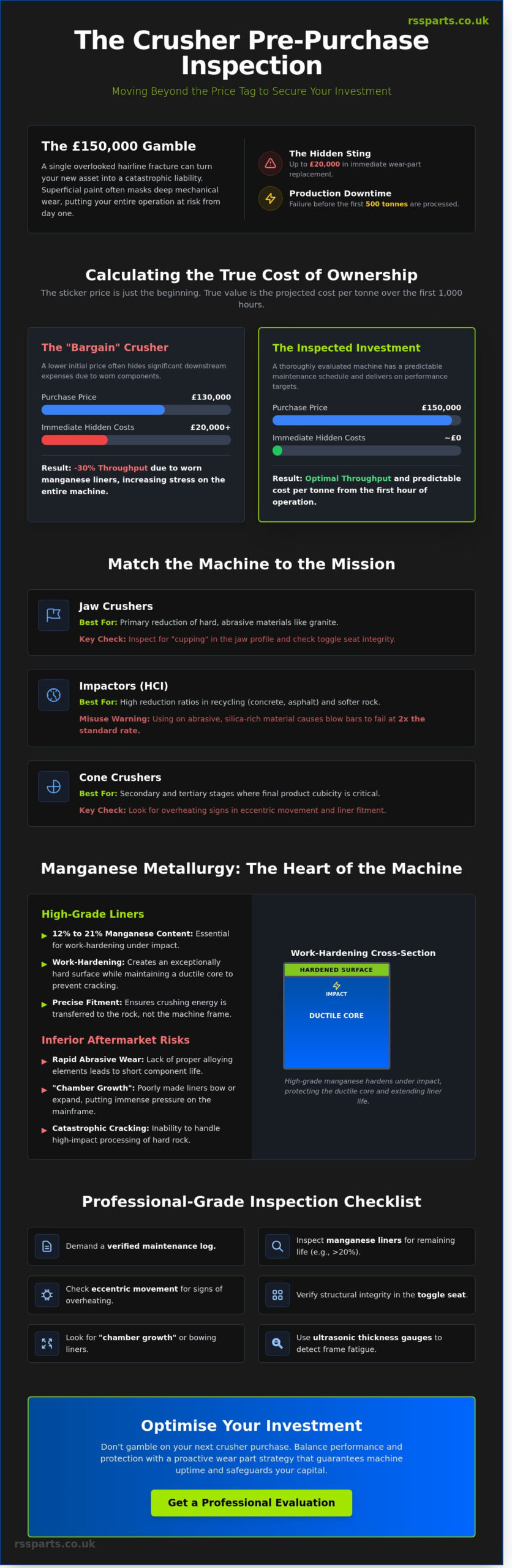
A single overlooked hairline fracture in a main-frame can transform a £150,000 investment into a catastrophic liability before the first 500 tonnes of aggregate are processed. When you’re scouting for a crusher for sale, the superficial paintwork often masks deep-seated mechanical wear that threatens your long-term operational integrity. It’s a high-stakes environment where technical precision isn’t just an advantage; it’s a requirement for survival. Relying on a visual scan is a gamble that seasoned plant managers in the UK’s £15 billion quarrying sector refuse to take without a verified maintenance log.
You’ve likely seen how a mismatched manganese profile or a failing eccentric bushing can derail a project’s timeline and decimate your margins. We’re here to ensure your next acquisition delivers the reliability your production targets demand. This article provides a technical framework to master the nuances of used machinery evaluation, helping you avoid the £20,000 sting of immediate wear-part replacement. We’ll break down a rigorous inspection checklist that covers structural geometry, hydraulic pressure benchmarks, and metallurgical suitability for your specific application. It’s time to move beyond guesswork and engineer a predictable maintenance schedule for your fleet.
Key Takeaways
- Learn why the true cost of a crusher for sale in the UK is dictated by its maintenance history and component wear rather than the initial capital outlay.
- Identify the metallurgical markers of high-grade manganese liners to distinguish precision-engineered wear parts from inferior aftermarket alternatives.
- Analyze the engineering trade-offs between mobile and stationary configurations to understand how transportability affects long-term wear-part economics.
- Implement a professional-grade inspection protocol using tools like ultrasonic thickness gauges to detect structural fatigue before it leads to catastrophic failure.
- Master the balance of performance and protection by establishing a proactive replacement schedule that optimizes machine uptime and protects your investment.
Navigating the Market for a Crusher for Sale: Beyond the Price Tag
The UK used equipment market currently faces a 15% increase in demand for mobile crushing units as infrastructure projects and regional road upgrades continue to consume aggregates. When searching for a crusher for sale, buyers often focus on the hour meter and the engine’s service history. While these metrics matter, they don’t tell the whole story of the machine’s mechanical integrity. We view every machine through the lens of performance and protection, a philosophy where the efficiency of the crushing chamber directly safeguards the structural longevity of the entire plant.
Acquiring a machine with a lower sticker price often results in immediate capital outlay for wear parts. If the manganese liners are at 20% life, you’ll face a maintenance shutdown within the first month of operation. This isn’t just a parts cost issue; it’s a lost production issue. True value lies in the relationship between the purchase price and the projected cost per tonne over the first 1,000 hours of operation. You aren’t just buying steel; you’re buying the ability to process material at a specific rate without catastrophic component failure.
Primary, Secondary, and Tertiary Crushing Applications
Success starts with matching the kinematics of the machine to the material’s compressive strength. A jaw crusher excels in primary reduction of hard rock like granite, while impactors are the standard for recycling concrete and asphalt. Using an impactor on highly abrasive silica-rich material causes blow bars to fail at double the standard rate. You must calibrate your choice based on feed size and the desired final fraction. Buying the wrong crusher for sale leads to eccentric strain and premature bearing failure because the geometry of the crush isn’t optimized for the feed stock.
The Hidden Costs of Used Machinery
The true cost of ownership includes the immediate wear-part cycles. Data from site audits shows that worn manganese liners can decrease throughput by as much as 30% because the original crushing profile is lost. This forces the operator to tighten the Closed Side Setting (CSS), which increases the pressure on the toggle plate and eccentric shaft. When inspecting a used unit, look beyond the paint. Check for integrity in the toggle seat and signs of overheating in the eccentric movement. A machine with “tired” manganese isn’t just slow; it’s actively damaging its own internal components through improper force distribution.
- Jaw Crushers: Best for primary reduction of hard, abrasive materials.
- Cone Crushers: Ideal for secondary and tertiary stages where cubicity is required.
- Impactors: Optimized for recycling and softer rock with high reduction ratios.
Technical Evaluation of Crushing Chambers: Liners, Manganese, and Metallurgy
The internal geometry of a crushing chamber defines the machine’s operational efficiency. When you evaluate a crusher for sale, the focus must shift from the chassis to the metallurgy of the wear parts. High-quality manganese liners rely on precise chemical compositions, typically ranging from 12% to 21% manganese content, to facilitate work-hardening. This process allows the surface to become exceptionally hard under impact while maintaining a ductile core. Inferior aftermarket castings often lack these refined alloying elements, leading to rapid abrasive wear or catastrophic cracking when processing hard UK granites.
Chamber growth is a critical warning sign in used units. This occurs when liners aren’t seated correctly or are made from poor-grade alloys that expand under stress. If you notice the liners are bowing or putting excessive pressure on the mainframe, it indicates a fundamental failure in component fitment. This misalignment can lead to “hot spots” where the energy of the crush is transferred into the machine frame rather than the rock, causing long-term structural fatigue. If you’re unsure about the integrity of a specific unit, our team can help you optimise your wear part strategy for maximum uptime.
Inspecting Jaw Crusher Liners and Cheek Plates
Look for cupping in the jaw profile. This uneven wear pattern reduces the effective stroke and increases the recirculating load, which can drop production by 15% or more. You should consult this technical guide to jaw crusher liners to understand how material selection impacts performance. Ensure wedge bolts aren’t seized; a seized tensioning system often suggests the machine hasn’t seen a liner change in over 1,200 operating hours.
Cone Crusher Mantles and Concaves
Measure the remaining nip and discharge gap. A reduced nip angle forces the material higher in the chamber, causing “ring bounce.” This phenomenon, often caused by trying to crush material harder than the machine’s original specification, accelerates fatigue in the adjustment ring threads. Check the backing compound. If the epoxy is crumbling, the liners aren’t properly supported, which leads to localized stress points and potential mantle failure. Finding a crusher for sale with fresh backing compound is a strong indicator of a well-maintained machine. For a comprehensive understanding of how mantle and concave profiles affect chamber efficiency, refer to this technical guide on cone crusher liners to inform your pre-purchase assessment.
Impactor Blow Bars and Apron Liners
Evaluate the wear life of the blow bars. Most bars can be flipped once to utilize the secondary edge, but if they’ve worn past the 55% mark, the rotor becomes vulnerable to impact damage. For deeper insights into chrome and ceramic inserts, review this guide on impactor blow bars. Inspect the curtains and apron liners for structural thinning; a thickness reduction of more than 25mm from original spec usually requires immediate replacement to protect the internal housing.
Comparing Crusher Configurations: Mobile vs. Stationary Wear Economics
Selecting the right configuration involves evaluating more than just site mobility. It dictates the fundamental wear economics of your operation. When you evaluate a crusher for sale, the structural engineering of the chassis determines how mechanical energy is dissipated. Mobile tracked units are designed for agility, utilizing compact frames that must withstand the rigours of transport and frequent repositioning. This portability requires a compromise in mass, which directly influences how the machine absorbs the massive compressive forces generated during the crushing cycle.
Stationary plants, by contrast, benefit from massive steel sub-structures and reinforced concrete foundations. These rigid setups provide superior dampening, ensuring that the energy is directed into the rock rather than the machine’s frame. This difference in stability often results in a 10% to 15% variance in the lifespan of manganese liners. Maintenance accessibility also varies significantly. While mobile units offer integrated conveyor system components that allow for rapid setup, their compact engine bays and tight internal clearances can make liner changes more complex than in a spacious static plant.
Mobile Crusher Considerations: Tracks and Engines
Mobile units face unique mechanical stressors that accelerate component fatigue. You must monitor the undercarriage regularly, checking for track chain stretch and pitch elongation. Excessive slack often indicates that the unit has been operated on uneven terrain, which introduces torsional stress to the crusher box. This vibration profile is a primary driver of premature manganese failure. If the machine isn’t perfectly level, the crushing force becomes eccentric, leading to uneven wear across the mantle.
Hydraulic integrity is another critical factor. A small leak in the drive system can contaminate the crushing zone, leading to slippage or catastrophic failure of the wedge locking mechanisms. In the UK’s demanding climate, temperature fluctuations can cause hydraulic seals to degrade faster. If you’re inspecting a crusher for sale in the used market, evidence of hydraulic weeping near the main shaft is a major red flag for future reliability.
Stationary Plant Advantages: Stability and Throughput
Static installations excel in high-tonnage environments where consistency is paramount. Because the plant is bolted to a permanent foundation, harmonic vibrations are significantly reduced. This stability allows for tighter CSS (Closed Side Setting) calibrations without the risk of frame cracking. You should frequently evaluate the integrity of the feed hoppers and the high-grade wear plates that protect the primary structure from abrasive impact.
Efficient throughput in a stationary setup relies on the synergy between the crusher and its discharge infrastructure. The integration of magnetic separators and heavy-duty belts ensures that tramp metal is removed before it can cause internal damage. In 85% of documented static plant failures, the root cause is traced back to neglected discharge conveyors that allowed material to back up into the crushing chamber, causing “choke” conditions that shatter manganese liners instantly.
The Ultimate Pre-Purchase Inspection Checklist for Industrial Crushers
When you’re evaluating a used crusher for sale, precision serves as your primary safeguard against unforeseen downtime. A professional evaluation requires more than a cursory glance; it demands a forensic approach to engineering integrity. You’ll need specific hardware to conduct a valid assessment. An ultrasonic thickness gauge is essential for measuring liner wear, while a thermal imaging camera helps identify friction-induced hotspots in the bearing housings. Don’t rely on visual estimates. A liner that appears functional might actually be at 85% of its wear life, necessitating an immediate and costly replacement post-purchase.
The Mechanical Integrity Checklist
Start by monitoring the main bearings during a cold start and through to reaching operating temperature. Any temperature spikes exceeding 70°C or excessive vibration levels suggest internal geometry issues. You must also analyse the lubrication system. Pull an oil sample to check for clarity. The presence of copper or bronze filings is a definitive indicator of bushing degradation. Ensure drive belts are correctly tensioned and pulleys show no signs of eccentric wobbling, as misalignment often leads to uneven bearing loads and premature shaft fatigue.
The Wear Zone Checklist
Measure the manganese liner thickness specifically at the bottom of the crushing chamber. This high-wear zone dictates your immediate maintenance budget. You should also examine the trommel plates and grizzly bars for structural thinning or stress fractures. Scrutinise the main frame for “welding scars” or fresh paint in unusual areas. These often mask historical stress fractures or previous catastrophic failures that could compromise the machine’s structural rigidity under heavy load.
The Operational Test
If the crusher for sale is still commissioned, observe it under a 100% load. Listen for rhythmic thumping or surging, which typically indicates an unbalanced rotor or a failing eccentric assembly. You must cycle the Closed Side Setting (CSS) adjustment mechanism through its full range. It should operate smoothly without hydraulic stuttering or mechanical binding. Finally, check the discharge conveyor belting. Tracking issues or severe edge fraying often point to a warped conveyor frame or seized return rollers that will require immediate attention.
Before concluding your inspection, demand a full review of the service logs and metallurgy certificates for the current wear parts. Consistent maintenance records provide a window into the machine’s operational history and the quality of components used by the previous owner. Verify that the manganese alloy matches your specific rock hardness to avoid rapid wear cycles. If the machine includes a secondary or tertiary cone stage, cross-reference the chamber profile against a detailed cone crusher liners selection and wear analysis to confirm the metallurgy is suited to your feed material.
Ensure the mechanical integrity of your plant by sourcing precision-engineered components from RSS Parts today.
Optimising Your Investment: Performance and Protection with RSS Parts
Identifying a crusher for sale is only the first step in a long-term procurement cycle. The real value of any capital investment is unlocked through precise maintenance and technical calibration. RSS Parts provides the engineering depth needed to maintain mechanical integrity long after the initial purchase. We focus on establishing a proactive replacement schedule based on specific tonnage throughput rather than waiting for visual failure. This technical approach prevents catastrophic component fatigue and ensures the geometry of your crushing chamber remains within optimal tolerances.
Custom engineering solutions are essential for operators dealing with high-abrasion environments or challenging feed materials. We don’t just supply off-the-shelf components; we analyse the specific wear patterns of your machine. By refining the metallurgy to suit the unique characteristics of your material, we extend the service life of your equipment. For a deeper analysis of how material science impacts your bottom line, refer to our technical guide on crusher wear parts.
Sourcing High-Performance Replacement Components
We maintain an extensive inventory of UK-stocked jaw, cone, and impactor liners designed to meet or exceed standard OEM specifications. Our metallurgy is specifically engineered for the rigours of UK quarries, where high-silica content often accelerates wear. By increasing the work-hardening capacity of our manganese alloys, we provide a more durable solution than generic alternatives. Our national delivery network is structured to reach sites across the UK within 24 to 48 hours. This rapid response reduces the significant costs associated with unplanned downtime and keeps your production targets on track.
Beyond the Crusher: Screening and Conveying
Efficiency isn’t limited to the crushing chamber. A high-performance circuit requires every component to operate in perfect harmony. If your site operations include the primary reduction of waste or timber, matching your machine with precision-engineered shredder parts ensures consistent material sizing and prevents downstream blockages. We help you optimise the entire processing circuit by supplying screening mats and rollers that mirror the durability of our manganese liners.
When you evaluate a crusher for sale, it’s vital to consider the secondary costs of sub-optimal geometry in your screening deck. Our team calibrates the entire system to ensure maximum uptime and operational safety. We prioritise substance and mechanical integrity to help you achieve the lowest cost-per-tonne possible.
Contact RSS Parts for a technical consultation on your next machine purchase. Our master technicians are ready to assist with your specific engineering challenges.
Securing Long-Term Reliability Through Precision Technical Evaluation
Finding a high-quality crusher for sale involves a deep dive into mechanical specifications that go far beyond a simple visual check. You’ve now identified how metallurgy and liner profile geometry directly impact your operational overheads. It’s clear that the choice between mobile and stationary configurations dictates your long-term wear economics and maintenance cycles. Since 2004, RSS Parts has provided UK operators with engineering expertise focused on high-performance metallurgy. We understand that every millimetre of manganese wear affects your bottom line. By applying a structured technical checklist, you ensure your investment delivers the exact performance and protection your site requires.
Our national supply of premium quarry and recycling components is backed by nearly two decades of precision engineering. We’re ready to help you calibrate your next acquisition for maximum efficiency and mechanical integrity. Consult with our Master Technicians on your next crusher purchase and ensure your equipment is fit for the most demanding applications. Your next project deserves the confidence that only expert-led engineering can provide.
Frequently Asked Questions
What is the most important thing to check when looking at a used crusher for sale?
When evaluating a crusher for sale, the structural integrity of the main frame and pitman remains the critical priority. You must inspect these components for stress fractures or evidence of previous weld repairs that suggest historical fatigue. A frame with 3 or more weld repairs in high-stress zones indicates a compromised lifespan. Ensure the eccentric shaft shows no signs of scoring or heat discolouration, as replacing these internal assemblies often exceeds 40% of the machine’s residual value.
How many hours is too many for a second-hand jaw crusher?
A second-hand jaw crusher is generally considered high-hour once it exceeds the 12,000-hour threshold. While well-maintained units can reach 25,000 hours, the risk of catastrophic bearing failure increases by 60% after the 15,000-hour mark. You should demand full service records for any machine over 8,000 hours. If the eccentric bearings haven’t been replaced by 14,000 hours, factor that £15,000 to £25,000 cost into your purchase price to ensure long-term reliability.
Can I replace the liners on a used crusher myself?
You can replace liners yourself if your facility is equipped with a 5-tonne overhead crane and calibrated torque wrenches. The process requires precise alignment to prevent uneven wear or premature cracking of the manganese. Most UK sites use a two-person team to complete a jaw liner swap within a 6-hour window. Incorrect seating of the wedge bolts leads to a 30% reduction in liner life, so precision during installation is vital for maintaining performance.
What is the difference between 18% and 22% manganese liners?
The primary difference lies in the work-hardening rate and the material’s ability to withstand impact without fracturing. 18% manganese is the industry standard for medium-hard rock, while 22% manganese is engineered for extreme abrasion and high-tensile materials. Choosing 22% manganese for soft limestone is inefficient, as the material won’t work-harden properly. This results in the liner wearing away 20% faster than the cheaper 18% alternative because the surface never reaches its optimal hardness.
How do I know if the toggle plate needs replacing on a jaw crusher?
You’ll know the toggle plate requires replacement when you observe visible deformation or if the ends have worn down by more than 10% of their original thickness. This component acts as a mechanical fuse designed to protect the more expensive eccentric shaft. If the toggle seat shows a gap exceeding 3mm, the mechanical geometry is compromised. Ignoring a worn toggle increases the risk of frame damage during an uncrushable event by nearly 85%, leading to expensive structural repairs.
Are mobile crushers more expensive to maintain than stationary ones?
Mobile crushers typically incur maintenance costs 20% higher than stationary units due to the complexity of the track gear and onboard power units. You’re maintaining a diesel engine, hydraulic drive system, and conveyor assembly alongside the crushing chamber. UK operators find that track maintenance alone adds £2,000 to £5,000 to annual operating budgets. Stationary plants benefit from simplified electric drives which offer a 95% uptime rate compared to the 88% average for mobile units.
What are the signs of a cracked crusher frame?
Signs of a cracked frame include oil weeping from the main housing seams and a distinct change in the machine’s acoustic profile during operation. You should perform a dye penetrant test if you spot hairline marks exceeding 50mm in length near the corner radii. If the frame alignment shifts by more than 2mm, it often indicates a structural failure. These cracks usually stem from operating with worn-out manganese liners that no longer protect the internal casting from extreme stress.
How does the material I am crushing affect which machine I should buy?
Material characteristics like the Bond Work Index and MoHS hardness determine if you need a jaw, cone, or impact crusher. If you’re processing abrasive granite with a silica content above 15%, a jaw crusher is the only viable primary stage. Impactors are better suited for recycling concrete where you need to liberate rebar. Buying a crusher for sale without matching the metallurgy to your feed material leads to a 40% spike in wear part expenses and reduced throughput.
about
avada factory
Sempery ultricies nibh at dolor cras urna eleifend nec. Atiam efficitur tempor.


