

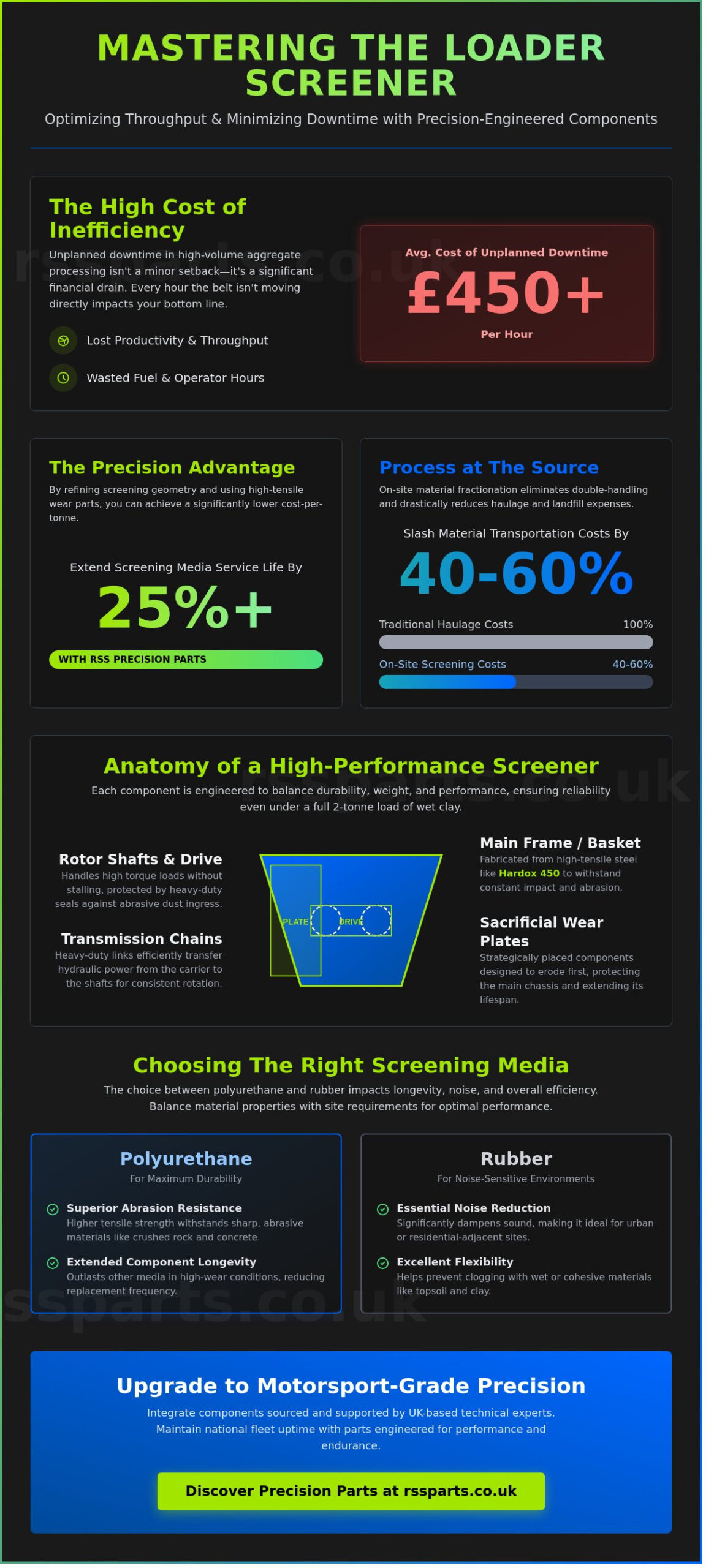
In high-volume UK aggregate processing, a single hour of unplanned downtime often costs an operation upwards of £450 in lost productivity and wasted fuel. You already know that maintaining a loader screener isn’t just about keeping the belt moving; it’s a precise exercise in managing the fine margins between profitable throughput and mechanical fatigue. We recognize that inconsistent material sizing and the rapid degradation of screening media in abrasive conditions are the primary enemies of your bottom line.
This technical guide will help you master the mechanics of your attachment and discover how to optimize material processing through precision component selection. By refining your screening geometry and selecting high-tensile wear parts, you can extend the service life of your screening stars by 25% or more. We’ll examine the engineering behind advanced mats and stars to help you achieve a lower cost-per-tonne while maintaining the highest levels of product purity in every load.
Key Takeaways
- Understand the mechanical distinctions between rotary star, vibrating, and portable units to select the most efficient loader screener for your specific on-site fractionation requirements.
- Analyze the physics of radial mounting and material ‘ramping’ to eliminate clogging and ensure consistent output through optimized tumbling motions.
- Evaluate the tensile strength and abrasion resistance of polyurethane versus rubber media to balance component longevity with essential noise-reduction requirements in urban environments.
- Implement a precision-led inspection protocol to identify star tip rounding and rotor shaft wear before they compromise your screening accuracy and operational efficiency.
- Discover the performance advantages of integrating motorsport-grade precision into your component sourcing, supported by UK-based technical expertise to maintain national fleet uptime.
What is a Loader Screener? Defining the Mechanism
A loader screener is a precision-engineered attachment designed to transform a standard carrier vehicle into a high-output material processor. Unlike static machinery, this tool enables on-site material fractionation, allowing operators to sort and size raw matter without transporting it to a secondary facility. It functions by utilizing the hydraulic power of the carrier, typically an excavator or telehandler, to drive internal components that separate fines from oversized debris. This process relies on the fundamental principles of Mechanical screening to achieve specific particle sizing across various media types.
Engineers distinguish between several configurations based on the material’s physical properties. Rotary star screeners use shafts fitted with flexible polyurethane stars to agitate material, making them ideal for wet or cohesive soils. Vibrating buckets employ high-frequency oscillations to sift through aggregates, while portable screening plants offer a larger footprint for massive stockpiling. The loader screener serves as a versatile middle ground, providing the mobility of a bucket with the throughput of a dedicated plant. It’s a critical asset in UK construction for topsoil reclamation, aggregate sizing, and waste recycling where site space is limited.
The Evolution of On-Site Screening
The industry has moved away from static grizzly screens that required 100% manual intervention or double-handling of materials. Modern attachments leverage advanced hydraulic efficiency to process up to 100 cubic metres of material per hour, depending on the carrier’s flow rate. This shift is driven by the need to reduce overheads. Processing material at the source can slash transportation costs by 40% to 60%, as only the usable product or concentrated waste leaves the site. It’s a calculated engineering solution to the rising costs of landfill taxes and haulage in the UK market.
Key Components of a Screening Attachment
The mechanical integrity of a loader screener depends on three primary subsystems. First, the rotor shafts and internal drive systems must handle high torque loads without stalling. These are often protected by heavy-duty seals to prevent ingress from abrasive dust. Second, the “basket” or main frame provides the structural skeleton. It’s typically fabricated from high-tensile steel, such as Hardox 450, to withstand the constant impact of rocks and concrete. Finally, the interface between the machine and the screening media determines the final output quality. This interface consists of:
- Rotor Spacing: Precisely calibrated gaps that define the fraction size.
- Transmission Chains: Heavy-duty links that transfer hydraulic power to the shafts.
- Wear Plates: Sacrificial components that protect the main chassis from erosion.
Each component is engineered to balance weight and durability. A screener that’s too heavy reduces the carrier’s lifting capacity, while one that’s too light won’t survive the rigours of a demolition site. Precision calibration ensures the attachment maintains its geometry even under a full 2-tonne load of wet clay.
The Engineering Behind the Screen: How Material is Separated
The loader screener relies on a calculated tumbling motion to process raw feedstock into usable assets. This isn’t just simple rotation; the radial arrangement of the screening media forces material into a constant state of agitation. This mechanical “ramping” effect ensures that smaller particles are driven toward the screening apertures while larger debris is kept in motion. This prevents the static bridging that leads to system clogging, particularly when processing varied densities. The physics of this movement allows the bucket to act as a mobile processing plant, transforming raw site waste into graded material without the need for static plant machinery.
Calibration of shaft speed and torque is the difference between efficiency and significant downtime. When dealing with the heavy, clay-rich soils often found in UK groundworks, high torque is essential to shear through clumpy or wet masses. A NIOSH study on vibrating screen performance highlights how mechanical frequency and amplitude impact material stratification, a principle that applies directly to the rotational energy of a screener bucket. Achieving an uncontaminated end product means the final output is entirely free of oversize material or foreign debris, meeting the precise grading requirements required for backfilling or landscaping.
Rotary Star Systems vs. Punch Plates
Star-shaped rollers excel in soil and compost applications because their flexible fingers “flick” material, creating a self-cleaning action as they rotate. This design is superior for organic matter that might otherwise blind a solid screen. For high-impact aggregate applications, engineers specify a punch plate to handle the abrasive forces of crushed concrete or stone. The distance between these stars or the diameter of the plate holes determines the final fraction size. Precise shaft spacing is the primary variable in controlling output quality and ensuring the loader screener delivers a consistent product.
Flow Dynamics in the Screening Basket
The internal geometry of the bucket dictates material retention and throughput speeds. A well-engineered basket ensures maximum surface area contact, forcing every kilogram of material against the screening media before it exits the cycle. Fractionation is the mechanical separation of particles by size. Proper churning prevents “dead zones” where material might sit idle, which would otherwise reduce the efficiency of the cycle. To maintain this level of precision, you should regularly inspect your screening components for signs of geometric deformation or excessive wear that can compromise the accuracy of your fractions.
Comparing Screening Media: Polyurethane, Rubber, and Wire
Selecting the correct media for your loader screener determines both the final product quality and the operational cost per tonne. Engineering the right interface between the raw material and the machine requires an evaluation of tensile strength and abrasion resistance. High-grade polyurethane typically offers a tensile strength of 40 to 50 MPa, significantly outperforming standard carbon steel in abrasive environments. While steel mesh might fail after processing 15,000 tonnes of abrasive granite, synthetic alternatives often reach 150,000 tonnes before requiring replacement.
Noise pollution is a critical metric for any loader screener operating in UK urban recycling centres or sites governed by Section 61 of the Control of Pollution Act. Synthetic media reduces ambient noise by approximately 10 decibels compared to traditional metal plates. This reduction is not merely a compliance benefit; it represents a decrease in structural vibration that can extend the fatigue life of the screener box itself.
For organic waste or damp topsoil, flexible polyurethane stars provide essential self-cleaning properties. These components utilize high-frequency oscillation to flick sticky material away from the aperture. This prevents “blinding,” a common failure where fines clog the screen and force an expensive mid-shift stoppage. In contrast, woven wire mesh relies on rigid geometry. While wire is precise for fine aggregate sizing, it lacks the elasticity to shed moisture-heavy fines effectively.
Polyurethane Screening Mats: The High-Performance Choice
Modern polyurethane screening mats are engineered to withstand a broad chemical range, typically from pH 3 to pH 11. This makes them the primary choice for high-moisture or acidic environments where steel would succumb to rapid oxidation. Their inherent elasticity allows the mat to absorb kinetic energy without permanent deformation. To achieve maximum performance, technicians must apply precise tensioning during installation. Incorrectly tensioned mats suffer from “whipping,” which causes heat build-up and premature internal delamination.
Rubber and Metal: Traditional Durability
Heavy-duty rubber mats are the industry standard for high-impact applications involving feed sizes over 150mm. The material’s ability to compress and rebound protects the underlying deck from structural damage. For precision sizing, woven wire mesh remains the technical leader, offering apertures as small as 0.5mm with tight tolerances. When severe abrasion is the primary challenge, we recommend manganese steel components. With a 12-14% manganese content, these parts work-harden under impact, creating a surface that becomes tougher as it processes more material.
Wear Pattern Analysis: When to Replace Your Components
Maintaining the peak performance of your loader screener requires a methodical approach to component inspection. Technicians should establish a rigorous 50-hour protocol to examine rotor shafts and screening stars for signs of fatigue. In high-volume UK recycling environments, ignoring these schedules often leads to unplanned downtime that exceeds £1,200 per hour in lost productivity. Precision is paramount; you’re not just looking for broken parts, but for subtle changes in component geometry that signal an impending drop in efficiency.
Rounding on star tips is the most common indicator of performance degradation. When the sharp edges of the stars wear down, the effective screening area changes, allowing oversized material to pass through the gaps. This loss of accuracy forces expensive rework and increases the mechanical load on the entire system. Beyond material quality, worn components reach a tipping point where friction increases significantly. Data from site-level monitoring shows that running a loader screener with 30% star wear can increase fuel consumption by as much as 18% as the engine struggles to maintain rotor speed against increased resistance.
Internal frame wear is another critical factor. When oversize material consistently impacts the internal housing, it compromises the structural integrity of the bucket. This often occurs when the operator feeds the unit beyond its engineered capacity, leading to stress fractures that require specialized coded welding to repair. Monitoring the thickness of the wear plates inside the frame is essential to avoid permanent structural deformation.
Identifying Premature Failure
Shaft seal failure is frequently misdiagnosed as a manufacturing defect when it’s actually the result of improper hydraulic calibration. If the hydraulic flow from the carrier vehicle isn’t precisely matched to the screener’s requirements, pressure spikes will blow the seals, leading to fluid contamination. Blinding or pegging, where damp material sticks to the screening media, also signals that the star configuration or speed isn’t optimized for the specific aggregate being processed.
In closed-circuit processing, the condition of upstream equipment is vital. The integrity of your crusher wear parts determines the feed size entering the screener. If crusher plates are worn, the screener receives irregularly shaped, sharp-edged material that accelerates abrasive wear on the stars and shafts, shortening their service life by up to 25%. For UK operators evaluating the full spectrum of upstream component selection, understanding how to source crusher parts uk to the correct metallurgical specification is equally critical to protecting downstream screening performance.
Maintenance Best Practices for Longevity
Longevity depends on consistent lubrication of high-torque drive systems. Use a high-performance, EP2-rated grease every 8 to 10 operating hours to protect the bearings from heat and dust ingress. When wear is detected, it’s not always necessary to strip the entire shaft; many modern systems allow you to replace individual stars or mats by sliding them off the hexagonal drive. Proactive replacement of consumables prevents catastrophic failure of the main drive assembly. On sites where Thwaites dumpers are used to transport processed material, maintaining consistent output sizing from your screener also reduces mechanical stress on the dumper’s drivetrain and chassis components.
Sourcing Precision Parts for Your Loader Screener
Maintaining a high-output loader screener requires an engineering-led approach that goes beyond basic component replacement. We apply motorsport-grade precision to industrial manufacturing because the mechanical stresses in a processing plant often mirror the extreme forces found on a race circuit. Using high-tensile materials and exact tolerances prevents the premature fatigue that typically plagues generic aftermarket components. It’s about ensuring that every replacement part contributes to the overall mechanical integrity of the machine.
UK operators face specific environmental challenges, from high moisture levels in aggregates to varied mineral hardness. Integrating your equipment into a wider quarry parts supplier uk strategy allows for a more cohesive maintenance regime. Our engineering team designs components for performance and protection, ensuring that parts don’t just fit the housing but actually refine the machine’s operational efficiency. This technical authority helps national fleets maintain 98% uptime by reducing the frequency of unscheduled interventions.
The RSS Parts Advantage: Engineering Wisdom
Our inventory is built on technical depth, ranging from heavy-duty shredder parts to high-intensity magnetic separators. We don’t just supply hardware; we calibrate our parts for the specific material processing challenges found across the UK. Our background in suspension geometry and damping gives us a unique perspective on the vibratory stresses of a loader screener. We understand how resonance affects bearing life and frame longevity. This expertise allows us to recommend components that handle high-frequency oscillations without compromising the structural integrity of the screening deck.
Securing Your Supply Chain
Reliability in the supply chain is just as critical as the tensile strength of the steel. We provide national delivery capabilities for all critical consumables, ensuring that wear parts are available before a failure occurs. Our Master Technicians are available for bespoke consultations, helping you identify specific wear patterns that might indicate a need for adjusted geometry or material upgrades. This professional partnership ensures your processing remains consistent regardless of the material throughput. You can optimize your screening performance with RSS Parts by choosing components engineered for the most demanding industrial environments.
Optimising Your Material Processing Efficiency
Achieving peak throughput requires more than just high-volume input; it demands a precise calibration of screening media and a proactive approach to component fatigue. Selecting between polyurethane, rubber, or wire isn’t merely a matter of cost but a technical decision that dictates the tensile strength and vibration frequency of your setup. Since 2004, RSS Parts has applied decades of material processing expertise to help UK operators refine these mechanical variables. We focus on the engineering nuances that ensure your loader screener maintains its structural integrity under heavy cyclic loading.
Replacing wear parts at the optimal interval prevents collateral damage to the screen box and drive assembly. Our components are engineered for maximum wear life, providing a level of operational protection that generic alternatives can’t match. As a specialist UK supplier of polyurethane and rubber media, we prioritise the mechanical integrity of your machinery. Explore our range of high-performance screening components to secure the precision parts your operation needs to stay productive. We’re here to ensure your equipment performs at its absolute best on every shift.
Frequently Asked Questions
What is the difference between a loader screener and a riddle bucket?
A loader screener uses rotating shafts to actively separate material, while a riddle bucket relies on passive gravity and physical shaking. The loader screener provides a higher throughput rate, often increasing efficiency by 40% compared to traditional riddle buckets. It’s engineered to process material while moving, whereas a riddle bucket requires more aggressive machine movement to clear the ribs.
Can I use a loader screener for wet topsoil or compost?
You can use a loader screener for wet topsoil or compost because the rotating stars create a self-cleaning action that prevents clogging. Unlike static grids, the star-based system agitates the material to break up clumps. This makes the bucket an essential tool for UK operators dealing with high moisture content, maintaining 95% separation accuracy even in damp conditions.
How often should I replace the polyurethane stars in my screening bucket?
Polyurethane stars typically require replacement after 500 to 800 operating hours, depending on the abrasiveness of the material. Highly abrasive aggregates like crushed concrete will accelerate wear, reducing the star diameter and increasing the gap between shafts. Monitor the star tips weekly; once you observe a 15% reduction in original tip length, replace the set to maintain consistent output sizing.
What carrier machine weight is required for a standard loader screener?
A standard loader screener typically requires a carrier machine with an operating weight between 3 tonnes and 25 tonnes. For a medium-sized bucket with a 1.2 cubic metre capacity, a 13-tonne excavator provides the necessary hydraulic flow of 80 litres per minute. Always check your machine’s lift capacity chart to ensure it can handle the combined weight of the attachment and a full load of wet soil.
Are the screening mats interchangeable for different material sizes?
Screening mats or star shafts aren’t usually interchangeable for different sizes within the same housing without a full shaft swap. The spacing is fixed during the engineering phase to ensure precise geometry and optimal torque. If your project requires multiple output sizes, such as 20mm and 50mm, you’ll need to install a dedicated shaft assembly designed for those specific tolerances.
Does a loader screener replace the need for a static screening plant?
A loader screener doesn’t replace a static screening plant for high-volume production exceeding 200 tonnes per hour, but it offers superior mobility for smaller sites. It eliminates the need for double handling material, saving approximately £2.50 per tonne in transport and fuel costs. For urban projects with limited space, the bucket attachment provides a compact alternative to a 20-tonne static trommel.
What are the signs that my screening shaft bearings are failing?
Signs of failing screening shaft bearings include audible grinding noises and increased hydraulic pressure readings on your carrier machine’s display. You might also notice the shafts vibrating unevenly or a 10% drop in rotational speed under load. If the bearing housing temperature exceeds 80 degrees Celsius during operation, shut down immediately to prevent catastrophic shaft failure and expensive hydraulic motor damage.
Can I process demolition waste with a star-based loader screener?
You shouldn’t process heavy demolition waste, such as large concrete chunks or rebar, with a star-based loader screener. The polyurethane stars are engineered for soil, compost, and soft aggregates; hard debris can shear the stars or bend the internal shafts. For demolition applications, we recommend a heavy-duty rotary drum or a screening bucket equipped with high-tensile steel ribs to handle the impact of 100mm masonry.
about
avada factory
Sempery ultricies nibh at dolor cras urna eleifend nec. Atiam efficitur tempor.


