

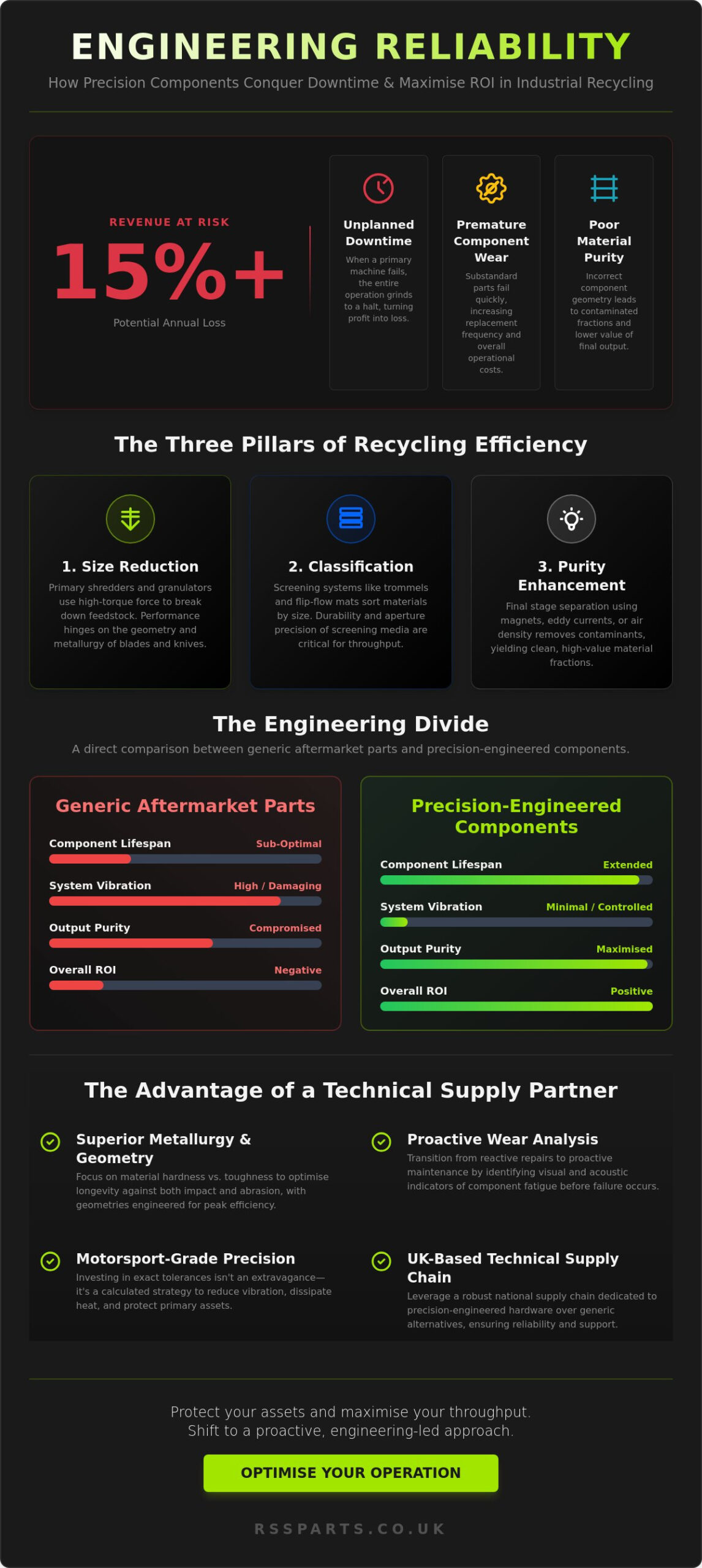
Most industrial recycling facilities lose over 15% of their potential annual revenue to the compounding costs of unplanned downtime and sub-optimal material separation. You know that when a primary shredder or granulator fails, the impact ripples through the entire site, turning a profitable shift into a costly recovery operation. It’s frustrating to watch replacement consumables wear out prematurely, especially when rising costs fail to yield a measurable improvement in your bottom line. Reliability is engineered, not accidental. We understand that in a high-stakes processing environment, mechanical integrity isn’t just a preference; it’s a requirement for survival.
This technical guide demonstrates how precision-engineered wear parts and advanced material science can fundamentally optimise the performance of your recycling equipment. By focusing on component geometry and superior metallurgy, you can achieve extended service intervals and significantly cleaner material fractions. We will explore the engineering solutions that drive higher throughput and introduce you to a specialised UK-based partner dedicated to the technical refinement of industrial machinery components. Discover how a calibrated approach to part selection ensures your operation maintains peak efficiency without compromise.
Key Takeaways
- Understand how precision component geometry and material integrity define the efficiency of high-performance recycling equipment ecosystems.
- Analyse the engineering requirements of the three core pillars—size reduction, classification, and purity enhancement—to ensure maximum facility throughput.
- Evaluate the critical mechanical trade-offs between material hardness and toughness to optimise component longevity against impact and abrasion.
- Transition from reactive repairs to proactive wear analysis by identifying the specific visual and acoustic indicators of component fatigue in heavy machinery.
- Discover the operational advantages of a UK-based technical supply chain that prioritises precision-engineered hardware over generic aftermarket alternatives.
Defining Industrial Recycling Equipment: The Role of Precision Engineering
Modern recycling equipment functions as a highly integrated ecosystem of size reduction, screening, and separation technologies. It’s a high-stakes environment where mechanical integrity determines the thin line between operational profit and systemic loss. We approach these systems with a Master Technician mindset, which means prioritizing component geometry and material metallurgy over superficial marketing claims. Every millimetre of a blade profile or screen aperture affects the system’s kinetic efficiency and final output quality.
In the United Kingdom, facilities process over 222 million tonnes of waste annually. This high-volume throughput demands a robust, national technical supply chain. Reliable operations depend on the synergy between primary machinery and the high-grade wear parts that protect them. Performance and protection aren’t separate goals; they’re the combined result of using components engineered for specific tensile strengths and abrasive resistances.
The Evolution of Material Processing Systems
Material recovery has transitioned from basic waste handling to sophisticated, multi-stage recovery plants. Modern systems face three primary challenges: contamination, abrasive wear, and extreme throughput volumes. Engineers now focus on consumable lifecycle management to drive facility profitability. By analyzing wear patterns, operators can predict failure points before they trigger catastrophic downtime. Different Industrial Shredder Designs require specific torque configurations and blade tolerances to handle varying feedstock, from municipal solid waste to high-tensile scrap metals.
Why Component Quality Dictates Operational ROI
Cheap replacement parts carry hidden costs that often exceed the initial savings. Substandard components lead to increased downtime and secondary damage to expensive driveshafts and motors. We view shredder parts as the frontline of the entire recycling equipment system. Precision fitment is vital. It reduces parasitic vibration and heat buildup, which directly extends the service life of bearings and hydraulic drives.
- Vibration Control: Precision-machined parts maintain the balance of rotating assemblies, preventing bearing fatigue.
- Heat Dissipation: High-quality alloys resist thermal expansion, maintaining tight tolerances during 24/7 operations.
- Structural Integrity: Proper metallurgy ensures parts don’t shatter when encountering non-shreddable contaminants.
When components are engineered to exact tolerances, the result is a balanced system. This technical precision ensures that a £500,000 installation isn’t compromised by a poorly machined wear plate or a low-grade fastener. Investing in motorsport-grade precision for industrial applications isn’t an extravagance; it’s a calculated strategy to maximize uptime and protect the primary asset.
Core Systems: Screening, Shredding, and Material Separation
High-performance recycling equipment depends on the precise synergy between size reduction, classification, and purity enhancement. Each stage requires specific mechanical calibrations to handle the abrasive nature of modern waste streams. Processing Construction and Demolition (C&D) waste demands high-impact resistance, while organic streams require anti-blinding properties to prevent system downtime. Engineers must prioritize component longevity to maintain a seamless production line and avoid the high costs of unscheduled maintenance. High-volume screening operations rely heavily on the durability and material selection of trommel plates to sustain throughput under heavy loads.
Classification and Sizing Media
Selecting the correct media is a matter of balancing durability with open area. Punch plates offer the structural rigidity needed for heavy C&D and primary screening, whereas woven wire mesh provides a higher open area for finer Commercial and Industrial (C&I) materials. Flip-flow mats utilize high-frequency vibration to process wet, sticky organics that would otherwise blind standard fixed screens. Hole geometry dictates the quality of the output; round holes prevent elongated “spears” from passing through, while square or hexagonal patterns maximize volume. Trommel plate aperture is the critical factor in sizing accuracy.
Size Reduction: Shredding and Crushing
Primary processing involves aggressive size reduction to prepare material for downstream sorting. Industrial shredders utilize high-tensile shredder blades to shear through diverse materials ranging from plastics to reinforced tyres. Maintaining blade sharpness is not just about throughput; it’s a matter of energy efficiency. A dull tooth geometry can increase power consumption by 25% due to increased frictional resistance and torque requirements. For secondary processing, crusher wear parts must be engineered from specialized manganese or chrome alloys to withstand extreme compression without fracturing. This technical precision ensures the material is sized correctly for high-speed separation.
Advanced Separation and Conveying
Purity is achieved through integrated separation systems that remove contaminants before they reach the final output. Magnetic separators extract ferrous metals, protecting downstream machinery from potential damage and increasing the value of the recycled product. Effective conveyor system components, such as precision-engineered scrapers and rollers, prevent material carryback and belt misalignment. These elements must work in unison to maintain a continuous, predictable flow. Expert Waste Processing Equipment Design ensures that every component, from the initial shredder to the final discharge conveyor, is calibrated for maximum uptime. Operators looking to refine their facility’s mechanical integrity should source precision-engineered components to ensure long-term reliability in harsh environments.
Material Science: Optimising Equipment Performance and Protection
Engineering high-performance recycling equipment requires an uncompromising approach to material selection. It’s a discipline where chemical composition and physical resilience must be perfectly balanced to survive the brutal conditions of a processing facility. We apply motorsport-grade precision to the manufacturing of industrial parts, ensuring that every component is calibrated for its specific mechanical environment. This level of engineering prevents the common pitfalls of component failure that plague less sophisticated operations.
The primary challenge lies in the trade-off between hardness and toughness. Hardness, often measured on the Brinell scale, provides the abrasion resistance needed to combat sliding wear. However, as hardness increases, material ductility typically decreases. If a material is too brittle, it cannot absorb the energy of heavy impacts, leading to premature cracking and catastrophic failure. Conversely, selecting a material with insufficient hardness results in rapid thinning, which can reduce the service life of a wear liner by more than 40% in abrasive environments. Our goal is to engineer a solution that offers both performance and protection.
Polyurethane vs. Rubber vs. Steel Screening Mats
Selecting the right screening media is vital for operational efficiency and noise management. Polyurethane and rubber offer superior damping properties compared to traditional steel. In many UK processing plants, transitioning to polyurethane mats reduces ambient noise levels by 8 to 12 dB, creating a safer working environment. For wet or sticky applications, the inherent flexibility of polyurethane provides essential self-cleaning properties that prevent aperture blinding. While these polymers excel in fine-to-medium screening, high-manganese steel remains the superior choice for heavy-duty aggregate scalping where the material size exceeds 80mm and impact forces are extreme.
Manganese Steel and Wear Plate Durability
Manganese steel, often referred to as Hadfield steel, is the industry standard for crusher liners and impactor bars due to its unique work-hardening characteristics. Under constant impact, the surface of the steel hardens significantly, often reaching over 500 HB, while the internal core retains its toughness to prevent fracturing. For high-impact zones within recycling equipment, we utilise Hardox-type wear plates that provide a consistent, through-hardened profile. High tensile strength ensures shredder blades maintain structural integrity under torque loads exceeding 150,000 Nm, preventing catastrophic failure during the processing of reinforced contaminants. This meticulous material selection ensures that your machinery remains operational during the most demanding duty cycles.
Maintenance Strategies for High-Volume Recycling Facilities
High-volume processing plants don’t have the luxury of unplanned downtime. Shifting from reactive repair to proactive wear analysis is essential for maintaining the mechanical integrity of recycling equipment. Monitoring visual and acoustic indicators, such as a sharp change in decibel levels or irregular harmonic resonance, allows technicians to intervene before a catastrophic failure occurs. A thorough technical audit of your quarry parts supplier uk ensures that the metallurgy matches the specific demands of your material stream. Reliability stems from consistency in tensile strength and hardness ratings across every component batch delivered to the site.
Identifying Wear Patterns Before Failure
Uneven wear on shredder blades or crusher liners usually indicates a calibration issue or an off-centre feed. If one side of a liner shows 25% more thinning than the other, the machine’s geometry is likely compromised. In impactor blow bars, “mushrooming” or peening suggests the material’s ductility is too high for the kinetic energy of the feed; this requires a shift to a higher Brinell hardness alloy. Technicians must also monitor screening mats with precision. An aperture increase of just 2.5mm can lead to a 14% rise in material contamination, which directly impacts the market value of the processed recyclate.
Lifecycle Management of Consumables
Optimising recycling equipment requires a strict rotation schedule for reversible wear parts. Flipping a blow bar at the 50% wear mark can extend its total service life by approximately 80%. High-grade conveyor scrapers are equally critical. Using tungsten carbide blades prevents material carryback, a common issue that causes premature belt wear and pulley failure. When storing heavy-duty components in the UK’s damp climate, apply VCI (Volatile Corrosion Inhibitor) coatings. This prevents surface oxidation on precision-machined surfaces, ensuring they maintain the required tolerances for a perfect fit during installation.
Engineering Reliability: The RSS Parts Approach to Technical Supply
RSS Parts operates at the intersection of high-end mechanical engineering and industrial utility. We don’t view recycling equipment as a collection of isolated machines; it’s a complex mechanical ecosystem that requires precise calibration. Our approach prioritises the integrity of the entire processing line. Generic hardware often fails because it lacks the tensile strength or exact geometry required for 24/7 operations. By maintaining a robust national supply chain, we ensure that UK facilities access components designed for high-stress environments. We apply the same meticulous standards used in Porsche-level motorsport tuning to industrial hardware. This ensures every plate, bearing, and belt exceeds standard expectations for durability and mechanical efficiency.
Specialist Components for the UK Recycling Sector
Our inventory covers the full spectrum of processing needs across the United Kingdom. From heavy-duty trommel plates to high-gradient magnetic separators, every component in our warehouse meets or exceeds OEM specifications for fitment and metallurgy. We don’t just supply parts; we supply mechanical security. Facilities across the country rely on our ability to deliver critical wear parts within 24 to 48 hours. This responsiveness keeps processing lines moving and prevents the cascading costs of unplanned downtime. We focus on motorsport-grade materials that resist abrasive wear and thermal fatigue better than standard aftermarket options. Our commitment to fitment accuracy means your technicians spend less time on installation and more time on facility optimisation.
Enhancing Facility ROI Through Precision Parts
Choosing the right component is a financial decision as much as a mechanical one. High-performance hardware reduces the total cost of ownership (TCO) by extending service intervals and preventing catastrophic system failures. We provide engineering wisdom that transforms a simple parts replacement into a genuine performance upgrade. Our team analyses the specific stresses of your application to recommend the optimal material and fitment for your recycling equipment. This philosophy of performance and protection ensures your machinery operates at peak efficiency while safeguarding your capital investment. Our technical team brings decades of experience in mechanical calibration to every consultation. We help you move beyond the limitations of a standard parts catalogue to achieve elite operational standards. Consult with our technical team for your next component upgrade.
Optimising Operational Integrity through Engineering Excellence
Maintaining a competitive edge in high-volume processing requires a shift from reactive repairs to precision-led component engineering. We’ve established that material science and exact mechanical geometry dictate the functional lifespan of shredding and screening systems. Facilities can’t afford the hidden costs of substandard parts that fail under extreme tensile stress or abrasive wear. Every individual component in your recycling equipment setup must be treated as a critical factor in your facility’s overall performance and protection.
RSS Parts has operated as a specialist UK supplier since 2004, focusing on delivering engineering-grade precision to the industrial sector. Our components are engineered to withstand the most demanding material separation cycles, ensuring your machinery operates with calibrated accuracy. With national delivery available on all critical wear parts, we help you eliminate the risk of unplanned downtime. It’s a methodical approach to supply that prioritises substance and mechanical integrity over generic alternatives.
Explore our range of high-performance recycling equipment components
Trust in the technical mastery that keeps your operations moving forward.
Frequently Asked Questions
What are the most common wear parts in recycling equipment?
Shredder blades, crusher liners, and screening media represent approximately 70% of maintenance costs in heavy-duty recycling equipment. These components endure constant abrasive force and high-impact stress during material processing. We engineer these parts using chromium-carbide overlays or heat-treated alloys to extend their service life beyond standard OEM specifications. Regular inspection of these high-stress zones prevents catastrophic failure and maintains the mechanical integrity of the entire system.
How do I choose between polyurethane and rubber screening mats?
Polyurethane mats offer superior abrasion resistance for wet applications, while rubber mats provide 15% better noise reduction and higher impact absorption for heavy aggregates. You should select polyurethane for fine screening where precision geometry is critical to prevent blinding. Rubber is the engineering choice for primary scalping where material sizes exceed 150mm. Our technical team evaluates your specific throughput requirements to calibrate the optimal material hardness for your plant.
What is the benefit of using high-manganese steel in crushers?
High-manganese steel provides a unique work-hardening capability that increases its surface hardness from 200 HB to over 500 HB under constant impact. This metallurgical property makes it the industry standard for jaw and cone crushers handling abrasive materials. It ensures the component maintains its structural profile while the outer layer becomes increasingly resistant to wear. This results in a 25% increase in component longevity compared to standard carbon steel alternatives.
How often should industrial shredder blades be replaced?
Industrial shredder blades typically require replacement or refurbishment every 500 to 2,000 operating hours depending on the processed material. Harder materials like scrap metal accelerate wear, reducing the blade’s cutting efficiency by up to 30% before a change is required. We recommend monitoring the gap between blades; once it exceeds 2mm, energy draw increases. Precision-ground blades ensure clean shears and reduce the strain on the drive motor.
Can high-quality wear parts reduce energy consumption in a recycling plant?
High-quality wear parts reduce energy consumption by up to 12% by maintaining the original geometry of the cutting and crushing surfaces. When components lose their edge, the motor must work harder to process the same volume of material. Optimised parts reduce internal friction and heat generation within the system. This mechanical efficiency lowers your electricity costs and protects the drivetrain from unnecessary torque spikes during peak operation.
What causes uneven wear on trommel plates and screening media?
Uneven wear is usually caused by a 5% to 10% deviation in feed distribution or incorrect drum inclination. If material isn’t distributed across the full width of the trommel, localized erosion occurs on specific plates. Misaligned support rollers also contribute to vibration patterns that accelerate fatigue. We solve this by refining the feed geometry and ensuring that every screening panel is calibrated to the specific centrifugal forces of your machinery.
Are replacement recycling parts compatible with all major machinery brands?
Precision-engineered replacement parts are compatible with all major machinery brands when manufactured to exact ISO 9001 tolerances. We focus on reverse-engineering OEM components to improve upon original weaknesses, ensuring 100% fitment accuracy for brands like Terex, Metso, and Sandvik. These parts meet or exceed the technical specifications required for high-performance recycling equipment. Our focus on precision machining ensures that installation is seamless and requires zero onsite modification.
How does a magnetic separator improve the quality of recycled material?
A magnetic separator removes 99% of ferrous contaminants from the waste stream to protect downstream equipment and increase product purity. By extracting steel and iron before they reach secondary shredders, you prevent damage to expensive non-ferrous separators and granulators. This process increases the market value of your recycled glass, plastic, or wood. It’s a critical protection layer that maintains the mechanical health of your entire processing line.
about
avada factory
Sempery ultricies nibh at dolor cras urna eleifend nec. Atiam efficitur tempor.


