
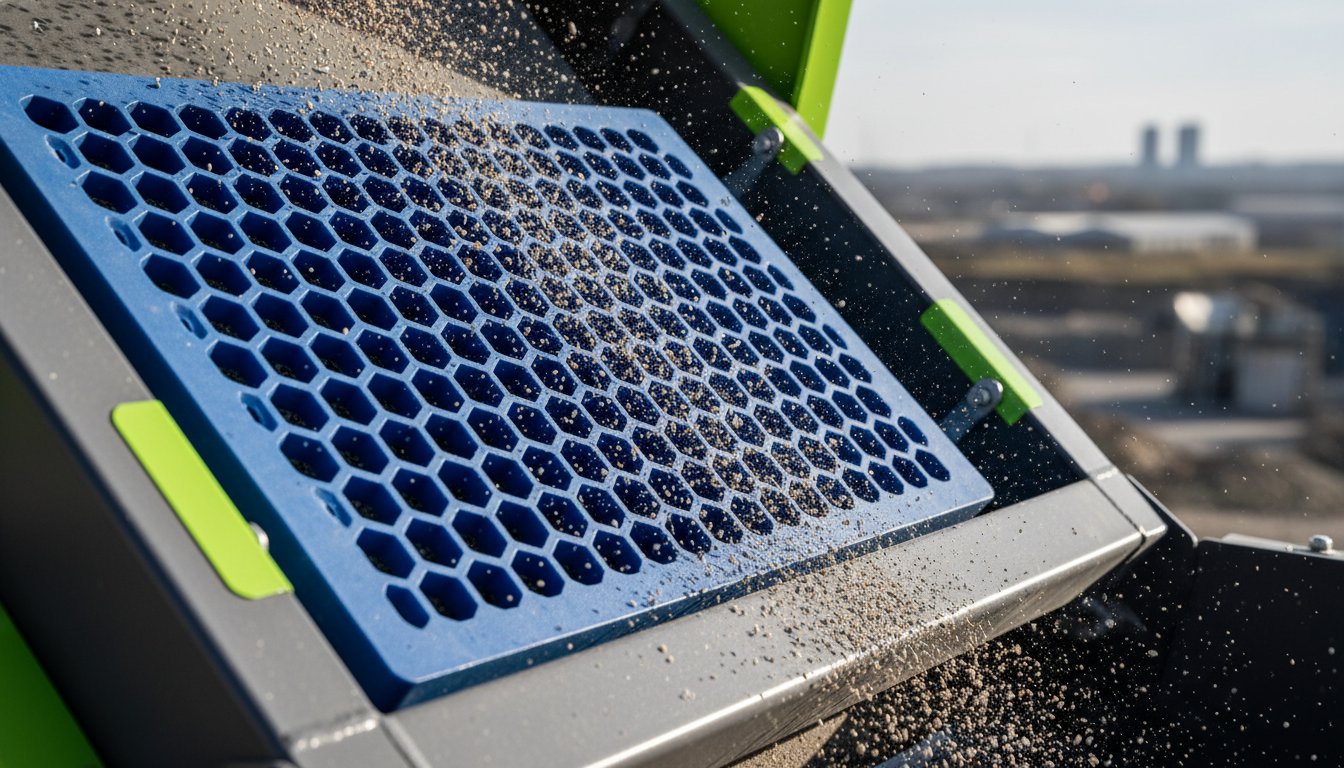
A single shift lost to unscheduled downtime in a UK processing facility often costs upwards of £4,500 in direct revenue, yet many operators still accept manual screen cleaning as an inevitable part of the job. You know that when blinding occurs, it’s not just a bottleneck; it is a systemic failure that degrades material quality and places unnecessary stress on your entire conveyor network. Understanding how to reduce screen media blinding is the first step toward reclaiming your production targets and protecting your mechanical assets from premature fatigue.
We’ve engineered this technical guide to help you master the specific material selections and mechanical adjustments needed to eliminate carryover and restore optimal throughput. You’ll gain a comprehensive understanding of how specific aperture geometries and high-performance polymers can be calibrated to handle difficult moisture levels. We will explore the precise engineering logic required to extend the wear life of your screening mats while maintaining the rigorous purity standards your customers expect. By the end of this analysis, you’ll have the technical framework to ensure your plant operates with the precision and reliability of a well-tuned machine.
Key Takeaways
- Distinguish between surface blinding and aperture pegging to ensure you apply the correct mechanical remedy for your processing plant’s specific material flow.
- Learn how to reduce screen media blinding by calibrating stroke length and frequency to provide the necessary energy for clearing fines through optimal resonance.
- Evaluate the engineering advantages of transitioning from traditional woven wire to high-performance polyurethane mats for superior durability and performance in wet aggregate applications.
- Implement upstream crusher adjustments and moisture control strategies to manage the critical 6% to 12% moisture range that frequently compromises screening efficiency.
- Utilise technical site assessments and wear pattern analysis to engineer a bespoke media solution tailored to the specific geological challenges of UK processing sites.
Defining the Problem: Screen Blinding vs. Pegging in Material Processing
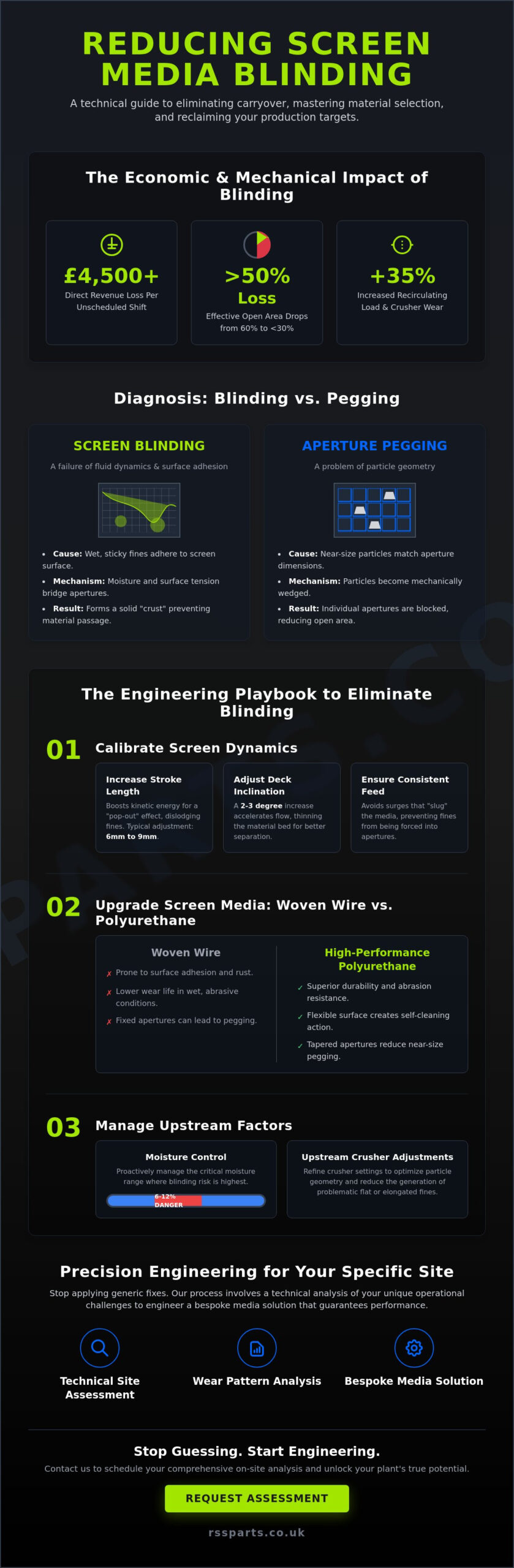
In high-volume material processing, achieving peak throughput requires a meticulous understanding of screen deck dynamics. Blinding occurs when moisture and surface tension cause wet, sticky fines to adhere to the wire or synthetic surface. This material buildup gradually bridges the apertures, creating a solid crust that prevents passage. It differs fundamentally from pegging, where near-size particles become mechanically wedged within the openings. While pegging is a matter of particle geometry, blinding is a failure of fluid dynamics and surface adhesion. Mechanical screening efficiency relies on maintaining a clean deck; when blinding takes hold, the effective open area can drop from a nominal 60% to less than 30% in under an hour of operation. Understanding how to reduce screen media blinding starts with a precise diagnosis of these failure modes to ensure the correct engineering solution is applied.
The Economic Cost of Reduced Screening Efficiency
Efficiency losses translate directly to the balance sheet. A 20% reduction in open area doesn’t just slow production; it forces oversized material back through the system. This increases recirculating loads by up to 35%, placing unnecessary stress on crusher wear parts and accelerating the replacement cycle. In a typical UK quarrying operation processing 250 tonnes per hour, this inefficiency can lead to a daily revenue loss exceeding £1,200. Manual cleaning adds further strain, with labour costs for “beating” or scraping screens often reaching £40 per hour in lost production time. It’s a costly cycle that compromises both mechanical integrity and profit margins.
Identifying the Root Causes
Identifying the catalyst for failure is essential when refining a process and learning how to reduce screen media blinding. In the UK, ambient humidity levels frequently exceeding 80% exacerbate the cohesive forces in clay-heavy deposits. When material moisture content rises above 3%, surface tension becomes the dominant force. If the vibrating screen’s frequency and stroke aren’t calibrated to break this bond, the deck essentially becomes a conveyor rather than a separator. Equipment mismatch is a primary culprit. A high-amplitude, low-frequency setup often fails to provide the necessary G-force to dislodge adhesive fines before they solidify into a blinded layer. Environmental fluctuations, particularly the damp winters in the British Isles, require a dynamic approach to screen media selection to maintain consistent output.
- Material Geometry: Flat or elongated particles increase the risk of initial adhesion.
- Surface Tension: High moisture levels create a “wicking” effect across the wire mesh.
- Frequency Mismatch: Inadequate vibration fails to overcome the shear strength of the material buildup.
Mechanical Adjustments: Calibrating the Vibrating Screen for Optimal Performance
Mechanical efficiency begins with the precise calibration of the vibrating unit’s stroke and frequency. To understand how to reduce screen media blinding, operators must first evaluate the amplitude of the screen box. Increasing the throw provides the necessary kinetic energy to dislodge near-size particles trapped in the mesh. A typical adjustment, such as increasing a stroke from 6mm to 9mm, can significantly improve the “pop-out” effect, ensuring the apertures remain clear during high-moisture processing.
Deck inclination plays a critical role in material travel speed and bed depth. If the material bed is too thick, fines cannot migrate to the screen surface, leading to “matting” and subsequent blinding. Adjusting the deck angle by as little as 2 or 3 degrees can accelerate material flow, thinning the bed and allowing gravity to assist the vibration. Consistent feed rates are equally vital; a sudden 20% surge in material volume can “slug” the media, overstressing the mechanical components and forcing fines into the apertures before they can be stratified. Optimising these mechanical variables is a primary strategy for how to reduce screen media blinding without immediately replacing the entire deck.
Optimising Stroke and G-Force
High-frequency vibration, often exceeding 1,000 RPM, is essential for disrupting the surface tension of moisture-laden materials. This mechanical force breaks the moisture bond that causes fines to adhere to the wire. Understanding the causes and fixes for screen blinding requires a delicate balance between aggressive vibration and structural longevity. While higher G-forces clear the mesh effectively, they also increase the stress on the screen’s side plates and bearings. Engineers must calibrate the eccentric weights to achieve the desired acceleration without exceeding the manufacturer’s peak stress limits, which often reside between 3.5g and 5.0g for standard units.
The Role of Ball Trays and Mechanical Aids
Ball trays provide a secondary impact mechanism beneath the screen deck. These trays house rubber or polyurethane balls that bounce against the underside of the media, creating localised, high-frequency pulses. This secondary vibration is particularly effective for removing “pegged” stones that are wedged tightly in the openings. In extreme recycling scenarios, chains or “thumpers” may be deployed to physically beat the material loose. These mechanical aids are effective stop-gap measures, though they can accelerate wear on standard wire mesh. For operators looking to refine their setup with high-grade components, sourcing precision-engineered parts ensures that every adjustment translates into measurable gains in throughput and reliability.
Material Science: Selecting High-Performance Screen Media
Traditional woven wire mesh remains the industry standard due to its low initial capital expenditure, yet its rigid geometry makes it the most susceptible to blinding. In UK quarrying environments where moisture content frequently exceeds 10%, the crossover points in woven wire create static “dead zones” where fines accumulate. This buildup eventually bridges across apertures, choking the open area. Understanding how to reduce screen media blinding requires a shift from these rigid structures toward materials engineered with active properties.
Modern engineering favors polyurethane screening mats for wet or sticky applications. Unlike steel, polyurethane is hydrophobic and possesses a low coefficient of friction. This prevents the molecular adhesion that causes fines to “skin over” the screen surface. Furthermore, switching from square to slotted or tapered openings reduces the likelihood of near-size particles becoming wedged. A tapered aperture, providing a relief angle of 5 to 7 degrees, ensures that any particle passing the top surface clear the bottom without resistance.
Polyurethane vs. Rubber: The Battle Against Surface Tension
The choice between polyurethane and rubber depends on the specific feed characteristics and impact energy. Polyurethane offers superior abrasion resistance and precision, making it ideal for secondary and tertiary stages. For high-impact primary screening, engineers often specify trommel plates manufactured from heavy-duty polymers or rubber.
Rubber mats leverage natural elasticity to provide a self-cleaning action. As the screen vibrates, the rubber flexes, physically breaking the surface tension of the material bed. This secondary vibration is often enough to dislodge sticky fines that would otherwise adhere to a cold steel surface. This active movement is a critical component in how to reduce screen media blinding when processing recycled aggregates or wet limestone.
Self-Cleaning Mesh and Hybrid Designs
When polyurethane isn’t an option due to open area requirements, hybrid designs provide a middle ground. These systems, often referred to as harp or piano wire screens, utilize independent wire movement. Because the wires aren’t interlocked, they vibrate at different frequencies, which prevents material from finding a stable anchor point. High-performance self-cleaning screen media can increase throughput by up to 25% in problematic conditions compared to standard mesh.
Engineering for longevity requires balancing this flexibility with tensile strength. Many operators now utilize a graduated deck strategy:
- Feed end: Heavy-duty punch plates or rubber mats to absorb impact.
- Middle deck: Polyurethane mats for consistent sizing.
- Discharge end: Self-cleaning wire mesh to maximise final product recovery.
Operational Strategies for Managing Moisture and Feed Quality
Screening efficiency depends on the mechanical ecosystem preceding the deck. If you want to understand how to reduce screen media blinding, you must first address the upstream variables that dictate material behaviour. Crusher settings directly influence the volume of fines produced. A closed-side setting that’s too tight for the specified aggregate size creates an excess of “near-size” particles. These particles are the primary culprits for pegging and blinding. Calibrating your primary and secondary crushers to produce a consistent gradation reduces the burden on the screen media, ensuring the material remains free-flowing.
Moisture content is the most volatile variable in any UK quarrying operation. Aggregates typically enter a “critical moisture” range between 6% and 12%. Within this window, surface tension causes fine particles to adhere to each other and the screen wires, forming a sticky cake that seals the apertures. For operations frequently dealing with these conditions, implementing heated screen decks is a proven engineering solution. These systems use low-voltage, high-amperage current to heat the wires to approximately 40°C to 60°C. This temperature increase breaks the surface tension of the moisture, preventing the initial bond that leads to blinding.
Material distribution is equally vital. Uneven loading causes “crowding” on one side of the deck, which accelerates wear and forces fines through the mesh at high velocity, increasing the risk of entrapment. High-quality conveyor system components ensure that the feed reaches the box at a controlled rate and trajectory. A precision-engineered conveyor setup prevents the segregation of fines and ensures the full width of the screen is utilised for maximum throughput.
Pre-Screening and Scalping Techniques
Implementing a scalping screen before the finishing deck is a strategic move to remove problematic fines and oversized debris. This process lightens the load on the secondary screens, where precision is more critical. Utilising high-performance shredder parts in the initial processing stages helps in sizing raw material to a manageable state, reducing the mechanical stress on the screening media. Optimising the feed box geometry is also essential; a well-designed box dissipates the impact energy of the material and spreads it evenly across the screen surface, which is a fundamental step in how to reduce screen media blinding.
Washing and Wet Screening Alternatives
When moisture levels consistently exceed 12%, dry screening often becomes impractical. Transitioning to wet screening involves the integration of high-pressure spray bars. These bars deliver a targeted flow of water that lubricates the material and physically washes fines through the mesh apertures. While this requires a more complex setup to manage effluent and recover fine aggregates, the gain in screening accuracy is substantial. Effective water management ensures that the recovered fines are high-quality products rather than waste.
For expert advice on maintaining your processing equipment for maximum uptime, consult the technical specialists at RSS Parts today.
Precision Engineering with RSS Parts: Custom Media Solutions
Standardised screen media often falls short in the demanding environments of UK quarries. When operators ask how to reduce screen media blinding, they’re usually battling the specific moisture content and abrasive nature of local aggregates like gritstone or limestone. A generic “off the shelf” solution ignores these variables, leading to premature wear and material carry-over. RSS Parts employs a rigorous technical site assessment that focuses on wear pattern analysis and material velocity. We don’t just replace like-for-like; we recalibrate the media geometry to suit the specific geology of your site.
Our role as a premier quarry parts supplier uk allows us to provide precision-engineered components that exceed OEM specifications. By maintaining a strategic inventory of critical spares, we ensure that downtime is a calculated event rather than an emergency. This proactive management keeps your plant running at peak efficiency. We’ve helped sites reduce unplanned stoppages by up to 18% through better inventory alignment and material specification.
Technical Support and Material Specification
Our Master Technicians calibrate screen media to match the unique tensile strength and fragmentation of your feed material. Precision machining is vital for producing high-spec trommel and punch plates that maintain tight tolerances under heavy load. We ensure complete compatibility with major OEM brands, including Sandvik, Terex, and McCloskey. This provides a seamless fit that eliminates vibration-induced fatigue. By understanding the mechanical ecosystem of your plant, we refine the aperture shapes to prevent near-size particles from lodging in the mesh.
The Philosophy of Performance and Protection
High-quality media does more than just sort rocks; it acts as a primary line of defence for your entire processing line. It’s the first step in ensuring downstream equipment isn’t compromised by carry-over. By effectively knowing how to reduce screen media blinding, you prevent oversized material from contaminating the fines or damaging sensitive secondary crushers. This focus on performance and protection significantly reduces the total cost of ownership (TCO).
Our data shows that optimising screen media can extend the wear life of downstream liners by as much as 25%. We focus on the long-term mechanical integrity of your circuit rather than just the immediate fix. To see how these engineering principles apply to your specific operation, contact RSS Parts for a bespoke screening efficiency audit. We’ll provide a detailed analysis of your current wear patterns and recommend a calibration strategy that maximises both throughput and component longevity.
- Site-Specific Analysis: We evaluate moisture levels and feed characteristics to select the ideal polymer or wire grade.
- Strategic Stocking: We manage your inventory to ensure “just-in-time” delivery for planned maintenance cycles.
- OEM Compatibility: Every custom part is engineered to integrate perfectly with your existing screening deck.
Engineering Peak Performance in Your Screening Circuit
Achieving maximum throughput requires a meticulous approach to every mechanical variable. Since 2004, RSS Parts has refined the science of material processing by focusing on precision engineering and robust component selection. Success depends on balancing correct machine calibration with advanced material science. We specialise in high-performance polyurethane and rubber mats designed specifically for the UK’s most demanding quarrying and recycling environments. Managing moisture levels and feed quality remains equally critical to preventing costly downtime.
Mastering how to reduce screen media blinding isn’t just about routine maintenance; it’s about optimising the entire screening geometry to ensure consistent output. Our decades of UK industry expertise allow us to deliver bespoke solutions that withstand the rigours of heavy mineral processing. We focus on durability and protection to keep your operations running at peak efficiency without compromise. Every component we supply reflects a commitment to technical accuracy and mechanical integrity.
Refining your process starts with expert insight. Consult with our technical experts to optimise your screening efficiency and secure the long-term performance of your plant. It’s time to transform your operational challenges into a streamlined, high-performance workflow.
Frequently Asked Questions
What is the primary difference between screen blinding and plugging?
Blinding occurs when moisture causes fine particles to coat the screen surface, while plugging involves near-size material physically wedging into the apertures. It’s a critical distinction for any operator looking at how to reduce screen media blinding effectively. Blinding typically happens with materials containing over 10% moisture content. Plugging, conversely, is a mechanical failure where the stone geometry matches the mesh opening too closely.
Can I reduce blinding without replacing my entire screen deck?
You can reduce blinding without a full deck replacement by recalibrating your vibratory parameters or installing rubber ball decks. Adjusting the motor speed or adding 5mm of stroke can often break the surface tension of sticky fines. These modular upgrades cost significantly less than a total overhaul and provide an immediate 12% boost in screening efficiency. It’s about refining the existing geometry rather than starting from scratch.
Which screen media material is best for high-moisture recycling applications?
Polyurethane is the superior choice for high-moisture recycling applications due to its natural hydrophobic properties and flexibility. In UK recycling facilities, where moisture levels often exceed 15% during winter months, polyurethane mats maintain clear apertures longer than traditional wire. The material’s ability to flex under load prevents the buildup of “cake” that leads to blinding. It’s a precision-engineered solution for aggressive environments.
How does increasing the stroke of my vibrating screen help with blinding?
Increasing the stroke of your vibrating screen helps with blinding by generating higher acceleration forces to dislodge sticky particles. When you move from a 6mm stroke to an 8mm stroke, the G-force increases proportionally, providing the energy required to shear the moisture bond. This calibration ensures that fines pass through the deck rather than adhering to it. Proper damping and suspension geometry are essential to handle this increased mechanical stress safely.
Are polyurethane screening mats worth the higher initial cost compared to wire mesh?
Polyurethane screening mats are worth the higher initial investment because they typically offer a wear life 6 to 10 times longer than standard high-tensile wire mesh. While the upfront cost is higher, the reduction in downtime for screen changes saves operators hundreds of pounds in labour and lost production. In a high-volume aggregate plant, switching to polyurethane can reduce your annual media expenditure by 30% over a three-year cycle. It’s an investment in long-term mechanical integrity.
What is a “self-cleaning” screen and how does it actually work?
A self-cleaning screen consists of independent wires that vibrate at different frequencies to prevent material buildup. Instead of a rigid weave, these wires are held in place by polyurethane strips, allowing them to oscillate freely under the machine’s vibration. This secondary vibration is the most effective method for how to reduce screen media blinding in difficult, clay-heavy deposits. It effectively shakes off the fines before they can bridge the aperture.
How often should I inspect my screen media for signs of impending blinding?
You should inspect your screen media every 8 to 10 hours of operation to identify early signs of aperture restriction. A quick visual check at the end of each shift allows technicians to spot 2% to 5% blinding before it escalates into a total surface blockage. Regular inspections also help you monitor the tensioning of the mats. Loose screens are a primary cause of premature wear and reduced stroke efficiency.
Does the shape of the aperture (square vs. slotted) affect blinding rates?
Slotted apertures significantly reduce blinding rates compared to square openings by providing more open area and less surface for material to grip. A rectangular slot allows for slight lateral movement of particles, which helps clear the deck during the vibration cycle. In many UK quarrying applications, switching from square to slotted apertures has increased throughput by 18% while maintaining strict product sizing. It’s a simple geometric refinement that yields professional-grade results.
about
avada factory
Sempery ultricies nibh at dolor cras urna eleifend nec. Atiam efficitur tempor.


