
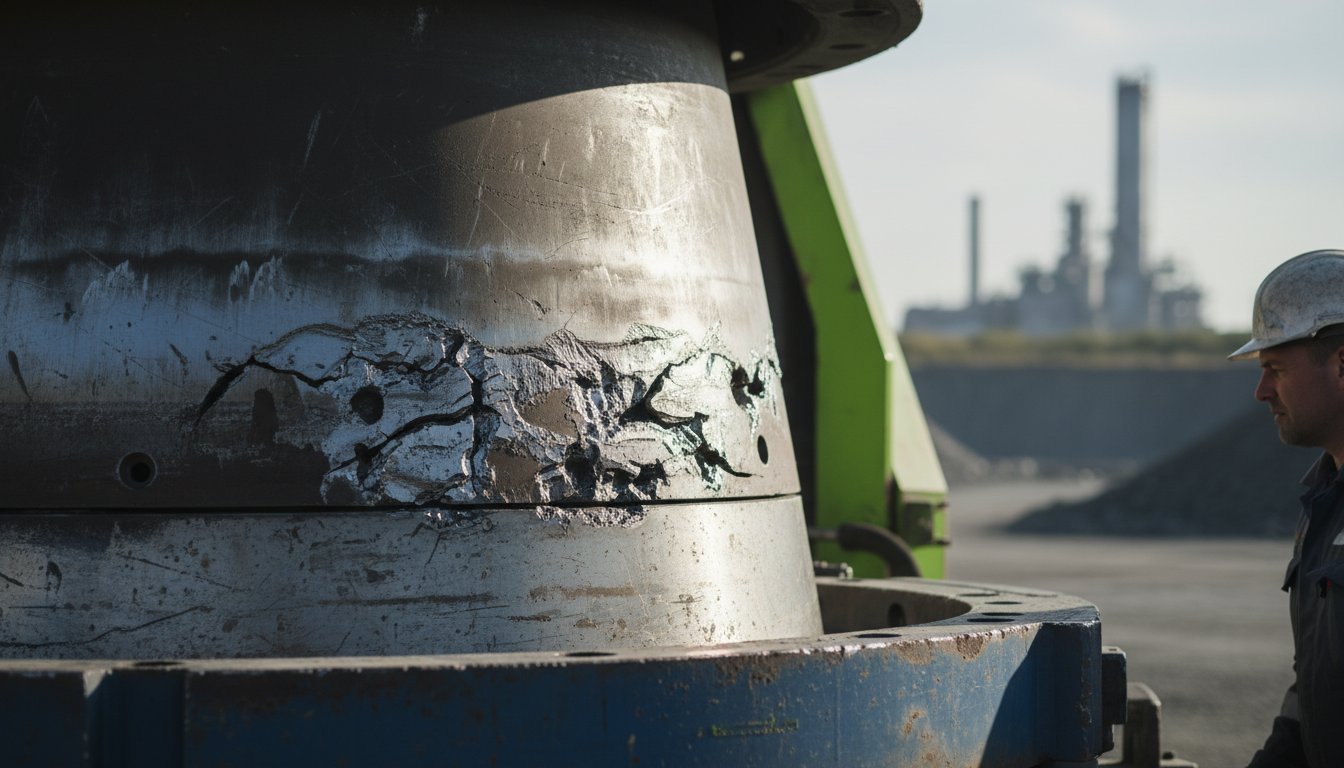
Research from the Mineral Products Association indicates that maintenance and energy costs can account for over 40% of total quarrying expenditure, with unplanned downtime often being the primary driver of budget overruns. You’re likely aware that while friction is a constant, replacing manganese components before they’ve reached their engineered service life indicates a failure in the mechanical ecosystem. Identifying the root causes of premature crusher liner wear is essential for any plant manager aiming to protect their margins and maintain consistent throughput. When liners degrade unevenly, it doesn’t just increase your expenditure on parts; it compromises your final product gradation and forces your primary equipment to work harder for diminishing returns.
This technical analysis identifies the hidden mechanical and operational factors that accelerate degradation, allowing you to optimise your plant’s uptime and performance. We’ll examine how feed distribution, moisture levels, and chamber geometry influence the rate of attrition. By the end of this guide, you’ll have a clear strategy to extend the interval between liner changes and reduce your total cost per tonne processed. It’s time to move beyond reactive maintenance and engineer a more resilient crushing circuit through precise calibration and informed material selection.
Key Takeaways
- Distinguish between standard abrasive consumption and catastrophic failure by understanding the work-hardening mechanics of high-manganese steel alloys.
- Evaluate how ‘dirty feed’ and material segregation act as abrasive agents, leading to eccentric wear patterns that compromise component integrity.
- Calibrate your mechanical settings to eliminate the primary causes of premature crusher liner wear, focusing on profile selection and Closed Side Setting (CSS) accuracy.
- Mitigate the threat of uncrushable contaminants and environmental stressors that lead to immediate, non-abrasive failure in high-performance alloys.
- Optimise plant uptime by transitioning to a data-driven maintenance programme that prioritises precision backing material for a secure, vibration-free fitment.
Defining Premature Wear vs. Normal Consumption
In heavy-duty quarrying, distinguishing between the standard consumption of sacrificial parts and the specific causes of premature crusher liner wear is critical for operational uptime. Every Crusher relies on the predictable erosion of its internal components to process aggregate. Normal wear is characterized by a steady, uniform reduction in thickness across the liner face. Conversely, premature wear manifests as accelerated thinning or catastrophic failure before the component reaches its engineered tonnage threshold.
Establishing a baseline for wear-life requires a precise analysis of the material’s Abrasion Index (Ai). For instance, processing a highly abrasive granite with an Ai of 0.60 will naturally result in a shorter lifecycle than limestone with an Ai of 0.05. Operators must calculate their expected wear-life by correlating the manganese grade against the feed material’s compressive strength and silica content. Failure to match the metallurgy to the application is one of the primary causes of premature crusher liner wear.
The Metallurgy of Manganese
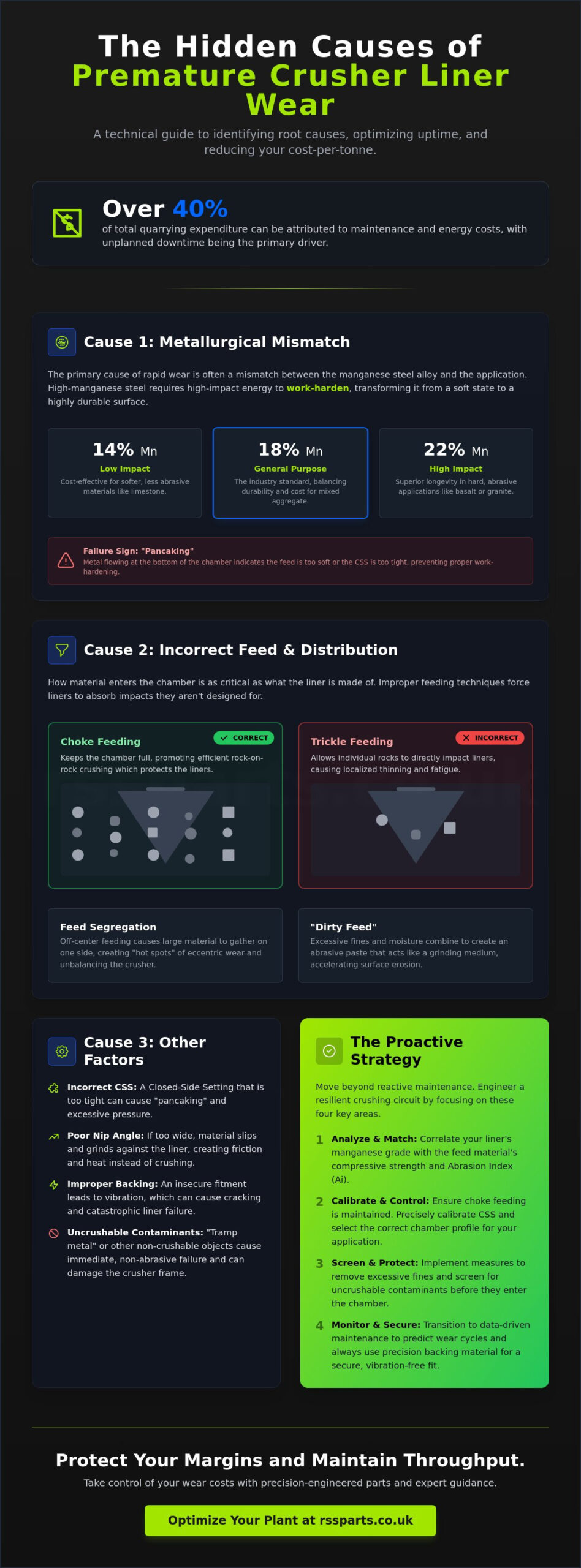
Manganese steel, often referred to as Hadfield steel, is the industry standard due to its unique ability to harden under pressure. Maximum wear resistance is only achieved when the liner reaches its peak Brinell hardness through consistent, high-impact energy. Work hardening is the metallurgical transformation of austenitic steel under compressive stress. If the application involves low-impact or soft feed, the liner remains in its relatively soft state, leading to rapid degradation rather than the intended durability. Choosing between 14%, 18%, or 22% manganese content depends on the impact levels. A 22% manganese liner provides superior longevity in high-impact basalt crushing, whereas a 14% liner is more cost-effective for softer, less abrasive materials.
Signs of Accelerated Degradation
Identifying the early indicators of failure prevents secondary damage to the crusher’s structural integrity. One common sign is ‘pancaking,’ where the metal flows at the bottom of the crushing chamber, indicating that the material is too soft for the impact forces or that the closed-side setting is too tight. Uneven wear across the jaw or cone face often signals poor feed distribution or an incorrect chamber profile. When liners thin inconsistently, they lose the ability to support the crushing forces, which can lead to cracked frames or damaged eccentric shafts. Monitoring these patterns allows technicians to refine the chamber geometry before a total component failure occurs.
Operational Dynamics: The Impact of Feed Distribution
The way material enters the crushing chamber dictates the lifespan of your wear parts. When “dirty feed” containing excessive fines enters the system, it combines with moisture to create an abrasive paste. This slurry acts as a grinding medium, accelerating surface erosion far beyond standard dry-crushing parameters. It’s one of the primary causes of premature crusher liner wear that operators often overlook during routine inspections.
The distinction between choke feeding and trickle feeding is fundamental to mechanical efficiency. Choke feeding ensures the crushing zone remains full, allowing rock-on-rock crushing to occur. This process protects the liners by using the material itself as a buffer. Trickle feeding, conversely, forces the liners to absorb the full energy of every impact. This leads to localized thinning, structural fatigue, and a significant reduction in the component’s service life.
The nip angle represents the geometric limit where the crusher effectively grips the material. If this angle is too wide, rocks will slip and bounce rather than being crushed. This creates unnecessary friction and heat, which are significant causes of premature crusher liner wear. Maintaining the correct geometry is vital for preventing material slippage and ensuring the energy is used for fracture rather than friction.
Feed Segregation and Chamber Balance
Off-centre feed points in cone crushers create an uneven distribution of forces. When large rocks congregate on one side while fines settle on the other, the machine suffers from eccentric wear. This imbalance creates “hot spots” where the liner wears through to the backing material prematurely. To mitigate this, engineers often integrate trommel plates or punch plates to pre-screen fines. Removing these sub-size particles before they enter the chamber balances the load and extends the component’s service life.
Material Hardness and Moisture Content
Moisture content significantly alters the abrasive potential of silica-rich materials. This “Sandpaper Effect” increases friction at the liner interface. If moisture levels exceed 5%, material can begin “packing” in the crushing chamber. This phenomenon leads to extreme pressure spikes, often resulting in liner cracking or the failure of concave bolts. Managing feed size distribution ensures the crushing work is spread across the entire liner surface. Optimising feed consistency is the first step toward achieving the performance and protection your machinery requires for high-output operations.
Mechanical Calibration and the Profile Problem
Achieving peak crushing efficiency requires more than just high-quality manganese; it demands precise mechanical calibration. When the liner profile doesn’t match the specific application, such as using a Standard profile where a Short Head is required, the crushing force distributes unevenly. This misalignment is one of the primary causes of premature crusher liner wear. The Closed Side Setting (CSS) dictates the stress levels within the chamber. A CSS that’s too tight for the feed material increases internal pressure beyond the liner’s design limits, leading to accelerated fatigue and potential cracking.
Oversized feed material creates a phenomenon known as bridging. When rocks are too large for the chamber opening, they lodge at the top, focusing all abrasive energy on the upper section of the mantle and concave. This prevents the material from reaching the parallel zone. This zone is critical. It’s the area where the mantle and concave are parallel for a set distance to ensure consistent product shape and uniform wear across the lower third of the liners. If the parallel zone isn’t maintained through correct CSS adjustment, the liners wear into a ‘cupped’ shape, which ruins product quality and forces an early change-out.
Selecting the Correct Liner Geometry
Liner geometry is categorised into Coarse, Medium, and Fine profiles, each engineered for specific reduction ratios. Using a Fine liner for a Coarse feed is a common operational error that leads to rapid ‘bellying’ of the manganese. In these scenarios, the nip angle becomes too aggressive, causing the material to bounce or slip rather than crush. Data from 2023 site audits suggests that 22% of premature failures stem from incorrect profile selection. Our engineers recommend reviewing your wear pattern history before re-ordering the same profile. If your liners show heavy wear in the middle but remain thick at the bottom, your geometry isn’t optimised for your feed size.
CSS Management and Wear Compensation
Regular CSS calibration is a non-negotiable maintenance task as the liner thins. As the manganese wears down, the gap widens, which alters the crushing dynamics and reduces the reduction ratio. Running to failure without adjustment causes a sharp drop in throughput and increases abrasive friction. This friction generates excess heat, which can compromise the structural integrity of the manganese. For detailed guidance on monitoring CSS and maintaining peak performance, refer to our crusher wear parts pillar. Consistent calibration ensures the crushing load stays within the ‘sweet spot’ of the chamber, preventing the localised stress that often causes of premature crusher liner wear in poorly managed circuits.
External Environmental Stressors and Contaminants
The operational environment dictates the longevity of your crushing equipment as much as the geological properties of the feed material. Ambient temperature plays a critical role in the mechanical behaviour of high-manganese alloys. When temperatures drop below 5°C, Hadfield steel exhibits increased brittleness, significantly raising the risk of fracture during high-impact cycles. This thermal stress is one of the often-overlooked causes of premature crusher liner wear in UK quarries during winter months. Proper pre-heating or the selection of specific alloy grades for cold-climate operations is essential for maintaining structural integrity.
Contamination from upstream processes frequently introduces “Tramp Iron”—uncrushable metallic objects—into the crushing chamber. These contaminants often originate from failing conveyor system components, such as detached scraper blades, broken idler brackets, or lost bucket teeth. Unlike standard abrasive wear, tramp metal causes immediate, non-linear failure by inducing extreme point-loading that exceeds the material’s elastic limit. This results in localized deformation that compromises the fitment of the liner against the crusher frame.
Managing Tramp Metal and Oversize
Effective protection requires a multi-layered approach. The installation of high-gradient magnetic separators is the primary defence against ferrous contaminants. A single piece of 20mm rebar can compromise the structural seating of a jaw plate, creating a void that leads to flexing and eventual fatigue cracking. Modern plants must implement automated “Tramp Release” protocols. These hydraulic relief systems allow the crusher to open momentarily, venting the uncrushable object to minimise shock-load damage to the main shaft and liners. Without these systems, a single event can lead to a catastrophic failure of the entire liner set.
Moisture and Fines: The ‘Packing’ Phenomenon
Excessive moisture combined with a high percentage of fines leads to “caking” at the bottom of the chamber. This material buildup restricts the discharge area, causing the crusher to “stall” or “belch” as it struggles to process the volume. Engineering data suggests that pre-screening to remove -5mm material before the primary stage can reduce liner wear by up to 18%. Packing creates a hydraulic-like pressure that can crack even the thickest manganese. Additionally, poorly calibrated dust suppression systems can over-saturate the feed. This alters the friction coefficient, causing the rock to slip rather than be gripped. This slippage focuses wear on a narrow band of the liner rather than distributing it across the full crushing face, leading to an uneven wear profile and premature replacement.
To ensure your plant operates with maximum efficiency and protection, explore our range of precision-engineered crusher components and support services.
Preventive Strategy: Optimising Your Replacement Cycle
Reactive maintenance is a primary driver of operational inefficiency in UK aggregate production. Transitioning to a data-driven wear-management programme allows plant managers to predict component end-of-life with 95% accuracy. Instead of waiting for catastrophic failure or a notable drop in throughput, operators must monitor liner thickness against cumulative tonnage. This methodology identifies the specific causes of premature crusher liner wear before they result in unscheduled downtime. A critical, often overlooked factor is the application of backing material. High-performance backing ensures a secure, vibration-free fitment. Without 100% surface contact, the liner undergoes microscopic flexing under load. This leads to fatigue and cracking, particularly when processing high-silica materials.
Performing a wear pattern analysis on discarded liners provides a diagnostic window into plant health. If a mantle shows localized thinning or “bell-shaping,” it often indicates an improper feed arrangement or an incorrect Closed Side Setting (CSS). Analysing these profiles helps engineers recalibrate the crushing chamber geometry to ensure even distribution. Selecting a quarry parts supplier in the UK who understands these specific material challenges is essential. Technical expertise in metallurgy ensures the selected alloy matches the compressive strength of the local rock, whether it is Mendip limestone or Scottish granite.
The RSS Parts Approach to Performance and Protection
Precision-engineered fitment serves as the first line of defence against causes of premature crusher liner wear. We focus on the mechanical interface between the mantle and the head to eliminate movement during the crushing cycle. Our selection of high-grade manganese alloys, typically featuring 18% to 22% Mn content, provides the work-hardening properties required for extreme UK quarrying conditions. RSS Parts supports national operations by maintaining a comprehensive inventory of industrial wear parts, ensuring that technical solutions are available for immediate deployment. This commitment to quality ensures that every component delivers maximum service life and maintains consistent product gradation.
Next Steps for Plant Efficiency
To refine your operation, implement a granular maintenance log that tracks liner thickness against every 1,000 tonnes processed. This data reveals if the chamber is being “choke fed” correctly or if localized hotspots are developing. You should also audit your pre-screening setup. If more than 10% of your feed material is already at or below the target CSS, it shouldn’t enter the crusher. Removing these fines reduces internal pressure and significantly extends the life of your liners. For a detailed review of your current setup, contact the technical experts at RSS Parts for a liner wear consultation to calibrate your equipment for peak performance.
Optimising Your Crushing Circuit for Maximum Longevity
Managing the causes of premature crusher liner wear requires a shift from reactive maintenance to precision engineering. Industry data shows that uneven feed distribution often accounts for significant profile degradation well before a component reaches its intended service life. When mechanical calibration isn’t precise, the resulting eccentric movement compromises the chamber geometry, forcing the machine to work harder for lower yields. It’s essential to monitor these operational dynamics to maintain the structural integrity of your wear parts and ensure consistent throughput.
RSS Parts delivers the technical authority needed to refine your plant’s performance. With over 20 years of UK industry expertise, we provide high-manganese alloys engineered for extreme durability and impact resistance. Our national supply chain is built to ensure you don’t face unnecessary downtime, keeping your production cycles efficient and your overheads controlled. Secure your plant’s efficiency with precision-engineered crusher wear parts from RSS Parts. You can rely on our meticulous approach to deliver the performance and protection your heavy machinery demands. Let’s get your operation running at peak mechanical integrity.
Frequently Asked Questions
What are the most common causes of premature crusher liner wear?
Improper feed distribution and incorrect alloy selection are the primary drivers of accelerated metal loss. Other technical factors include operating at a Closed Side Setting that is too tight or failing to remove tramp metal before it enters the chamber. According to industry field data, 40% of premature failures stem from feed segregation issues that prevent the crusher from operating at its engineered capacity.
How does feed segregation affect the lifespan of my jaw crusher liners?
Feed segregation causes uneven pressure distribution across the jaw face, leading to localised high-stress zones. When large rocks congregate on one side and fines on the other, the liner wears at an accelerated rate in the high-impact area. This imbalance can reduce component life by up to 30% compared to a homogenous feed, as the wear profile becomes distorted and inefficient.
Is 22% manganese always better than 18% for liner longevity?
No, 22% manganese isn’t universally superior because its performance depends on the work-hardening characteristics of the material being crushed. While 22% Mn offers higher initial hardness, it requires consistent high-impact force to reach its maximum wear resistance. In low-impact applications, 18% Mn often provides better value because the 22% alloy may never fully work-harden, leading to unnecessary expenditure on premium materials.
What is ‘packing’ in a crusher and how does it damage the liners?
Packing occurs when fine material or moisture-rich clay fills the voids between larger rocks, creating a solid mass that cannot be compressed. This creates extreme hydraulic pressure within the crushing chamber. This phenomenon often leads to structural cracking or “pancaking” of the liners, which are major causes of premature crusher liner wear and can even risk damage to the crusher frame itself.
Can the wrong Closed Side Setting (CSS) cause my liners to wear out faster?
Operating with a CSS that is too tight for the feed size significantly accelerates abrasive wear. If the CSS is set below the recommended 4:1 reduction ratio, the liners experience excessive scrubbing rather than clean crushing. This friction generates heat and removes metal at a rate 25% faster than optimal settings, while also increasing the risk of fatigue failure in the casting.
How do I know if my crusher liners need replacing before they fail?
You should monitor the liner thickness and the production output consistency through weekly measurements. Most UK operators replace liners once they’ve reached 70% to 80% of their original thickness or when the CSS can no longer be adjusted to maintain the required product size. Visual inspections for cupping or significant profile changes are essential indicators that the component’s geometry is compromised.
Does moisture in the feed material increase the rate of liner wear?
High moisture levels, typically exceeding 5% in the feed, significantly increase wear by causing fines to stick to the liner surface. This creates a slurry effect that acts as an abrasive paste, accelerating metal loss through friction. In damp conditions, the causes of premature crusher liner wear often involve this accelerated abrasion combined with the increased risk of packing in the lower chamber zones.
Why is my cone crusher liner wearing more on one side than the other?
Uneven wear in cone crushers is almost always the result of a non-centred feed or segregated material entering the chamber. If the feed isn’t distributed 360 degrees around the mantle, one side of the bowl liner handles a higher volume of rock. This imbalance results in a tilted wear pattern that can reduce the total usable life of the liner set by 15% or more and puts unnecessary strain on the eccentric bushings.
about
avada factory
Sempery ultricies nibh at dolor cras urna eleifend nec. Atiam efficitur tempor.


