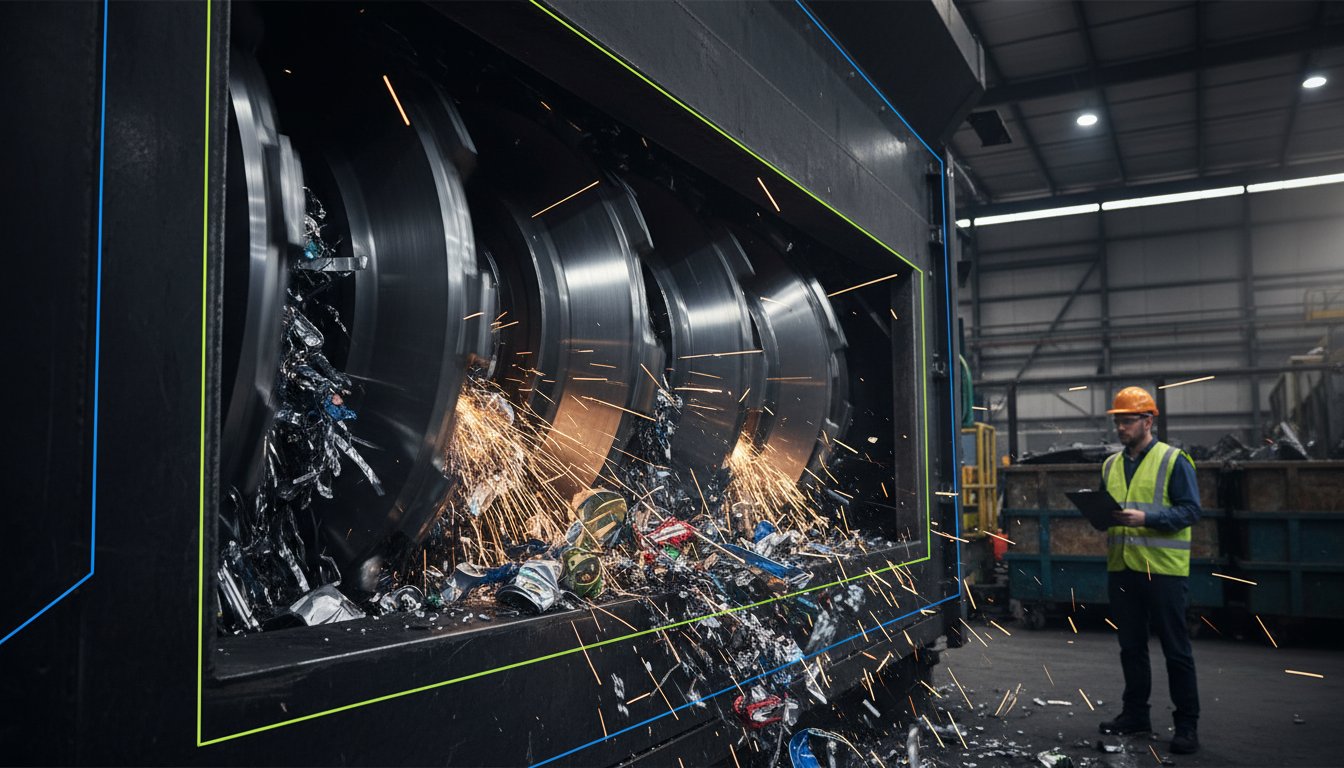
A single hour of unscheduled downtime in a UK quarrying operation can cost upwards of £5,000 in lost revenue, yet the selection of critical components is often left to chance. You likely recognize that the abrasive nature of aggregate processing makes component fatigue an unavoidable reality. It’s frustrating when a liner fails prematurely, disrupting your workflow and inflating your cost-per-tonne. Selecting the wrong wear parts doesn’t just increase maintenance frequency; it compromises the mechanical integrity of your entire processing circuit.
We’ll help you master the engineering principles behind heavy machinery consumables to reduce downtime and optimise your material processing efficiency. This technical guide examines the specific applications for manganese, rubber, and polyurethane, providing the data you need to engineer a predictable and cost-effective maintenance cycle. We’ll move from material composition to precise fitment strategies to ensure your plant achieves maximum longevity.
Key Takeaways
- Evaluate the technical relationship between Brinell hardness and component longevity to optimize material selection for high-stress industrial applications.
- Distinguish between the mechanical stresses of impact, abrasion, and erosion to calibrate your machinery for maximum processing efficiency.
- Transition to a data-driven “Cost-Per-Tonne” KPI to establish a proactive maintenance rhythm that protects your primary machine chassis.
- Understand the engineering superiority of precision-specified wear parts in reducing downtime and ensuring the mechanical integrity of your UK-based operations.
Defining Wear Parts in Heavy Industrial Applications
Every industrial processing machine faces a calculated battle against degradation. In high-output environments, Defining Wear Parts involves identifying specific components engineered to erode so the machine’s primary chassis remains intact. These are sacrificial elements. They act as the first line of defense against the relentless abrasive media found in UK industrial sites. By absorbing the brunt of the work, these consumables ensure that the multi-million pound structural framework of a crusher, shredder, or screen isn’t compromised by direct friction or impact.
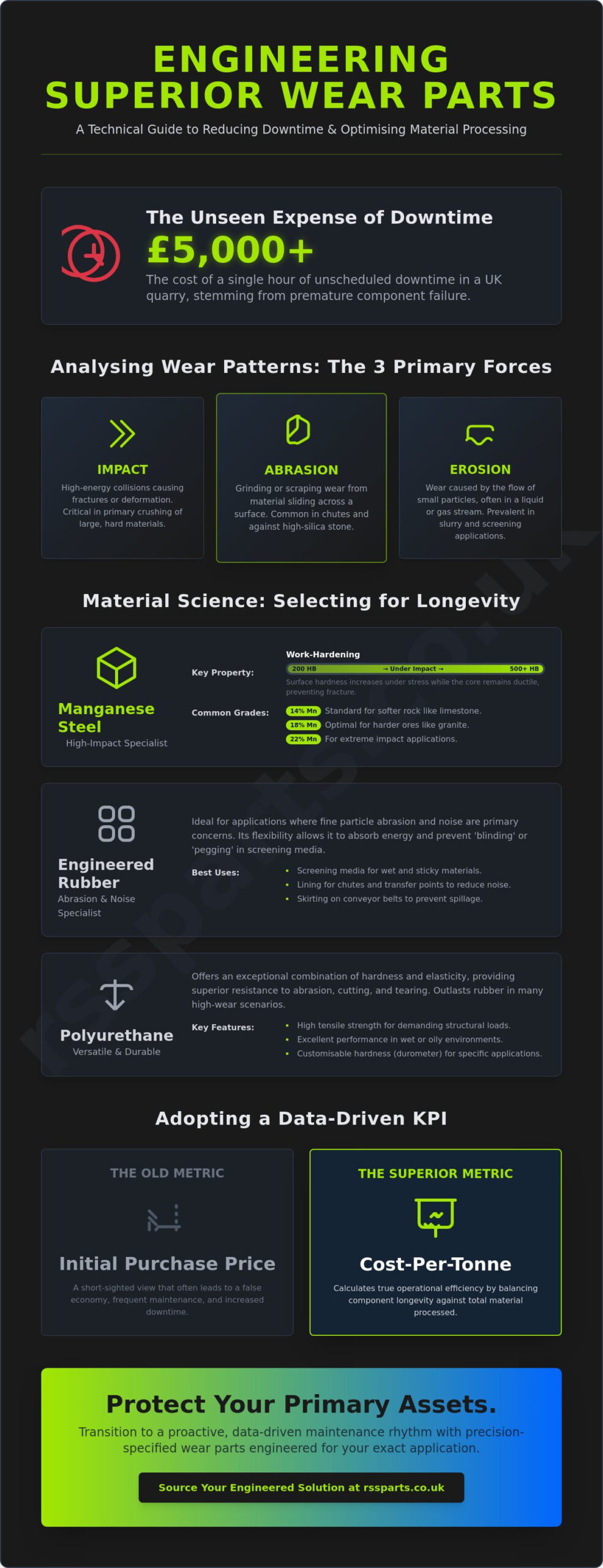
The economic reality of heavy industry dictates that downtime is the most significant expense. In a high-volume UK quarry, operational halts can cost upwards of £5,000 per hour in lost production and logistical delays. Opting for inferior components to save a few hundred pounds on the initial purchase is a false economy. We operate under a “Performance and Protection” engineering philosophy. This approach demands that wear parts don’t just fit; they must optimize the material flow while providing a robust shield for the machine’s internal geometry. It’s about maintaining peak calibration for as long as possible before a scheduled intervention is required.
Sacrificial Engineering: Why Machines Need Consumables
Sacrificial engineering is the practice of directing destructive forces toward easily replaceable components. These parts are designed to absorb massive amounts of kinetic energy and abrasive friction that would otherwise deform the machine’s housing. Precision fitment is a non-negotiable requirement in this process. Even a 2mm deviation in seat geometry can lead to secondary wear, where vibrations cause the part to rattle against the chassis, leading to structural fatigue. A wear part is effectively the mechanical fuse of heavy machinery; it’s designed to erode predictably to prevent an uncontrolled system breakdown.
The Core Industries: From Quarrying to Material Recycling
The demands placed on these components vary significantly across UK sectors. In the quarrying industry, operators often contend with materials containing silica levels exceeding 90% in specific gritstone regions. This requires high-chromium alloys with exceptional hardness to resist micro-cutting. Conversely, the recycling sector faces unpredictable waste streams containing a mix of plastics, glass, and rogue metals. These environments demand high impact resistance to prevent brittle fractures. For those managing screening operations, the selection of trommel plates is a critical factor in maintaining throughput. The right plate geometry ensures that material is sized correctly while the underlying drum remains protected from the constant bombardment of heavy debris.
- Quarrying: Focuses on abrasion resistance against high-silica stone.
- Recycling: Requires a balance of toughness and hardness to handle contaminated waste.
- Demolition: Demands extreme impact strength for processing reinforced concrete and rebar.
Material Science: Selecting Alloys and Polymers for Longevity
Selecting the correct material for industrial wear parts requires a calculated balance between Brinell hardness (HB) and fracture toughness. While a high Brinell rating indicates superior resistance to abrasive sliding, it often comes at the cost of brittleness. Engineering teams must evaluate the specific stress profile of their application to prevent premature component failure. For instance, heat-treated steels like AR400 or AR500 provide excellent surface protection for chutes; however, they lack the impact-absorbing qualities required for primary crushing. Tensile strength also dictates how a component handles structural loads without permanent deformation under extreme pressure.
Metallurgy in Crushing: The Role of Manganese
Hadfield Manganese steel is the industry standard for high-impact environments. This alloy possesses a unique work-hardening capability. Under constant compressive stress, the surface hardness increases from roughly 200 HB to over 500 HB, while the core remains ductile. Choosing the right grade is vital for efficiency. A 14% manganese content suits standard limestone, but harder ores like granite require 18% or 22% concentrations to maintain structural integrity.
Using 22% manganese on soft rock is actually counterproductive. The material won’t receive enough impact to work-harden, which leads to rapid abrasive loss. You can find detailed specifications on crusher wear parts to match your specific geology. Recent NREL research on wear-resistant alloys suggests that emerging composite microstructures could soon push these performance boundaries even further, offering higher durability in extreme mining conditions.
Polymers and Elastomers: When Steel Isn’t the Answer
Steel isn’t always the optimal solution for material handling. In wet screening or fine material processing, polyurethane and rubber offer distinct mechanical advantages. Polyurethane screening mats provide exceptional flexibility. This prevents pegging or blinding, a common issue where damp material clogs the apertures. These elastomers also offer a 50% reduction in noise levels compared to steel plate. This is a critical factor for sites operating near residential areas in the UK.
- Polyurethane: Ideal for fine, wet materials and offers superior chemical resistance in recycling shredder applications where oils are present.
- Rubber: Best for primary screening decks because it absorbs the massive kinetic energy of falling rock, protecting the underlying sub-structure from fatigue.
- Heat-Treated Steel: Reserved for high-velocity sliding abrasion where impact is secondary to surface friction.
If you’re looking to calibrate your machinery for maximum uptime, it’s worth reviewing how precision-engineered wear parts can reduce your overall cost-per-tonne.
Analysing Wear Patterns: Impact, Abrasion, and Erosion
Identifying the specific mechanical stress acting on your machinery is the first step toward extending component life. Heavy industry typically encounters three primary wear categories: impact, abrasion, and erosion. Each requires a distinct metallurgical response. While impact wear involves high-energy collisions that can cause work-hardening or fracture, sliding abrasion is a grinding process that removes surface material through friction. Precision in diagnosing these patterns prevents premature failure and reduces the total cost of ownership for wear parts.
High-Impact Scenarios: Blow Bars and Jaw Liners
In primary crushing, impactor blow bars endure extreme stress distribution. Kinetic energy transfers directly into the leading edge of the component. This differ significantly from sliding abrasion because the primary risk is brittle fracture rather than gradual thinning. Operators must monitor for “slugging,” where oversized or uncrushable material enters the chamber. Slugging accounts for approximately 85% of catastrophic failures in impact crushers by exceeding the material’s yield strength. To protect the surrounding chassis from these violent forces, engineers often integrate high-grade wear plates as a secondary line of defence. These plates absorb residual energy, ensuring the structural integrity of the machine remains intact during high-tonnage cycles.
Abrasive Environments: Shredder Blades and Screen Media
Recycling and waste processing present a different challenge. Heterogeneous waste streams create erratic wear profiles on blades and screens. In these environments, sliding abrasion is the dominant force. The interaction between material moisture and grit is critical. When moisture levels in processed waste exceed 12%, it often creates an abrasive slurry that accelerates metal loss by up to 3.5 times compared to dry conditions. Maintaining the sharp profile of shredder parts is essential for throughput. Once the blade edge rounds off, the machine consumes more energy to achieve the same shear, leading to increased heat and further material degradation.
- Gouging: Deep, singular grooves indicating high-impact events or large tramp metal.
- Polishing: A smooth, mirror-like finish suggesting fine-particle sliding abrasion.
- Scalloping: Wave-like patterns typically found in conveyor chutes, indicating high-velocity erosive wear.
- Edge Rounding: Loss of profile on wear parts like blades or hammers, which reduces cutting efficiency.
- Stress Cracking: Small “spider-web” fractures that signal the material has reached its fatigue limit.
Erosive wear is frequently overlooked in conveyor systems handling fine particles. Unlike abrasion, erosion occurs when high-velocity particles strike a surface at specific angles, usually between 20 and 90 degrees. This “sandblasting” effect can thin a standard steel liner in weeks. Correcting the drop height and impingement angle is often more effective than simply thickening the plate. By analysing these patterns, site engineers can move from reactive replacements to a predictive maintenance strategy that aligns with planned downtime.
Optimising Maintenance Cycles and Cost-Per-Tonne
In the high-stakes environment of material processing, the most critical metric for operational efficiency is the Cost-Per-Tonne. This KPI moves beyond the initial purchase price of wear parts and focuses on the total lifecycle value. A component that carries a 15% price premium but delivers a 40% increase in service life significantly reduces the overall cost of production. True profitability relies on balancing part longevity with the physical protection of the primary machinery.
The 5-Step Proactive Maintenance Framework
Implementing a structured approach to maintenance prevents unplanned downtime, which can cost UK quarrying operations upwards of £5,000 per hour in lost productivity. Follow this technical sequence:
- Step 1: Baseline Measurement. Establish a starting point by measuring the thickness of new components. Track wear at 100-hour intervals to calculate a predictable wear rate.
- Step 2: Hot Spot Identification. Analyse the material flow path. Identify areas where high-velocity impact or sliding abrasion causes accelerated thinning.
- Step 3: Geometry Correction. Address fitment issues immediately. Misaligned components create turbulence in material flow, leading to uneven wear patterns.
- Step 4: Shutdown Alignment. Coordinate the replacement of wear parts with scheduled plant maintenance. Replacing a part at 85% wear during a planned stop is more economical than a total failure during peak production.
- Step 5: Performance Review. Document the tonnage processed before failure. Use this data to refine material selection for the next cycle.
Precision Fitment: Protecting the Machine Chassis
Neglecting a replacement schedule often leads to the “running to failure” trap. When a part wears through completely, the abrasive material begins to erode the machine’s structural integrity. This often results in catastrophic damage to bearing housings and internal bores, requiring expensive line-boring repairs. Precision-engineered bolt-on edges act as a sacrificial barrier, shielding the bucket lip plate from direct contact. If these edges aren’t fitted with the correct geometry, they can actually accelerate lip wear by allowing material to “wash” behind the plate.
Fastener integrity is equally vital. In high-vibration environments, using the correct torque settings ensures the component remains flush against the chassis. Loose parts cause micro-movements that vibrate through the entire machine, increasing energy consumption and stressing the hydraulic systems. A secure, flush fitment optimises the penetration angle, reducing the fuel burn required to move each tonne of material. It’s a matter of engineering precision over simple replacement.
Maximise your machine’s uptime and protect your capital investment with high-grade components. Explore the RSS Parts range of industrial solutions.
Strategic Sourcing: The RSS Parts Engineering Approach
Generic spares often compromise on metallurgical integrity to reach a lower price point. At RSS Parts, we classify wear parts as precision-engineered components designed to optimize machine geometry and extend service intervals. This isn’t about merely filling a bin with generic metal; it’s about calibrating the material composition to the specific abrasive profile of your site. We differentiate ourselves by moving away from the “all-fits-one” mentality, focusing instead on components that maintain their structural profile under extreme tensile stress.
Beyond the Catalogue: Technical Consultation
Our engineers don’t just process orders. They analyze failure points. When a crusher liner wears unevenly, we don’t simply supply a replica; we refine the material selection to address the specific impact patterns of your aggregate. This Master Technician approach ensures that site-specific issues, such as premature fatigue or brittle fracture, are solved through engineering rather than repetitive replacement.
Maintaining a single source for screening, crushing, and conveyor components provides a significant operational advantage. It eliminates the mechanical disharmony that occurs when mixing parts from multiple vendors with varying tolerances. By overseeing the entire mechanical ecosystem, we ensure every component works in tandem to maximize throughput and minimize parasitic power loss.
- Engineered material selection for high-silica or high-moisture environments.
- Unified procurement for screening media, crusher liners, and conveyor rollers.
- Detailed wear-pattern analysis to prevent catastrophic component failure.
Ensuring Operational Continuity across the UK
Downtime in a UK quarry or recycling facility can easily exceed £5,000 per hour in lost productivity. Our national stockholding strategy is built on this reality. We maintain a robust inventory of critical components to ensure immediate dispatch across the country. Our deep technical understanding of articulated dump trucks and heavy crushers allows us to anticipate demand cycles, ensuring that the parts you need are on the shelf before you realize you need them.
Protection is as vital as performance. We prioritize the integration of magnetic separators to capture tramp metal before it reaches downstream wear parts. This proactive shielding can extend the life of secondary crushers by up to 40% in certain recycling applications. Our commitment to UK-wide availability and technical support transforms the traditional vendor-client relationship into a high-stakes engineering partnership. We focus on the technical details so you can focus on the tonnage.
Ready to optimize your plant’s performance? Consult with RSS Parts for your next maintenance cycle to secure engineering-led support and precision-fit components.
Engineering Superior Performance in Material Handling
Achieving peak operational efficiency requires a granular understanding of how specific alloys respond to the distinct forces of impact and abrasion. By calibrating material selection to the unique wear patterns of your specific application, you directly reduce the cost-per-tonne and extend maintenance cycles significantly. Precision in engineering isn’t just about fitment; it’s about the metallurgical integrity that maintains performance under extreme stress. Since 2004, our technical guidance has helped operators in the UK quarrying, recycling, and material handling sectors navigate these mechanical challenges with expert precision.
Success in heavy industry depends on reliable supply chains and specialist knowledge. We maintain a comprehensive UK stock to ensure your facility avoids the high costs of unplanned downtime and mechanical failure. Whether you’re refining a quarrying process or managing complex recycling streams, the right wear parts act as the primary line of defence for your machinery’s structural integrity. We invite you to optimise your machinery with precision-engineered wear parts from RSS Parts. Your equipment deserves the highest standard of protection to ensure long-term reliability on every site.
Frequently Asked Questions
What is the most durable material for wear parts in high-impact crushing?
High-manganese steel, specifically alloys containing 18% to 22% manganese, represents the industry standard for high-impact crushing environments. This material relies on a metallurgical process known as work-hardening; the surface becomes significantly tougher as it sustains repeated impacts. For primary crushing operations, these wear parts maintain a ductile internal core to prevent catastrophic brittle failure while the exterior surface reaches a hardness exceeding 500 Brinell.
How do I calculate the cost-per-tonne for my wear components?
You calculate the cost-per-tonne by dividing the total expenditure of the component, including the initial purchase price and the labour costs for installation, by the total tonnage processed before failure. If a £4,500 set of liners processes 150,000 tonnes of granite, the component cost is £0.03 per tonne. Accurate record-keeping ensures you identify whether premium wear parts offer a lower operational cost despite a higher initial investment.
Can I use polyurethane screening mats for all types of material?
Polyurethane screening mats aren’t suitable for applications exceeding 80 degrees Celsius or for processing heavy, sharp-edged primary rock over 250mm. They excel in wet, abrasive conditions and fine-to-medium screening where noise reduction is a priority. For high-heat environments or extreme primary impact, modular steel systems or rubber media provide the necessary thermal stability and structural integrity that polymers lack.
What are the first signs that a jaw crusher liner needs replacing?
The first indication is typically a 15% reduction in hourly throughput or a noticeable change in the product’s cubicity and shape. You should monitor the tooth profile; once the peaks have worn down to 10% of their original height, the crushing geometry is compromised. This leads to increased recirculating loads and higher fuel consumption as the machine struggles to grip the material effectively during the compression stroke.
Why is manganese steel the preferred choice for quarrying consumables?
Manganese steel is the preferred choice because it possesses a unique ability to work-harden under compressive stress. In a quarrying environment, the constant impact transforms the surface structure from an austenitic state to a hard martensitic layer. This self-renewing surface allows the wear parts to withstand extreme abrasion while the inner core remains flexible enough to absorb shocks without cracking or snapping under load.
How does precision fitment affect the lifespan of a wear plate?
Precision fitment can extend the lifespan of a wear plate by up to 30% by eliminating structural vibration and “chatter” during operation. When a plate isn’t perfectly calibrated to the substrate, small gaps allow fine particles to migrate behind the part, causing accelerated erosion known as “washout.” Secure, flush mounting ensures that impact forces are distributed evenly across the entire surface area of the engineering component.
What is the difference between sliding abrasion and impact wear?
Sliding abrasion occurs when material moves across a surface, causing gradual metal loss through friction, similar to the action of industrial grinding. Impact wear happens when material strikes a surface at high velocity, leading to surface fatigue, pitting, or subsurface cracking. Understanding this distinction is vital for material selection; high-chrome irons resist sliding abrasion effectively, whereas manganese alloys are engineered specifically to handle high-energy impacts.
How often should I inspect the bolt-on edges on my excavator buckets?
You should inspect bolt-on edges every 50 to 100 operating hours, depending on the abrasiveness of the material being moved. Check for loose hardware and ensure the wear hasn’t reached the bucket’s base edge, which can lead to expensive structural repairs. Replacing an edge when it’s 80% worn prevents the £2,000 to £5,000 cost associated with rebuilding a damaged bucket lip or welding new adapters.
about
avada factory
Sempery ultricies nibh at dolor cras urna eleifend nec. Atiam efficitur tempor.