
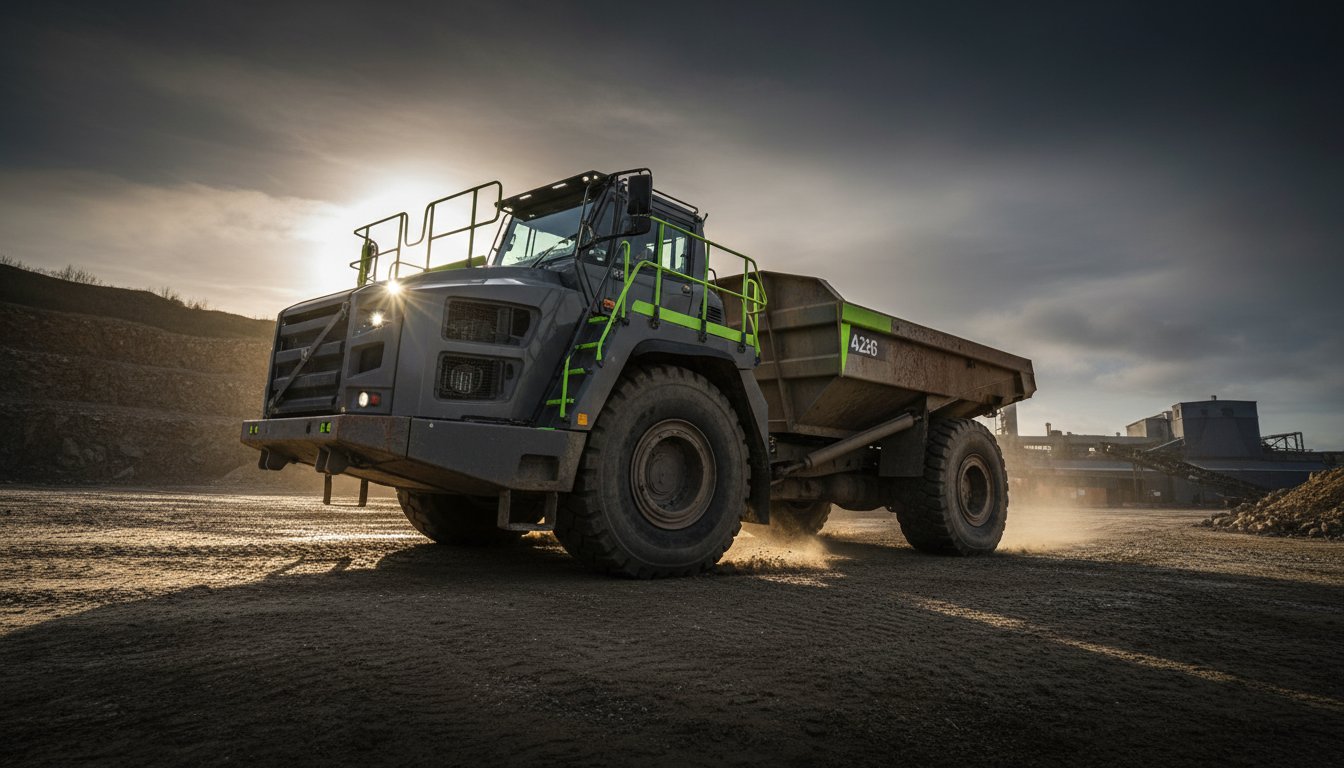
What if the difference between completing your earthworks project on schedule and watching deadlines slip away comes down to choosing the right hauling equipment? Most construction managers focus solely on payload capacity when selecting dump trucks, yet overlook the critical advantage that articulated dump truck designs offer in challenging terrain conditions.
We understand the frustration of navigating conflicting information about heavy equipment specifications whilst trying to make informed purchasing decisions that protect both your project timeline and bottom line. This comprehensive guide will equip you with precise technical knowledge about articulated dump trucks, from their engineered advantages in soft ground conditions to the specific maintenance protocols that maximise operational efficiency and component longevity.
You’ll discover the mechanical principles behind articulated chassis design, learn to evaluate payload-to-weight ratios for your specific applications, and master the maintenance schedules that prevent costly downtime. By the end, you’ll possess the technical expertise to confidently specify, operate, and maintain these sophisticated machines.
Key Takeaways
- Master the fundamental engineering principles behind articulated dump truck operation, including the critical articulation mechanism that delivers superior manoeuvrability in challenging terrain conditions.
- Discover the precise performance advantages and operational cost considerations that position these machines as optimal solutions for specific construction and mining applications.
- Learn the systematic approach to selecting the correct specification based on payload requirements, site geometry, and budgetary constraints for maximum operational efficiency.
- Implement proven maintenance protocols that extend component lifespan and minimise costly downtime through strategic preventive care and timely part replacement schedules.
- Explore emerging technologies and sustainable innovations that are reshaping the future landscape of heavy machinery performance and environmental compliance.
What Are Articulated Dump Trucks and How Do They Work?
An articulated dump truck represents a sophisticated engineering solution designed to tackle the most challenging terrain in construction and mining operations. Unlike conventional rigid dump trucks, these machines feature a distinctive hinge mechanism that connects the front cab unit to the rear dump body, creating two independent chassis sections that can pivot relative to each other. This articulation point, typically positioned behind the cab, allows the truck to maintain optimal traction and stability whilst navigating uneven surfaces, steep gradients, and tight turning radii that would prove problematic for rigid alternatives.
The articulation mechanism operates through a combination of hydraulic cylinders and robust pivot joints that enable the rear section to follow the front unit’s path with remarkable precision. This design fundamentally alters the truck’s weight distribution and handling characteristics. When the front wheels encounter an obstacle or depression, the articulated joint allows the rear section to maintain ground contact independently, ensuring continuous power delivery through the all-wheel drive system.
Modern articulated dump trucks typically feature six-wheel drive configurations, with power transmitted to all wheels through sophisticated differentials and transfer cases. Load capacities range from 25 tonnes for compact models to over 45 tonnes for the largest variants, with payload capacity directly influencing operational efficiency and project economics. The dump body incorporates hydraulic lifting mechanisms capable of achieving dump angles between 50 and 70 degrees, ensuring complete material discharge even with sticky or cohesive loads.
Key Features of Articulated Dump Trucks
The articulated design delivers exceptional manoeuvrability advantages, with turning radii typically 30-40% smaller than equivalent rigid trucks. This flexibility proves invaluable in confined construction sites and narrow haul roads. The all-wheel drive system, combined with advanced traction control, enables operation on gradients up to 35 degrees whilst maintaining stability and control.
Common Uses Across Industries
Construction applications dominate articulated dump truck deployment, particularly for site preparation, earthmoving, and material transport across rough terrain. Mining operations utilise these machines for overburden removal and ore transport along temporary haul roads. Infrastructure projects, including motorway construction and quarrying operations, rely on their ability to operate efficiently in challenging conditions where rigid trucks would struggle to maintain productivity.
Why Choose an Articulated Dump Truck: Benefits and Considerations
The articulated dump truck represents a sophisticated engineering solution that bridges the gap between rigid haulers and smaller construction vehicles. Unlike conventional rigid trucks, the articulated design features a pivot point between the cab and dump body, delivering exceptional manoeuvrability across challenging terrain whilst maintaining substantial payload capacity.
Fuel efficiency stands as a primary advantage, with modern articulated dump trucks achieving approximately 15-20% better fuel economy compared to rigid alternatives of similar capacity. This improvement stems from optimised weight distribution and advanced transmission systems that reduce engine strain during operation. Operating costs typically range £180-£220 per hour, factoring in fuel, maintenance, and operator wages, making them cost-effective for medium to large-scale operations.
Safety features distinguish articulated trucks from conventional alternatives. The articulated joint provides enhanced stability on uneven surfaces, reducing rollover risk by up to 35% compared to rigid trucks operating on similar gradients. Advanced traction control systems and differential locks ensure consistent performance across wet or loose surfaces, whilst improved visibility from the operator’s position reduces blind spot incidents.
Comparing with Rigid Dump Trucks
Terrain adaptability represents the most significant advantage of articulated design. Where rigid trucks struggle with slopes exceeding 15 degrees, articulated units maintain stability on gradients up to 25 degrees. However, rigid trucks offer higher payload capacity, typically 15-20% more than articulated equivalents of similar size.
Evaluating Performance and Productivity
Productivity metrics focus on tonnes per hour rather than simple payload capacity. Articulated trucks excel in cycle efficiency, completing haul cycles 12-18% faster on rough terrain due to superior traction and manoeuvrability. Key performance indicators include fuel consumption per tonne hauled, maintenance intervals, and operational availability.
Environmental considerations increasingly influence equipment selection. Modern articulated dump trucks meet Stage V emission standards, reducing particulate matter by 95% compared to older models. Noise levels typically measure 72-75 decibels at operator position, meeting current workplace regulations whilst minimising site disruption.
For operators seeking to maximise their equipment investment, understanding these performance characteristics proves essential. Professional guidance from experienced equipment specialists can help identify the optimal configuration for specific operational requirements, ensuring both immediate productivity and long-term reliability.
How to Select the Right Articulated Dump Truck for Your Needs
Selecting the optimal articulated dump truck requires methodical evaluation of your operational parameters and site-specific constraints. The decision extends beyond initial purchase price to encompass total cost of ownership, operational efficiency, and long-term reliability. Proper selection directly impacts productivity rates, maintenance costs, and equipment longevity across the vehicle’s service life.
Begin by conducting a comprehensive assessment of your project portfolio and budget allocation. Document your typical haul distances, cycle times, and daily tonnage requirements. Projects involving distances exceeding 1.5 kilometres typically benefit from articulated dump trucks over rigid alternatives due to superior speed capabilities and reduced operator fatigue. Budget considerations should encompass not only acquisition costs but also financing terms, insurance premiums, and projected resale values after 5-7 years of operation.
Site conditions fundamentally determine vehicle specification requirements. Evaluate ground bearing capacity, gradient percentages, and turning radius constraints. Articulated dump trucks excel in challenging terrain where gradients exceed 15% and ground conditions vary significantly. Consider seasonal variations in site accessibility, particularly during wet weather periods when traction and manoeuvrability become critical factors.
Understanding Load Capacity and Size
Load capacity specifications encompass both payload weight and heaped volume measurements. Struck capacity represents level load volume, whilst heaped capacity accounts for material above the body sides. Match truck size to your primary material types: cohesive materials like clay achieve higher heaped ratios than loose aggregates. A 25-tonne articulated dump truck typically offers 15-17 cubic metres heaped capacity, whilst 40-tonne models provide 23-26 cubic metres.
Evaluating Brands and Models
Leading manufacturers including Caterpillar, Volvo, and Bell Equipment dominate the UK market through established dealer networks and parts availability. Caterpillar’s 730 series delivers proven reliability in quarry applications, whilst Volvo’s A-series emphasises fuel efficiency and operator comfort. Bell’s B-series offers competitive acquisition costs with robust South African engineering heritage. Evaluate warranty terms, service intervals, and local dealer proximity when comparing models.
Research customer testimonials and independent reliability studies from construction industry publications. Equipment with documented uptimes exceeding 90% and service intervals extending beyond 500 hours typically justify premium pricing through reduced operational disruption. Prioritise models with comprehensive diagnostic systems and remote monitoring capabilities to optimise maintenance scheduling and prevent costly breakdowns.
Maintenance Tips for Extending the Life of Your Articulated Dump Truck
Systematic maintenance protocols form the foundation of articulated dump truck longevity, directly impacting operational costs and machine reliability. Professional operators understand that proactive maintenance strategies can extend machine life by 40-60% compared to reactive repair approaches, whilst reducing unplanned downtime costs by up to £2,500 per incident according to Construction Equipment Association data from 2023.
The engineering complexity of these machines demands precision in maintenance execution. Each component operates within specific tolerances that deteriorate predictably under load cycles. Understanding these degradation patterns allows operators to optimise replacement intervals and prevent cascading failures.
Routine Maintenance Checklist
Daily pre-operation inspections should encompass hydraulic fluid levels, tyre condition assessment, and articulation joint lubrication verification. Weekly protocols must include transmission oil analysis, brake system pressure testing, and differential service checks. Monthly comprehensive inspections require detailed examination of suspension components, steering geometry verification, and engine performance diagnostics.
Maintenance records serve as critical performance data. Digital logging systems enable trend analysis, revealing component wear patterns and predicting failure intervals with 85% accuracy when properly calibrated.
Handling Wear and Tear
High-stress components require strategic management approaches. Articulation bearings typically require replacement every 4,000-6,000 operating hours, whilst hydraulic seals demand attention at 2,500-3,500 hour intervals. Transmission components show measurable wear patterns after 8,000 hours under standard operating conditions.
OEM replacement parts ensure dimensional accuracy and material specifications match original engineering tolerances. Aftermarket alternatives may offer cost savings of 20-30%, but require careful verification of metallurgy and precision manufacturing standards. Protecting high-impact surfaces within the dump body is equally critical; specifying the correct industrial wear plates for your material type can significantly reduce body degradation and extend intervals between costly structural repairs. For quarrying and aggregate operations in particular, understanding the full spectrum of wear parts selection across your material processing circuit ensures that component choices are engineered to match abrasion levels and reduce cost-per-tonne across the entire operation.
Professional inspection protocols identify wear progression before critical failure points. Vibration analysis detects bearing deterioration 2-3 months before audible symptoms appear. Oil analysis reveals internal component wear through particle contamination levels, enabling predictive replacement scheduling.
The articulated dump truck’s complex hydraulic systems demand particular attention to contamination control. Hydraulic filtration systems require replacement every 500 operating hours, whilst reservoir cleaning should occur annually to maintain system cleanliness standards.
For precision-engineered replacement components that meet exacting performance standards, explore our comprehensive range of heavy machinery parts designed for optimal reliability and extended service life.
Exploring the Future of Articulated Dump Trucks
The heavy construction machinery industry stands at a technological crossroads, where traditional hydraulic systems meet advanced digital integration. Leading manufacturers are investing billions in research and development, with Caterpillar alone allocating £2.1 billion annually to innovation programmes. These investments are reshaping how articulated dump truck operators approach efficiency, safety, and environmental compliance.
Autonomous operation represents the most significant advancement in construction equipment since hydraulic systems. Volvo’s autonomous hauling trials at the Kristineberg mine in Sweden demonstrated a 15% improvement in fuel efficiency and 25% reduction in operational costs between 2018 and 2022. These systems utilise GPS positioning accurate to within 2.5 centimetres, combined with LIDAR sensors capable of detecting objects at distances exceeding 200 metres.
Technological Innovations
Machine learning algorithms now monitor component wear patterns in real-time, predicting maintenance requirements up to 300 operating hours in advance. Komatsu’s KOMTRAX system processes over 500 data points per minute, including hydraulic pressure, engine temperature, and transmission performance. Advanced collision avoidance systems incorporate radar technology originally developed for military applications, providing 360-degree awareness around the articulated dump truck.
Sustainability and Environmental Impact
Electric powertrains are transforming the industry landscape. Volvo’s TA15 electric articulated hauler, launched in 2021, delivers equivalent performance to diesel variants whilst eliminating direct emissions. The machine’s 264 kWh battery system provides 8 hours of continuous operation under typical quarry conditions.
Hydrogen fuel cell technology offers extended range capabilities. Liebherr’s prototype hydrogen-powered hauler achieved 12 hours of operation during 2023 trials, with refuelling completed in under 20 minutes. These developments align with the UK’s commitment to achieve net-zero emissions by 2050, driving regulatory pressure across construction sectors.
Predictive analytics platforms are revolutionising fleet management. Telematics systems now integrate weather data, site topology, and material density calculations to optimise loading cycles. This integration reduces fuel consumption by an average of 18% whilst extending component lifespan through intelligent load distribution algorithms.
The convergence of these technologies positions the articulated dump truck as a sophisticated data platform rather than merely a hauling machine, fundamentally altering operational paradigms across construction and mining applications.
Maximising Your Heavy Machinery Investment
Understanding the engineering fundamentals of articulated dump trucks transforms your equipment selection from guesswork into precision decision-making. The articulation joint’s 40-degree steering capability and superior traction control in challenging terrain conditions deliver measurable productivity gains that directly impact your project timelines and operational costs.
Proper maintenance protocols, particularly hydraulic system inspections every 250 operating hours and regular articulation joint lubrication, extend equipment lifespan by up to 30% whilst reducing unexpected downtime. These systematic approaches to care mirror the meticulous attention to detail required for optimal performance in demanding applications.
The integration of telematics systems and autonomous capabilities represents the next evolution in articulated dump truck technology, promising enhanced efficiency and safety protocols for forward-thinking operations.
When your equipment demands precision-engineered components that deliver both performance and protection, explore our range of high-quality dump truck parts. As specialists in heavy machinery parts trusted by construction professionals across the UK, we understand that mechanical integrity isn’t negotiable. Your projects deserve components that match your commitment to excellence.
Frequently Asked Questions
What is an articulated dump truck and how does it operate?
An articulated dump truck is a heavy-duty vehicle featuring a pivot joint between the cab and rear dump body, allowing enhanced manoeuvrability on uneven terrain. The hydraulic steering system controls the front and rear sections independently, whilst the dump body tilts backwards using hydraulic cylinders to discharge materials. This articulated design provides superior traction and stability compared to conventional rigid trucks, making it ideal for construction sites, quarries, and off-road applications where precise material placement is essential.
What are the benefits of using an articulated dump truck over a rigid one?
Articulated dump trucks deliver 40% better weight distribution across all six wheels, reducing ground pressure and preventing site damage on soft surfaces. The pivot joint enables a turning radius that’s typically 25% tighter than rigid alternatives, crucial for navigating confined construction areas. Additionally, the all-wheel drive system and differential locks provide exceptional traction on gradients up to 30 degrees, where rigid trucks would struggle to maintain grip and operational efficiency.
How do I maintain my articulated dump truck effectively?
Effective maintenance requires daily pre-operational inspections focusing on hydraulic fluid levels, tyre pressure (typically 35-40 PSI), and pivot joint lubrication points. Schedule engine oil changes every 250 operating hours, hydraulic filter replacements every 500 hours, and comprehensive transmission servicing every 1,000 hours. Critical attention must be paid to the articulation joint bearings, which require greasing every 50 operating hours to prevent premature wear and maintain precise steering geometry essential for safe operation.
What factors should I consider when buying an articulated dump truck?
Payload capacity represents the primary consideration, with models ranging from 25 tonnes to 45 tonnes depending on your operational requirements. Engine power should align with typical gradient conditions, requiring minimum 400 horsepower for steep quarry work. Evaluate the hydraulic system specifications, particularly dump cycle times (typically 8-12 seconds) and maximum dump height clearance. Consider maintenance accessibility, parts availability in the UK market, and manufacturer warranty coverage, which typically extends 12-24 months for commercial applications.
Are there any environmental concerns with using dump trucks?
Modern articulated dump trucks must comply with Stage V emission standards, reducing particulate matter by 95% compared to older models through advanced diesel particulate filters and selective catalytic reduction systems. Fuel consumption typically ranges 15-25 litres per hour depending on load conditions, making operational efficiency crucial for environmental impact. Many manufacturers now offer hybrid powertrains and telematics systems that optimise route planning, reducing both fuel consumption and carbon emissions by up to 20% in typical quarry operations.
What are the latest technological advancements in dump trucks?
GPS-guided payload monitoring systems now provide real-time weight distribution data, preventing overloading and optimising fuel efficiency through precise load management. Advanced telematics platforms offer predictive maintenance alerts, reducing unplanned downtime by approximately 30% through early component failure detection. Autonomous driving capabilities are emerging in controlled environments, with several manufacturers testing fully automated articulated dump trucks in Scandinavian mining operations, though UK regulatory approval remains pending for widespread commercial deployment.
about
avada factory
Sempery ultricies nibh at dolor cras urna eleifend nec. Atiam efficitur tempor.
