

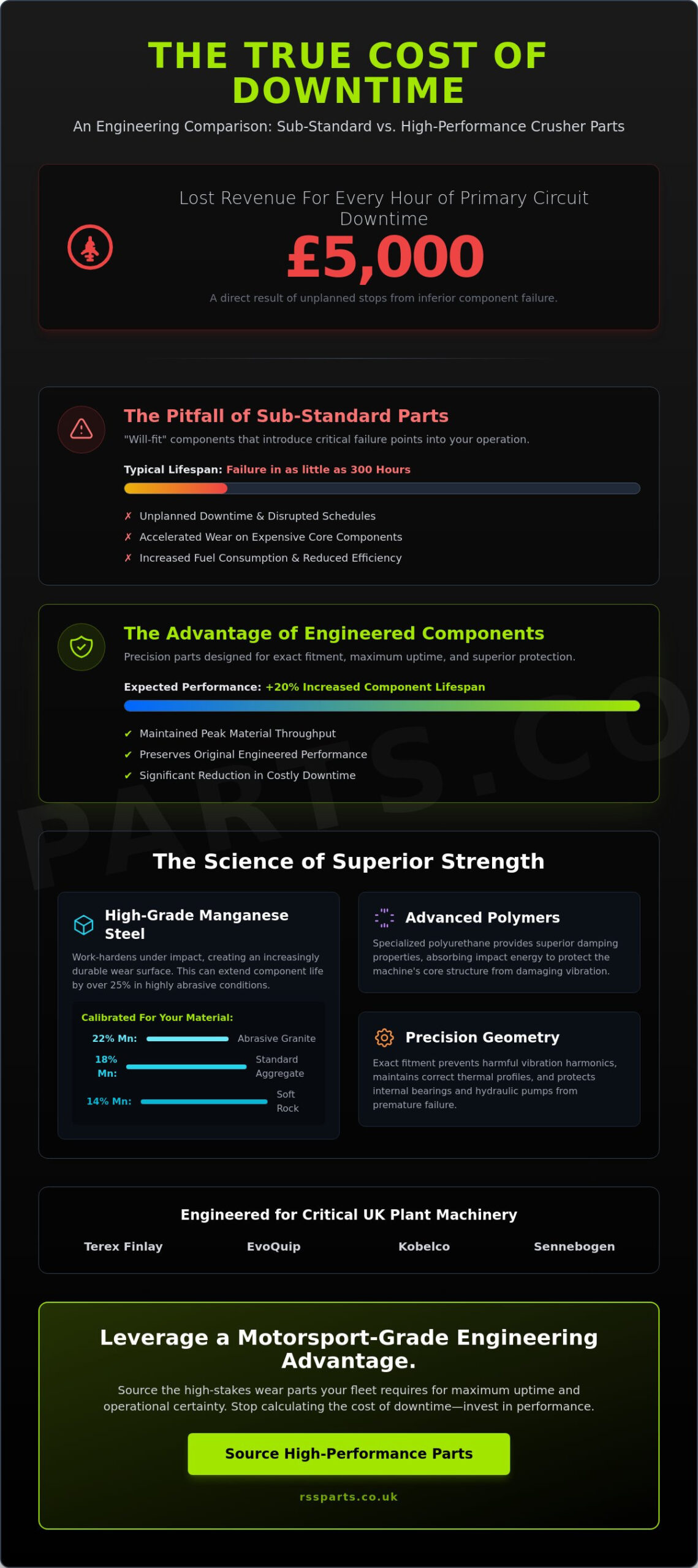
The true cost of a sub-standard crusher liner isn’t found on the invoice; it’s calculated in the £5,000 of lost revenue for every hour your primary circuit remains stationary. Operators who rely on high-performance machinery distributed by molson inc know that maintaining mechanical integrity is a matter of precision engineering, not just luck. You’ve likely seen how inferior aftermarket liners can suffer from accelerated wear in as little as 300 hours, leading to unplanned downtime that disrupts your entire site schedule and compromises your project deadlines.
We’re here to show you how to maintain the performance and protection of your heavy plant with components engineered for exact fitment and superior tensile strength. By refining your parts strategy and focusing on precise component geometry, you can achieve a 20% increase in component lifespan while keeping material throughput at its peak. This technical guide explores the metallurgy of high-grade manganese and the damping properties of specialized polyurethane, providing a reliable UK-based roadmap for sourcing the high-stakes wear parts your fleet requires for maximum uptime.
Key Takeaways
- Understand the distinction between the global beverage entity molson inc and the Molson Group’s heavy equipment ecosystem to ensure accurate technical sourcing for UK plant machinery.
- Identify critical high-wear zones in crushers and screeners to optimize the performance and protection of your material processing machinery.
- Analyze the role of material science, specifically tensile strength and Brinell hardness, in selecting components that withstand rigorous industrial applications.
- Develop a methodical maintenance framework to monitor wear patterns and refine conveyor alignment for an extended component lifecycle.
- Leverage technical consultancy to source motorsport-grade industrial parts that provide a significant engineering advantage over standard distribution models.
The Molson Group Equipment Ecosystem: Navigating the UK Plant Market
In the UK heavy plant sector, the name Molson represents a critical infrastructure partner rather than a beverage provider. While many associate the name with the global brewing entity molson inc, the Molson Group operates as a specialized distributor of high-performance machinery for the quarrying, demolition, and recycling industries. They manage a complex ecosystem of heavy equipment that requires precise technical management to maintain peak output. For engineers and site managers, understanding this distinction is the first step in sourcing the correct components for their fleet.
The UK market relies heavily on these platforms due to their specific engineering for rugged environments. Operators in the aggregate and waste sectors prioritize machine uptime above all else. When a primary crusher or material handler fails, the cost of downtime often exceeds the price of the replacement part itself. This creates a high-stakes environment where the quality of every bolt, seal, and wear plate must meet exact tolerances. Maintaining these assets demands more than just a general knowledge of mechanics; it requires a deep understanding of the original manufacturer’s specifications.
Key Machine Brands Distributed by Molson
- Terex Finlay: These machines serve as the standard-bearer for mobile crushing and screening. Their engineering focuses on high-volume throughput and structural durability in abrasive environments.
- EvoQuip: This brand provides compact crushing solutions. These machines are essential for urban recycling and construction sites where space is at a premium and maneuverability is a technical requirement.
- Kobelco and Sennebogen: These manufacturers represent the pinnacle of hydraulic engineering. Kobelco excavators are known for fuel efficiency and refined control, while Sennebogen material handlers are engineered for the extreme duty cycles of scrap yards and ports.
The Importance of Component Compatibility
Maintaining the mechanical integrity of high-value assets requires a commitment to precision. Every component within a machine’s assembly interacts with a specific geometry. When you install a “will-fit” part that lacks technical precision, you risk more than just a premature failure of that single item. Substandard parts can alter the vibration harmonics or thermal profiles of the entire assembly. This often leads to accelerated wear on expensive internal bearings or hydraulic pumps.
We see this frequently with wear parts in crushing units. If the tensile strength of the manganese steel isn’t calibrated correctly, the part may crack under impact or wear down too quickly. This forces the engine to work harder to achieve the same output, which increases fuel consumption and reduces the overall lifecycle of the machine. Professional operators don’t just look for a part that fits; they look for a component that preserves the engineered performance of their equipment. Precision isn’t optional when you’re managing a fleet worth millions of pounds.
Essential Wear Components for Material Processing Machinery
Material processing is a relentless battle of attrition. For operators utilizing heavy equipment distributed by molson inc, identifying high-wear zones is the first step in a professional maintenance strategy. These zones are almost always concentrated where kinetic energy meets abrasive resistance. In crushers, this occurs within the crushing cavity; in screeners, it’s the impact area of the deck; in shredders, it’s the rotor tips and counter-knives. Precision engineering ensures these components don’t just fit, but actually enhance the machine’s mechanical cycle.
Crushing Chamber Components
Jaw crusher liners rely on the interaction between fixed and swing jaw dynamics. Wear patterns typically cluster at the bottom third of the plate where the most significant work occurs. If these patterns become uneven, it’s a sign of poor feed distribution. Cone crusher liners require a different approach. The mantle and concave must be perfectly matched to maintain the nip angle. We calibrate Manganese steel grades based on the material’s Bond Work Index. Use 14% Mn for soft rock, 18% for standard aggregate, and 22% for highly abrasive materials like granite. High-grade Manganese work-hardens under load, which can extend component life by 25% in high-impact environments.
Screening Media and Trommels
Screening efficiency hinges on the surface interface. Trommel plates act as the primary structural filter in rotary screeners, and they must withstand the constant tumbling of heavy debris without deforming. When choosing media, the material choice dictates the outcome:
- Polyurethane mats: These offer a service life up to 10 times longer than wire mesh in wet applications and significantly reduce noise levels.
- Woven wire mesh: This remains the standard for maximizing open area, which is vital for high-volume fine screening where “near-size” blinding is a risk.
- Punch plates: These are engineered for heavy-duty scalping where impact loads frequently exceed 500kg per drop.
Shredder blades are the front line of recycling. These components experience extreme shear forces that can dull edges rapidly if the metallurgy isn’t matched to the waste stream. Maintaining sharp profiles isn’t just about throughput; it’s about protecting the drive motor from torque spikes. For those running high-capacity lines from molson inc, switching to precision-machined blades can reduce energy consumption by roughly 12% per tonne processed. If you’re looking to optimize your plant’s reliability, you can source precision-engineered wear parts designed for the most demanding UK site conditions.
Engineering Precision: Material Selection for Performance and Protection
Engineering excellence isn’t merely about ensuring a part fits into a housing; it’s about the molecular integrity of the component under extreme stress. From a Master Technician’s perspective, material science is the true foundation of part longevity. When we evaluate replacement components for machinery distributed by molson inc, we focus on the specific metallurgical properties required for the UK’s demanding quarrying and recycling environments. A part that looks identical to the original but lacks the correct heat treatment will fail prematurely, leading to expensive secondary damage.
We analyse tensile strength and hardness using the Brinell scale (HB) to ensure wear plates can withstand both impact and abrasion. For most heavy-duty applications, a hardness of 400 to 500 HB is the industry standard. However, hardness alone is brittle. We balance this with high tensile strength to ensure the part doesn’t crack when it encounters uncrushable objects. Precision machining in uniball joints and conveyor components is equally vital. Maintaining tolerances within microns reduces parasitic drag and prevents the heat build-up that destroys seals and bearings. High-quality crusher wear parts serve as a critical sacrificial barrier, absorbing massive kinetic energy to protect the machine’s internal housing from structural fatigue.
Metallurgy in Quarrying Applications
Manganese is the primary choice for impact zones due to its unique work-hardening properties. When the surface of a 12-14% manganese casting is struck by heavy aggregate, it hardens physically while the core remains ductile and tough. This prevents the component from snapping under the high-pressure environment of a primary crusher. For shredding highly abrasive materials, high-chrome alloys are engineered to resist sliding wear. Every metal component undergoes a rigorous heat treatment process, including quenching and tempering, to ensure consistent hardness throughout the entire cross-section of the part.
Polyurethane and Rubber Engineering
Screening efficiency relies heavily on polymer selection and Shore hardness ratings. We typically specify Shore 60A to 90A ratings depending on whether the application requires flexibility or maximum abrasion resistance. Modern polymers offer significant noise reduction benefits, often lowering decibel levels by up to 10dB compared to traditional steel mesh. This is a vital consideration for UK sites operating near residential zones. Our engineered mats are designed with specific aperture geometries to prevent blinding and pegging. This ensures that even in wet British weather, sticky fines pass through the screen rather than clogging the system and halting production.
Optimising Component Lifespan: A Technical Maintenance Framework
Maximising the service life of heavy plant equipment requires a shift from reactive replacement to predictive engineering. For operators managing machinery sourced via molson inc, maintaining peak mechanical integrity depends on understanding how individual components interact under load. Precision calibration reduces parasitic power loss and prevents premature metallurgical failure. We approach maintenance as a calibration exercise rather than a simple repair schedule.
Wear Pattern Analysis
Effective maintenance starts with identifying uneven wear in jaw liners. If the wear profile isn’t uniform across the face, it introduces eccentric loading on the main shaft; this often leads to bearing overheating or catastrophic failure. In cone crushers, technicians must monitor the “sweet spot” to maintain a consistent material bed. This prevents ring bounce, a condition where the bowl assembly lifts during the crushing cycle, causing significant stress to the adjustment ring and mainframe. Our visual inspection protocols for screening media and trommel plates focus on specific indicators:
- Aperture deformation exceeding 10% of the original specification.
- Localised thinning on the lead-in edge of trommel plates.
- Structural stress fractures around the fastening points of screening meshes.
Conveyor System Integrity
Precision-engineered conveyor system components act as the circulatory system of the plant. If a belt isn’t perfectly aligned, the resulting friction destroys roller bearings and compromises belt edge integrity. Scraper maintenance is equally vital. Worn scrapers allow material carry-back, which builds up on return idlers and causes tracking issues. In high-drop zones, we recommend installing impact beds rather than standard idlers. These beds absorb kinetic energy that would otherwise cause carcass punctures or ply separation. Correct alignment can reduce motor energy consumption by up to 15% in high-capacity systems.
Recognising the microscopic signs of fatigue in shredder parts is critical before a fracture occurs. We use technical data, including vibration analysis and thermal imaging, to predict replacement intervals. For equipment supplied by molson inc, tracking the tonnage processed against wear part thickness allows for a mathematical approach to inventory management. It’s about ensuring performance and protection are never compromised. By monitoring the hardness of the base metal over time, we can determine exactly when a component is nearing its fatigue limit, preventing the secondary damage caused by component disintegration within the chamber.
RSS Parts: Your Technical Partner for High-Performance Components
RSS Parts operates at the intersection of high-end engineering consultancy and specialized component supply. We recognize that heavy plant machinery distributed by molson inc requires more than basic maintenance; it needs components engineered to withstand extreme torsional stress and relentless abrasive environments. Our background in motorsport-grade engineering allows us to apply elite standards to the quarrying, recycling, and material handling sectors across the UK. We don’t just distribute parts; we provide a technical partnership focused on mechanical longevity and operational excellence.
The RSS Engineering Advantage
Every component in our inventory undergoes meticulous quality control and material verification. We analyze the mechanical ecosystem of your equipment, looking at how individual parts interact under load. This isn’t about simple replacement. It’s about refining the performance of the machine. By focusing on substance and mechanical integrity, we help operators significantly reduce their cost-per-tonne. We evaluate tensile strength and metallurgical composition to ensure every part provides the protection your investment deserves. Our approach mirrors the precision of professional car tuning, where every millimeter of geometry matters and tolerances are never ignored.
Comprehensive Inventory for Molson-Distributed Brands
We maintain an extensive inventory tailored for the brands typically handled by molson inc, including Terex, Finlay, and EvoQuip platforms. Whether you’re managing a primary crusher or a complex recycling line, our components are selected for their ability to optimize throughput and minimize unplanned downtime. We stock specialized items that general retailers often overlook, such as high-performance magnetic separators and precision-ground shredder cutters. Maintaining peak operational efficiency is only possible when you work with a quarry parts supplier uk that understands the engineering behind the metal.
- Wear parts for crushing and screening equipment designed for maximum durability in harsh environments.
- Specialized hydraulic components calibrated for heavy-duty cycles and consistent pressure.
- Custom-engineered solutions for unique material handling challenges that standard parts can’t solve.
Our national supply capabilities ensure that high-performance components are available when your site requires them most. We prioritize safety and performance in equal measure, ensuring your fleet remains productive in the harshest UK conditions. If you’re looking to upgrade your maintenance strategy from reactive to precision-led, our team is ready to assist. Contact our engineering team for technical parts support to discuss your specific machinery requirements and performance goals.
Securing Mechanical Integrity and Peak Operational Output
Maintaining the operational efficiency of heavy plant machinery requires more than just reactive repairs; it demands an engineering-led approach to component selection. By prioritising high-performance metallurgy and adhering to a rigorous maintenance framework, operators can significantly reduce unplanned downtime across the UK’s quarrying and recycling sectors. Selecting parts that match or exceed the original specifications of equipment distributed by molson inc ensures that your machinery maintains its structural integrity under extreme tensile stress. Engineering precision is the difference between a profitable shift and a costly mechanical failure.
Since 2004, RSS Parts has operated as a UK-based technical authority, bridging the gap between standard aftermarket supply and precision engineering consultancy. Our focus remains on the national distribution of high-performance quarry and recycling consumables that deliver both performance and protection. Don’t settle for substandard components that compromise your site’s safety and output. We’ve spent nearly two decades refining our material selection to meet the specific demands of the British landscape. Consult the Master Technicians at RSS Parts for your machinery needs to ensure your fleet remains at peak calibration. Your equipment’s longevity is our primary objective.
Frequently Asked Questions
Do RSS Parts replacement components fit Molson-distributed machines?
Yes, RSS Parts engineers replacement components to match the exact dimensional tolerances of machinery originally supplied by molson inc. We utilize precision 3D scanning and high-tensile metallurgy to ensure 100% fitment compatibility with brands like Terex Finlay and EvoQuip. Our manufacturing process maintains a 0.5mm tolerance threshold. This ensures that every part integrates into the original mechanical assembly without requiring field modifications or specialized shimming.
What manganese grade is best for crushing hard basalt or granite?
For processing abrasive aggregates like basalt or granite, we recommend a high-manganese content of 18% to 22%. These grades are calibrated to work-harden under high impact, reaching a surface hardness of 500 to 550 Brinell. While standard 14% manganese suffices for softer limestone, the 22% grade provides 30% greater wear life in high-silica applications. We also incorporate 2% molybdenum to stabilize the grain structure during the casting process.
How do polyurethane screening mats compare to traditional wire mesh?
Polyurethane screening mats offer up to 10 times the service life of traditional high-tensile wire mesh in wet or abrasive environments. While wire mesh provides a higher initial open area, polyurethane reduces decibel levels by 50%, improving site safety. Our modular polyurethane systems utilize a 90 Shore A hardness rating. This material resilience prevents pegging and blinding, which maintains a consistent throughput of 250 tonnes per hour even in damp conditions.
Can you supply wear parts for older Terex Finlay models?
We maintain a comprehensive engineering database for legacy Terex Finlay models, including the 390 and 683 series produced over 15 years ago. Our technical archive allows us to manufacture bespoke jaw plates and conveyor components that are no longer stocked by molson inc or original dealers. By utilizing archival technical drawings, we provide 100% mechanical continuity for older fleets. This keeps your capital equipment operational beyond its standard 10,000-hour service life.
What are the signs that my cone crusher liners need urgent replacement?
You should initiate a liner change when the mantle or concave thickness reaches 25mm at the thinnest point. A 15% drop in hourly throughput or a noticeable shift in the Closed Side Setting calibration often signals critical wear. If the crusher experiences frequent tramp relief cycles, the liner geometry is likely compromised. Monitoring these metrics prevents structural damage to the adjustment ring and ensures consistent product grading for your clients.
How does RSS Parts ensure the quality of its aftermarket components?
Quality is verified through a multi-stage inspection protocol that includes ultrasonic testing for internal casting voids and spectral analysis of alloy compositions. Every batch undergoes Rockwell hardness testing to ensure it meets our internal 60 HRC standard for wear resistance. We calibrate our manufacturing equipment every 30 days to maintain ISO 9001:2015 compliance. This rigorous approach guarantees that our aftermarket solutions provide the same mechanical integrity as factory-fitted components.
Do you provide on-site mechanical repair services for Molson equipment?
Our expertise is focused on the precision engineering and supply of high-performance components rather than field labour. We provide technical consultancy regarding part selection and installation geometry to help your internal fitters optimise machine performance. By specialising in the supply chain, we maintain a 98% stock availability rate for critical wear items. This ensures your maintenance team has the hardware to complete repairs within a standard 24-hour window.
What is the lead time for national delivery of trommel plates in the UK?
We offer a standard 48-hour delivery window for stock trommel plates across the UK mainland. For bespoke punch plate configurations or custom aperture sizes, the engineering and logistics cycle typically spans 7 to 10 working days. Our central distribution hub utilises tracked freight services to ensure predictable arrival times for every order. This logistical efficiency minimises downtime, allowing your screening operations to resume full production capacity with minimal delay.
about
avada factory
Sempery ultricies nibh at dolor cras urna eleifend nec. Atiam efficitur tempor.


