

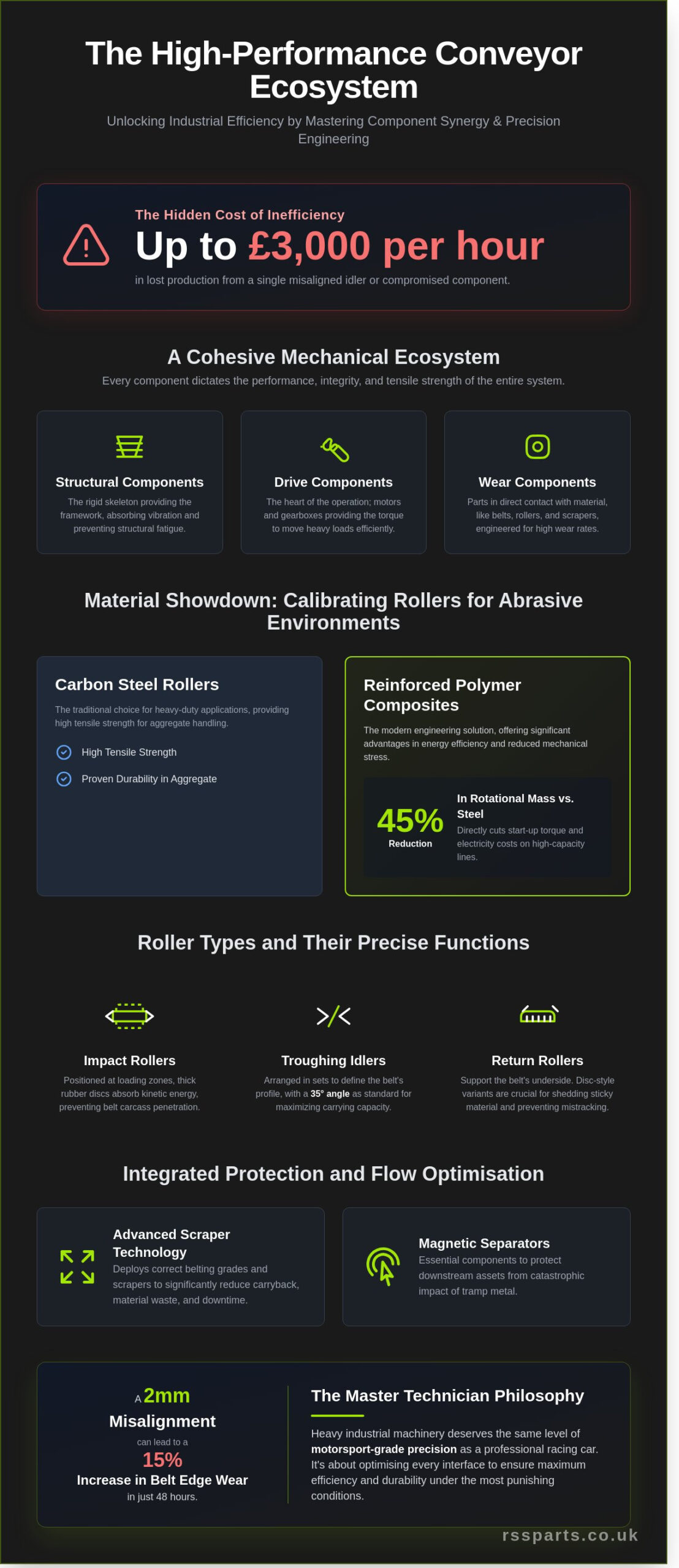
A single misaligned idler or a compromised scraper doesn’t just hinder throughput; it can hemorrhage up to £3,000 per hour in lost production for a standard UK aggregate facility. You’ve likely seen how frequent belt slippage and tracking issues turn a streamlined operation into a series of costly interruptions. We know that true industrial efficiency isn’t achieved through brute force; it’s found in the precise calibration of individual conveyor system components. It’s about ensuring every roller and pulley operates within its engineered tolerances to prevent the high wear rates often found in abrasive environments.
By mastering the mechanical synergy of these parts, you’ll gain the expertise to extend component lifespan and significantly reduce your maintenance intervals. We’ll provide a technical deep dive into the engineering solutions that eliminate carryback and material waste. This guide examines the critical role of high-tensile materials and integrated separation technologies in improving material purity. It’s time to refine your system’s geometry for peak performance and protection.
Key Takeaways
- Understand the conveyor as a cohesive mechanical ecosystem where component synergy is vital for maintaining tensile strength and operational integrity.
- Evaluate the engineering trade-offs between steel and composite rollers to ensure your system is precisely calibrated for abrasive industrial environments.
- Optimise material flow by selecting the correct belting grades and deploying advanced scraper technology to significantly reduce carryback and downtime.
- Learn how to integrate magnetic separators as essential conveyor system components to protect downstream assets from the catastrophic impact of tramp metal.
- Master the process of conducting technical audits to ensure replacement parts meet or exceed OEM specifications for maximum component longevity.
Anatomy of Industrial Conveyor System Components
An industrial conveyor system is far more than a simple assembly of belts and pulleys; it’s a cohesive mechanical ecosystem where every individual part dictates the performance of the whole. In high-volume UK recycling facilities processing upwards of 50 tonnes of material per hour, the technical synergy between conveyor system components is what maintains critical tensile strength. If a single roller fails or a motor loses calibration, the entire line faces immediate degradation. We view these systems through the lens of mechanical integrity, where precision engineering ensures that structural, drive, and wear components operate in perfect synchronisation to prevent unscheduled downtime.
To understand the system, we must categorise its primary elements. The structural components provide the rigid skeleton required to withstand constant vibration. The drive components, including the motor and gearbox, act as the heart of the operation, providing the torque necessary to move heavy loads. Finally, the wear components, such as the belt and scrapers, interact directly with the material. Engineering these parts to a high standard isn’t an optional luxury. It’s a fundamental requirement for heavy-duty material handling where a 2mm misalignment can lead to a 15% increase in belt edge wear within just 48 hours of operation.
The Framework of Material Handling
The interaction between the conveyor belting and the support structure defines the operational lifespan of the machine. In demanding environments like UK-based aggregate or recycling plants, high-quality conveyor system components prevent structural fatigue by absorbing kinetic energy rather than resisting it rigidly. Proper alignment and tracking are the most vital factors here. When a frame is engineered with precision centre-lines, it reduces the lateral forces that typically lead to frame twisting. This meticulous attention to geometry ensures that the belt stays centred, protecting the drive motor from excessive current draw and heat buildup caused by friction.
Performance and Protection: The RSS Parts Philosophy
Our approach to material handling mirrors the “Master Technician” philosophy found in elite motorsport. We believe that balancing high throughput with component durability requires a shift in perspective. Heavy industrial machinery deserves the same level of “motorsport-grade” precision as a professional racing car. It’s about optimising every interface to ensure maximum efficiency under load. By treating a conveyor system as a high-performance vehicle, we prioritise both performance and protection. This means using materials that offer superior damping and tensile properties, ensuring that the components don’t just survive the shift, but thrive under the most punishing conditions. Precision calibration isn’t just for the track; it’s the standard for any serious engineering application.
Critical Wear Parts: Rollers, Idlers, and Bearings
Rollers represent the heart of mechanical movement within any industrial setup. These conveyor system components dictate the system’s total friction coefficient and energy requirements. Selecting the correct material is a foundational engineering decision. Traditional carbon steel rollers provide the high tensile strength required for heavy-duty aggregate handling. However, modern reinforced polymer composites are gaining traction in UK manufacturing. These composite units reduce rotational mass by up to 45% compared to steel alternatives. This reduction significantly lowers the torque required during start-up, directly cutting electricity costs on high-capacity lines.
Types of Conveyor Rollers and Their Functions
Precision in roller placement ensures the belt maintains its designed trajectory under varying load conditions. Each variant serves a distinct mechanical purpose:
- Impact rollers: Positioned at loading zones, these feature thick rubber discs to absorb the kinetic energy of falling material; this prevents belt carcass penetration and extends the life of the primary belt.
- Troughing idlers: Arranged in sets of three or five, these components define the belt’s profile to maximise carrying capacity. A 35-degree troughing angle is the standard for most dry bulk applications in British quarries.
- Return rollers: These support the belt on its underside. Using disc-style return rollers helps shed sticky material, preventing the debris build-up that leads to belt mistracking.
Bearing Technology and Lubrication Systems
Precision bearings are the silent enablers of system uptime. High-performance units often utilise triple-labyrinth seals to prevent the ingress of fine particulates like stone dust or cement. In recent field tests, labyrinth seals demonstrated a 200% increase in bearing longevity within abrasive environments compared to standard contact seals. Engineers must choose between “sealed-for-life” units and regreasable options. While sealed units reduce immediate maintenance labour, regreasable bearings allow technicians to flush out contaminants in extreme conditions. Much like the precision-engineered components found in professional motorsport, conveyor bearings must maintain exact tolerances to prevent heat generation and premature fatigue.
Identifying failure before it triggers a catastrophic shutdown is vital for maintaining a 98% uptime target. Technicians should monitor for “chirping” sounds, which indicate a breached seal, or flat spots on the roller shell that suggest a seized bearing. A single seized roller can increase local drag by 20%, leading to localised belt wear and increased motor strain. Using thermal imaging to detect rollers running 15 degrees Celsius above ambient temperature provides a reliable early warning system for scheduled replacement during planned downtime. For comprehensive guidance on optimising roller performance in extreme conditions, our detailed analysis of how to select and maintain high-performance conveyor rollers provides the engineering criteria necessary to prevent costly failures.
Conveyor Belting and Scrapers: Optimising Material Flow
Material handling efficiency relies on the precise interface between the belt surface and the cleaning system. In UK quarrying and recycling sectors, selecting the correct conveyor system components is a calculation of tensile strength against abrasive wear. A belt is not a static part; it’s a dynamic engineering surface that must withstand constant impact and carcass fatigue. High-performance operations prioritise EP (Polyester/Nylon) fabric belts, typically specified in 3-ply or 4-ply configurations to balance flexibility with load-bearing capacity.
Conveyor Belting Specifications
Engineers must match the belt grade to the specific material density and sharp-edge profile. For heavy-duty aggregate work, a DIN Y or DIN X grade rubber cover is standard. A DIN X cover offers superior resistance to cutting and gouging, essential when handling sharp flint or recycled concrete. For detailed specifications and engineering requirements for high-tensile, abrasion-resistant polymers, our comprehensive guide on conveyor belting for heavy-duty material handling provides the technical data needed to optimise belt geometry and material selection for specific site conditions.
- Ply Ratings: An EP500/3 belt provides a 500kN/m tensile strength across three layers, offering the necessary safety factor for high-tonnage inclines.
- Cover Thickness: A 6mm top and 2mm bottom cover is the baseline for most UK recycling plants, providing a sacrificial layer that protects the internal carcass.
- Specialised Profiles: Chevron patterns are required for inclines exceeding 18 degrees to prevent material rollback, though these require specialised “finger” scrapers to clean effectively.
Excessive belt tension often masks underlying tracking issues but leads to accelerated pulley lagging wear and bearing failure. Precision calibration ensures the belt remains taut enough to prevent drive slip without overstressing the mechanical splices.
Primary and Secondary Scraper Systems
Effective cleaning extends the service life of all conveyor system components by up to 40% by eliminating carryback. Carryback is the fine material that sticks to the belt after discharge, eventually falling off under return idlers and causing seized bearings or belt misalignment.
The primary scraper sits at the head drum, usually at the 3 o’clock position. It removes the bulk of the material, roughly 60% to 75% of the total volume. Secondary scrapers are installed further back to shave off the remaining fines. While rubber was the historical standard, polyurethane has become the preferred material for high-performance blades. Polyurethane offers a lower coefficient of friction against the belt and maintains its cleaning edge longer than rubber.
Modern tensioning systems use spring or air-cushioned mounts. These units provide constant pressure, allowing the blade to deflect when encountering mechanical fasteners or belt imperfections. This protects the belt carcass from accidental gouging while ensuring the blade never loses contact with the surface. Consistent cleaning prevents material build-up on the return rollers, which is the leading cause of “vibration-induced” component fatigue in large-scale systems. For comprehensive guidance on implementing effective belt cleaning systems, our detailed analysis of conveyor scrapers for carryback control and belt longevity provides the engineering specifications necessary to eliminate material adhesion and extend component service life.
Magnetic Separators and Integrated Protection
Magnetic separators aren’t just optional accessories; they’re critical conveyor system components that safeguard the entire production line from mechanical failure. In heavy-duty UK quarrying and recycling operations, the presence of tramp metal like rebar, bolts, or discarded tools poses a constant threat to downstream machinery. Integrating high-gradient magnets ensures that these contaminants are extracted before they can reach sensitive processing zones.
The primary engineering objective is the protection of expensive crusher wear parts. When a piece of uncrushable steel enters a jaw or cone crusher, it causes immediate sacrificial damage or, worse, structural cracking of the main frame. Statistics from UK processing sites show that effective magnetic extraction can reduce unplanned downtime by as much as 35%, preventing repair bills that often exceed £15,000 per incident. By removing ferrous debris early, you maintain the geometric integrity of your crushing chambers and extend the service life of your liners.
Overband Magnetic Separators
Overband magnets are suspended above the conveyor belt, typically at a height of 300mm to 450mm depending on the burden depth. These units use a cross-belt design to pull metal upwards and discharge it into a side collection skip. For standard recycling tasks, permanent magnets offer a cost-effective, “always-on” solution. However, heavy industry often requires electromagnetic systems. These provide the deep-reaching flux density necessary to pull heavy iron through a thick material bed. This level of extraction is vital for protecting shredder parts, where even a small steel bolt can chip a carbide-tipped blade and unbalance the entire rotor assembly. For a comprehensive understanding of how to engineer effective tramp metal extraction and achieve 99.8% product purity, our technical guide on magnetic separators for industrial metal interdiction details the flux density specifications and installation configurations required for zero equipment failures.
Magnetic Pulleys and Drums
Replacing a standard head pulley with a magnetic alternative provides a final line of defence at the discharge point. These conveyor system components work by holding ferrous material against the belt surface as the primary product falls away. The metal is carried around to the underside of the pulley and released once it leaves the magnetic field. It’s an elegant, automatic solution for continuous operation. To optimise performance, engineers must calibrate the magnetic field depth to match the specific belt speed and material density. A field that’s too weak will miss buried metal; one that’s too strong can cause “bridging,” where metal build-up interferes with the belt’s tracking and drive efficiency.
Protect your investment with precision-engineered extraction technology. View our range of high-performance conveyor components and protection systems.
Selecting Replacement Components for Maximum Longevity
Achieving peak operational efficiency begins with a rigorous technical audit of your existing conveyor system components. You can’t improve what you haven’t measured. Engineers should evaluate current wear cycles; if a roller fails every six months, the application likely demands a higher specification than the original OEM part. We recommend identifying high-tensile materials, such as S355 grade steel or heat-treated alloys, which offer a 25% increase in yield strength over standard mild steel alternatives. Transitioning from reactive ordering to a proactive spares inventory can reduce unplanned downtime by up to 18% in heavy-duty environments.
The goal is to move beyond simple replacement. High-end aftermarket parts often exceed original specifications by utilising precision-machined housings and superior sealing arrangements. This engineering-led approach ensures that every new component contributes to the overall stability of the system geometry, rather than acting as a temporary fix.
Material Science in Component Selection
Material selection dictates the lifecycle of every wear part. For instance, trommel plates and primary liners require specific Brinell hardness (HB) ratings, typically between 400 and 500 HB, to withstand constant abrasive impact. In high-velocity zones, polyurethane components often outperform traditional rubber, providing a 4:1 wear life advantage. While premium components carry a higher initial price, the cost-per-tonne processed often drops from £0.12 to £0.07 over the component’s life. It’s a calculation that prioritises long-term mechanical integrity over short-term procurement savings. For a deeper understanding of how manganese, rubber, and polyurethane perform across different processing applications, our comprehensive resource on industrial wear parts for material processing longevity provides the Brinell hardness data and material composition analysis needed to engineer a predictable maintenance cycle.
The Procurement Process: Technical Accuracy
Technical accuracy during procurement prevents costly installation delays. You need precise measurements: shell length, shaft diameter, and bearing series for rollers, alongside the specific belt width and tension requirements for scrapers. Verify that replacement conveyor system components align with the existing structural geometry to avoid eccentric loading. Partnering with a specialist quarry parts supplier UK ensures you receive technical support that understands local site conditions. This expertise helps refine your hardware choices, ensuring every part is calibrated for the specific stresses of your facility.
This principle of seeking specialized technical guidance applies across heavy industries, from component sourcing to the acquisition of entire systems. In the maritime world, for example, the complex sale and purchase of vessels is managed by expert ship brokering firms such as BTR Marine Services LLC.
- Audit: Document failure modes and intervals to identify weak points.
- Specification: Opt for 400+ HB materials for high-abrasion zones.
- Precision: Double-verify shaft tolerances and bearing grades before ordering.
- Inventory: Maintain a 10% buffer of critical drive and tracking components.
By treating procurement as an engineering exercise rather than a simple purchase, you secure the performance and protection of your entire line. This methodical path from technical problem to precision solution is what separates a standard operation from a high-performance facility.
Engineering Resilience into Your Material Flow
Maintaining peak operational efficiency in material processing requires more than just routine maintenance; it demands a deep understanding of how individual conveyor system components interact under load. Since 2004, our technical teams have observed that selecting high-performance rollers and scrapers specifically engineered for harsh quarrying environments can extend service intervals by up to 40%. By integrating advanced magnetic separators and precision-calibrated idlers, you mitigate the risk of catastrophic belt failure and ensure consistent throughput across your entire facility.
RSS Parts brings 20 years of UK-based engineering expertise to your site. We focus on the complex mechanical ecosystem of recycling and material processing plants, providing components that withstand the most abrasive conditions. Whether you’re refining a high-speed sorting line or upgrading a heavy-duty quarrying setup, the focus remains on technical accuracy and long-term reliability. It’s about achieving a balance between performance and protection to keep your operations running without interruption.
Explore our range of precision-engineered conveyor system components and secure your plant’s mechanical integrity today.
Frequently Asked Questions
What are the most common conveyor system components that require replacement?
The most common conveyor system components that require replacement include belts, rollers, and scraper blades. Conveyor belts represent approximately 40% of total maintenance expenditure over the system’s lifecycle due to constant frictional contact. Idler rollers often require replacement every 3 to 5 years depending on the load environment. Regular replacement of these parts prevents catastrophic failure and maintains the precision required for high-volume material handling.
How often should conveyor rollers be inspected for wear?
You should inspect conveyor rollers for wear every 500 operating hours or on a monthly basis. Meticulous inspection reduces energy consumption by 15% by eliminating friction from seized bearings. Technicians must check for flat spots or material buildup that disrupts the belt’s path. Identifying a failing roller early prevents it from becoming a knife that slices through the expensive belt carcass.
What is the difference between a primary and secondary conveyor scraper?
A primary scraper sits at the head pulley to remove 60% of bulk material, while a secondary scraper follows to clear residual fines. The primary blade’s typically made of heavy-duty polyurethane to handle high-impact forces at the discharge point. The secondary scraper uses a finer blade, often tungsten carbide, to achieve a final clean. Using both ensures the belt remains free of debris, protecting the return idlers from premature wear.
Can I use polyurethane components in a system originally designed for rubber?
You can substitute polyurethane components for rubber, and this often results in a 300% increase in service life for high-abrasion applications. Polyurethane offers superior tensile strength and chemical resistance compared to traditional rubber compounds. While the initial cost of polyurethane components is roughly 25% higher, the reduction in downtime and replacement frequency provides a better return on investment for professional engineering teams.
How do I determine the correct belt tension for my conveyor system?
Determine correct belt tension by measuring the sag between idlers, which should ideally sit between 1% and 3% of the idler spacing. Improper tension causes 20% of all belt tracking issues and leads to premature pulley lag wear. Use a calibrated tensioning tool to ensure the belt’s tight enough to prevent drive pulley slippage but loose enough to avoid straining the terminal bearings and shafts.
What are the signs that my conveyor bearings are beginning to fail?
Signs of failing conveyor bearings include an audible grinding noise and a temperature rise of 10°C or more above the standard operating baseline. Vibration levels exceeding 5mm/s often indicate internal raceway damage or lubrication loss. Monitoring these metrics allows for planned maintenance during scheduled windows. It prevents the 48-hour emergency shutdowns that occur when a bearing seizes and damages the drive shaft.
How does a magnetic separator protect other conveyor components?
A magnetic separator protects conveyor system components by extracting tramp metal before it reaches sensitive downstream equipment like crushers or fine screens. These units remove 95% of ferrous contaminants that cause belt punctures and internal component damage. By isolating metal debris, you safeguard the integrity of the belt and reduce the risk of costly mechanical blockages that halt production lines.
Why is carryback a problem for conveyor system longevity?
Carryback is a problem because it causes material buildup on return idlers, leading to 30% more belt mistracking and increased component friction. This residual material can account for 2.5 tonnes of waste per week on high-capacity systems in the UK. It acts as an abrasive paste that grinds down pulleys and rollers. Eliminating carryback’s essential for maintaining the engineering precision and longevity of the entire mechanical assembly.
about
avada factory
Sempery ultricies nibh at dolor cras urna eleifend nec. Atiam efficitur tempor.


