
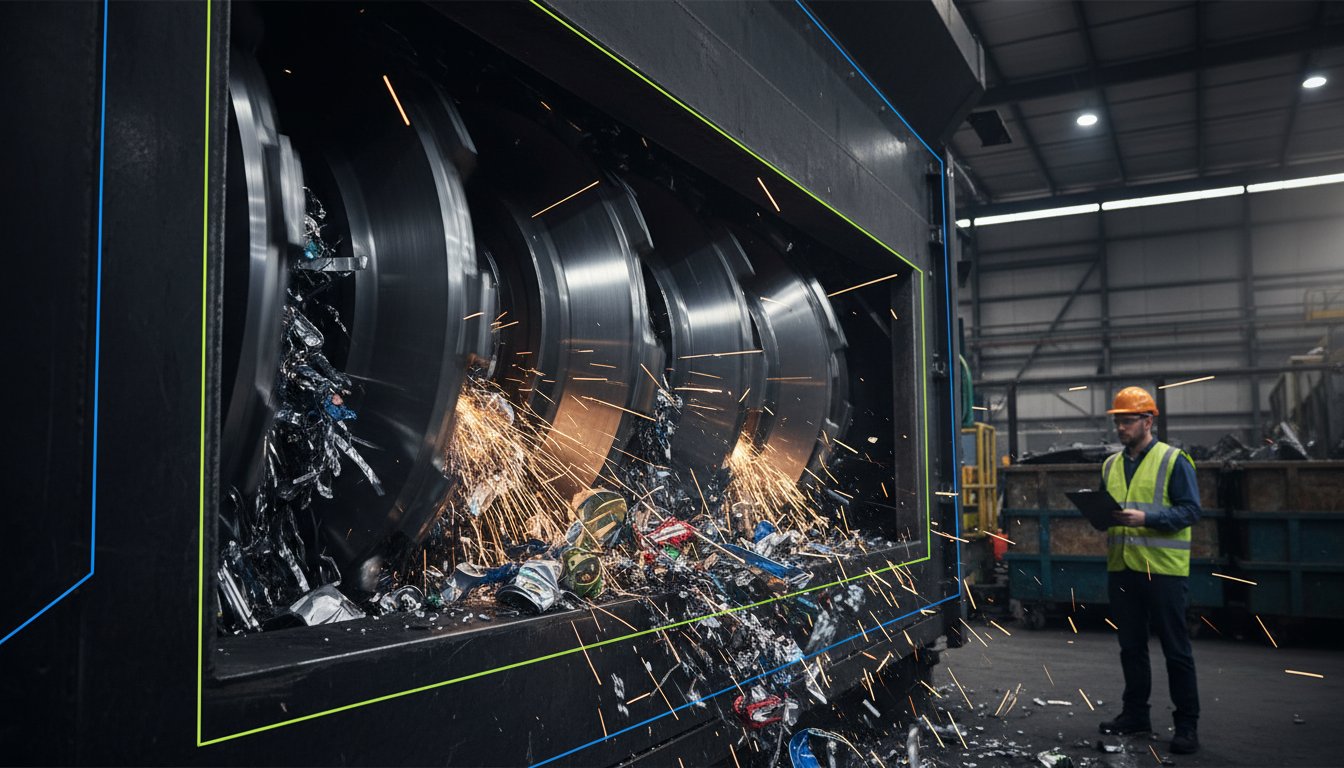
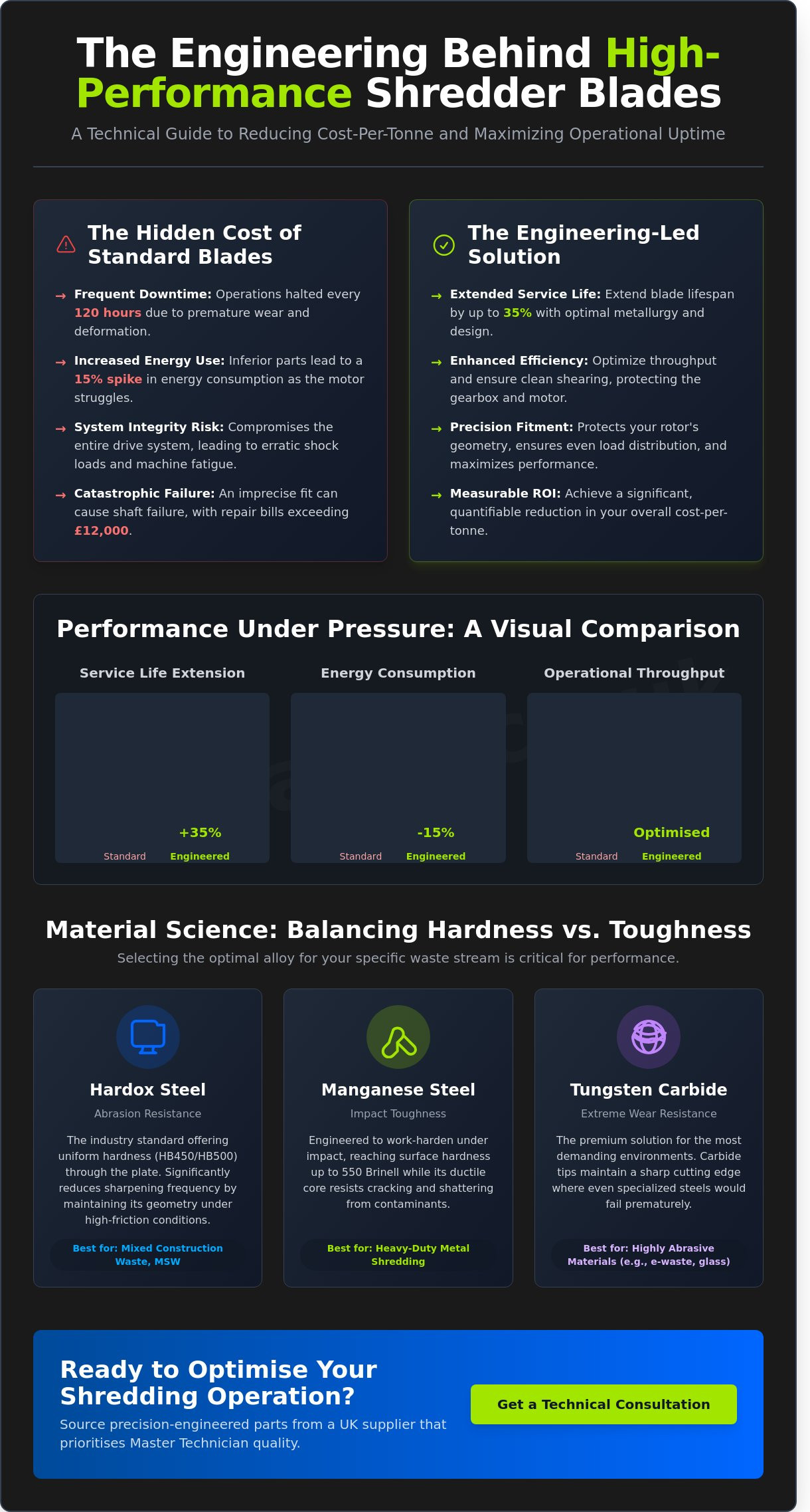
The most expensive shredder blades aren’t the ones with the highest invoice price. They’re the ones that force a UK recycling facility to a standstill every 120 hours of operation due to premature edge rounding and heat-induced deformation. You already know that inconsistent metallurgy doesn’t just slow down your line; it compromises the mechanical integrity of your entire drive system and increases energy consumption. It’s a performance challenge that requires an engineering-led solution rather than a simple parts replacement.
We’ll show you how to master the technical specifications and metallurgical choices required to optimize throughput and extend the service life of your industrial shredder by up to 35%. By moving beyond generic aftermarket options, you can achieve a precision fit that protects your rotor’s geometry and ensures consistent performance and protection. This guide examines the engineering behind Hardox and Tungsten Carbide applications to ensure your next component selection delivers a measurable reduction in your cost-per-tonne. We’ll calibrate your approach to maintenance intervals and material hardness to ensure your facility maintains peak performance under the most demanding heavy-duty cycles.
Key Takeaways
- Learn how to balance abrasion resistance with impact toughness by selecting the optimal metallurgical grade, such as Hardox or Manganese, for your specific recycling application.
- Discover how to refine your machine’s efficiency by matching specialized blade profiles to the unique demands of your waste stream, from MSW to industrial polymers.
- Identify the critical visual indicators of wear and “smearing” to prevent unnecessary energy consumption and maintain the mechanical integrity of your shredding system.
- Master the technical specifications required to select high-performance shredder blades that offer superior durability compared to standard consumer-grade components.
- Understand the value of sourcing precision-engineered parts from a UK-based supplier that prioritizes Master Technician quality and dedicated technical support.
Understanding Industrial Shredder Blades: Performance and Protection
In heavy-duty material reduction, the Industrial shredder represents the frontline of waste management. Industrial shredder blades aren’t mere cutting tools; they’re high-precision engineering components designed for extreme stress. Unlike consumer-grade “knife” blades found in light office equipment, these industrial wear parts are forged to withstand 500kN of force or more. We treat these components with the same technical rigor as a motorsport drivetrain, applying a “performance and protection” philosophy to every application.
Blade quality is the primary driver of operational efficiency. High-quality shredder blades optimise throughput while shielding the gearbox and motor from erratic shock loads. Data from UK recycling facilities indicates that inferior parts lead to a 15% increase in energy consumption and significantly higher rates of premature machine fatigue. When the blade fails to shear cleanly, the entire mechanical ecosystem suffers. Understanding how precision-engineered components interact across your entire operation is covered in depth in our guide to recycling equipment performance and component engineering.
The Role of Precision Engineering in Waste Processing
Blade geometry dictates the torque requirements of the shredder motor. If the tooth profile is off by even 2mm, the motor works harder to achieve the same reduction. Dimensional accuracy is vital for maintaining tight tolerances between the rotary blades and the stator. A “near-enough” fitment often causes uneven load distribution across the shaft; this eventually leads to catastrophic shaft failure and repair bills exceeding £12,000 for a standard 150kW unit. Precision machining ensures that every revolution translates into maximum material fracture with minimal heat generation.
Shredder Blades vs. Cutters: Key Terminology
UK plant operators distinguish between primary shredding teeth and secondary cutters based on the processing stage. Primary teeth focus on initial fracture and tearing. Secondary cutters refine the material to a specific fraction size, often 30mm or 50mm. Counter-blades, or static knives, provide the necessary resistance for the rotary blades to shear against. In the UK recycling sector, these are collectively known as “wear parts,” yet their impact on uptime is anything but secondary. Understanding these distinctions is critical for maintaining the mechanical integrity of the plant.
Metallurgy and Material Selection: Hardox, Manganese, and Carbide
Engineering high-performance shredder blades requires a precise balance between hardness and toughness. Hardness provides the abrasion resistance needed to maintain a sharp edge against abrasive materials, while toughness ensures the blade doesn’t shatter when encountering non-shreddable contaminants. High-carbon steels are often the baseline for many operations, but specialised alloys like manganese are engineered to work-harden under impact. These alloys can reach surface hardness levels of up to 550 Brinell while maintaining a ductile core that resists cracking. For heavy-duty metal shredding, tensile strength is the critical metric. Blades must withstand forces exceeding 1,200 MPa to prevent deformation during the shearing of structural steel or reinforced materials. Effective management of these industrial cycles often involves adhering to the EPA’s Guide for Industrial Waste Management to ensure environmental compliance and operational efficiency.
Hardox and Abrasion-Resistant Steels
Hardox is the industry standard for general recycling applications because it offers uniform hardness through the entire thickness of the plate. Brinell ratings, such as HB450 or HB500, define the material’s resistance to penetration and wear. Choosing a higher Brinell rating directly correlates to the blade’s ability to maintain its geometry under high-friction conditions. Increasing the hardness of the base material significantly reduces the frequency of blade sharpening by extending the intervals between edge restorations. This reliability is why many UK facilities prefer Hardox for processing mixed construction waste or municipal solids where consistency is paramount.
The Advantages of Carbide-Tipped Cutters
Tungsten carbide tips are the premium solution for extreme wear environments where standard steel fails prematurely. While the initial investment for carbide-tipped shredder blades can be 200% higher than standard steel, the extended service life often justifies the cost for high-volume plants processing consistent feedstock like tyres or electronic scrap. You’ll need to manage the inherent brittleness of carbide carefully, as it’s susceptible to fracturing if the waste stream contains heavy tramp metal or unexpected shocks. For a deeper technical analysis of how these material stresses impact component longevity, refer to this guide on Crusher Wear Parts. If your facility processes over 50 tonnes of abrasive material daily, the reduction in downtime for blade swaps often offsets the higher capital expenditure. To ensure your machinery is equipped with the most resilient components for your specific application, you can consult with our technical team to refine your material specifications.
Selecting the Right Blade Profile for Your Waste Stream
Engineering a successful shredding operation requires more than raw horsepower; it demands a precise match between blade geometry and material physics. The profile of your shredder blades determines how energy is transferred into the waste stream. Selecting an incorrect profile leads to parasitic power loss, increased heat generation, and premature component failure. We treat blade selection as a calibration exercise, ensuring the mechanical bite matches the shear strength of the specific feedstock.
Waste Stream Suitability Guide
Municipal Solid Waste (MSW) requires a profile designed to prevent “wrapping,” where film plastics or textiles coil around the shaft. Profiles with tighter tolerances between the knife and the spacers are essential here. For timber and forestry waste, aggressive hook designs are the standard. A hook with a 15 to 20-degree rake angle allows the machine to “grab” bulky wood waste, pulling it into the cutting chamber without the need for excessive ram pressure. This mechanical advantage reduces the load on the drive motor by up to 12% compared to flatter profiles.
In contrast, metal and Waste Electrical and Electronic Equipment (WEEE) recycling demands heavy-duty square blocks. These profiles prioritise impact resistance over slicing. The geometry focuses on crushing and shearing brittle components. Academic research into the wear of tool blades indicates that square-edged cutters maintain their structural integrity longer under the high-frequency shock loads typical of scrap metal processing. This durability is vital for maintaining a consistent 30mm to 50mm output size in secondary raw material production.
Optimizing Throughput with Custom Geometries
Throughput is a function of “cuts per minute” and the volume of material captured in each rotation. Staggering the shredder blades on the shaft, often in a helical or V-pattern with 45-degree offsets, ensures that torque is applied incrementally. This prevents the “gulping” effect where the motor stalls under a sudden, massive load. By distributing the cutting force, operators can often achieve a 10% to 18% increase in hourly tonnage without upgrading their power supply.
Blade thickness directly dictates the final product size and grain quality. In a twin-shaft configuration, a 20mm blade produces a significantly finer fraction than a 50mm variant, but it requires a higher blade count per metre. Increasing the blade count improves the “grab” on small-diameter materials like plastic bottles but raises the maintenance overhead. For niche applications, such as high-security data destruction or specialised polymer recovery, custom profiles with multi-point tips can be engineered to meet specific UK environmental or security standards. Precision in geometry is the difference between a profitable recycling line and a high-maintenance liability.
Maintenance and Wear Analysis: When to Replace Your Blades
Maintaining peak efficiency in high-volume waste processing requires a disciplined approach to wear analysis. When shredder blades lose their geometric precision, they transition from a clean shearing action to a blunt crushing force. You’ll first notice “rounding” on the leading edges, where the sharp 90-degree angle becomes a radius. This is often accompanied by “smearing,” a phenomenon where heat and pressure cause material to fuse to the blade face rather than being severed. These visual cues aren’t just aesthetic concerns; they’re indicators of a failing mechanical system.
Monitoring energy consumption is the most accurate way to quantify blade degradation. As edges dull, the motor must work harder to penetrate the material stream. Data from UK processing plants shows that electricity costs can spike by 15% to 22% when operating with severely worn components. This extra load doesn’t just hit your utility bill. It places immense strain on the hydraulic pumps and drive gearboxes, leading to premature seal failure and oil degradation due to excessive heat generation.
The True Cost of Running Dull Blades
The financial impact of worn shredder blades extends far beyond energy bills. You’ll see a sharp increase in the volume of “overs,” which are materials that fail to pass through the screen on the first attempt. This creates a closed-loop inefficiency where you’re paying to process the same material twice. In a typical 10-tonne-per-hour operation, a 10% increase in overs can cost upwards of £400 per shift in lost throughput and additional fuel. For detailed guidance on maintaining system integrity, consult our guide on Industrial Shredder Parts to establish a baseline for component longevity.
Inspection Checklist for Plant Managers
Proactive maintenance prevents catastrophic failure. Managers should implement a rigorous inspection schedule based on every 500 tonnes processed or on a weekly basis, whichever comes first. Use this checklist to evaluate your cutting chamber:
- Fastener Integrity: Check all bolt-on edges for tension. Vibrational fatigue can loosen high-tensile fasteners, leading to catastrophic blade detachment.
- Counter-Knife Calibration: Measure the gap between the rotor blade and the static counter-knife. Even a 1mm deviation from the manufacturer’s spec can reduce shearing efficiency by 30%.
- Thermal Analysis: Use an infrared thermometer to identify “hot spots” on the rotor shaft or bearing housings. Uneven heat distribution usually indicates uneven blade wear or a misaligned shaft.
- Tonnage Tracking: Record exactly how many tonnes each set of blades processes. This data allows you to predict the exact “drop-off” point where replacement becomes more cost-effective than continued operation.
Don’t wait for a total system shutdown to address component wear. It’s more profitable to swap blades during a scheduled window than to manage an emergency repair mid-shift. If you’re seeing a drop in output quality or a rise in operating temperatures, it’s time to evaluate your hardware.
Optimize your machinery today: Enquire about precision-engineered replacement parts
Why RSS Parts is the Preferred UK Supplier for Shredder Blades
RSS Parts isn’t just a component vendor; we’re an engineering consultancy that applies motorsport-grade precision to the recycling industry. Our UK-based technical team approaches every project with a Master Technician mindset, ensuring that every replacement part meets a standard of excellence usually reserved for professional racing. We don’t just sell shredder blades; we optimize the mechanical integrity of your entire processing line through superior metallurgy and exact fitment.
Engineering Precision for the Recycling Sector
Our engineering process ensures that all components match or exceed OEM specifications. By applying the same high-tensile strength standards found in performance automotive engineering, we’ve refined the durability of our industrial tools. RSS Parts serves as a single-source supplier for Quarry Parts, which allows operators to streamline their procurement for complex material processing environments.
In 2023, a national recycling contractor reported a 15% increase in operational uptime after integrating our precision-machined components. This improvement was driven by our focus on reducing the vibration and parasitic loss that typically lead to premature bearing failure. We offer a comprehensive suite of wear parts designed to work in harmony, including:
- High-grade alloy cutting tools calibrated for specific waste streams.
- Precision-drilled screens for consistent particle sizing.
- Hardened wear plates that protect the structural integrity of the shredder chamber.
Sourcing Your Replacement Components
Efficiency in the recycling sector depends on rapid access to high-quality parts. Our national UK distribution network ensures that critical components reach your site without the logistical delays associated with international shipping. We provide more than just shredder blades; we offer a complete technical partnership that prioritizes your machinery’s performance and protection.
Technical consultancy is at the core of what we do. We help you choose the correct metallurgy, whether that involves manganese steel for impact resistance or chrome-moly alloys for abrasive environments. We analyze the specific geometry of your existing setup to recommend solutions that maximize throughput while minimizing energy consumption. Our goal is to ensure your recycling equipment operates with the same calibration and reliability as a track-ready vehicle.
Contact RSS Parts for a technical consultation on your shredder requirements to discuss how our engineering-led approach can reduce your cost-per-tonne and improve your facility’s output.
Optimising Your Industrial Throughput
Maximising the efficiency of your waste stream requires more than just standard replacements; it demands a precise calibration of material hardness and blade geometry. By integrating high-tensile materials like Hardox and Carbide into your setup, you ensure your equipment maintains its edge under extreme mechanical stress. RSS Parts has applied motorsport-grade precision to heavy industrial wear parts since 2004, bridging the gap between high-performance engineering and rugged recycling demands. Our team utilizes decades of combined expertise to help you select the exact profile for your specific application, reducing downtime and protecting your primary assets.
We maintain a comprehensive UK stock at our facility to ensure rapid national delivery, keeping your operations moving without delay. Investing in premium shredder blades is a strategic decision that directly impacts your bottom line through improved uptime and superior output quality. Refine your process and secure your facility’s long-term performance today.
Request a Technical Quote for Premium Shredder Blades
Frequently Asked Questions
How often should I rotate or flip my shredder blades?
You should rotate or flip your shredder blades every 40 to 80 operating hours to maintain optimal cutting geometry. This frequency depends on the abrasive nature of your feedstock, such as contaminated plastics or reinforced rubber. Regular rotation ensures even wear across all cutting edges, which prevents premature failure and maintains a consistent throughput. Monitoring edge radius daily allows you to identify the precise moment when a 2mm deviation occurs; this signals it’s time for a rotation.
Can I sharpen industrial shredder blades or should I always replace them?
You can sharpen industrial shredder blades provided the process doesn’t compromise the material’s heat treatment or core hardness. Most high-quality blades allow for 3 to 5 regrinds before the dimensional tolerance falls outside the manufacturer’s specification. If a blade has suffered deep chipping or structural cracking, you’ve got to replace it immediately. Professional grinding services ensure the blade’s profile remains precise, which is vital for maintaining the correct shear gap between the rotor and counter-knives.
What is the difference between Hardox 450 and Hardox 500 for shredding?
Hardox 500 provides approximately 25% more wear resistance than Hardox 450 due to its higher Brinell hardness rating. While Hardox 450 offers superior impact toughness for processing heavy metal scrap, Hardox 500 is the engineered choice for highly abrasive environments like glass or mineral recycling. Selecting the wrong grade can lead to brittle fracture in high-impact applications. We typically recommend Hardox 450 for primary shredding where unpredictable contaminants are present in the waste stream.
How do I know if my shredder blades are compatible with my machine brand?
You verify compatibility by cross-referencing the OEM part number and measuring the precise mounting hole geometry and centre-to-centre distances. Even a 0.5mm deviation in the bolt pattern can lead to catastrophic failure during high-torque operations. Our technical database covers major UK machinery brands, ensuring that every replacement blade meets or exceeds original engineering specifications. Always check the seat width and thickness to ensure the blade integrates perfectly with your existing rotor assembly.
Why are my shredder blades breaking instead of wearing down?
Shredder blades usually break because of excessive shock loading or an incorrect material specification for the specific feedstock. If you’re processing rigid materials with blades hardened to over 55 HRC, the lack of ductility often leads to brittle fractures. This frequently happens when tramp metal enters the chamber unexpectedly. Switching to a blade with higher tensile strength or adjusting the torque limiters on your machine can reduce these instances by up to 40%.
Does the thickness of the shredder blade affect the final product size?
The thickness of the shredder blades directly determines the width of the final shredded fraction in a single-shaft or twin-shaft system. For example, a 40mm blade will produce a consistent 40mm strip, whereas a 20mm blade provides a finer output for secondary processing. If your goal is a specific 30mm minus product for RDF production, your blade width and spacer configuration must be calibrated to those exact dimensions to ensure 100% compliance with your output requirements.
What is the lead time for custom-engineered shredder cutters in the UK?
Lead times for custom-engineered shredder cutters in the UK typically range from 4 to 6 weeks. This timeline accounts for precision machining, specialised heat treatment, and final quality inspections at our facility. For standard profiles, we often maintain stock that can be dispatched within 24 to 48 hours. Planning your maintenance cycles at least 60 days in advance ensures you’ve got the necessary components on-site before a scheduled shutdown occurs.
How does blade wear impact the energy efficiency of my recycling plant?
Blade wear significantly impacts energy efficiency because dull edges require more torque to shear through material, increasing motor load by up to 30%. When shredder blades lose their sharp profile, the machine spends more energy rubbing and tearing rather than cutting. This inefficiency translates to higher electricity costs and increased heat generation within the hydraulic system. Maintaining sharp edges ensures the recycling plant operates at peak mechanical efficiency, reducing the cost per tonne of processed material.
about
avada factory
Sempery ultricies nibh at dolor cras urna eleifend nec. Atiam efficitur tempor.


